5
Muscles
4
Joints
2
Organs
2
Mental
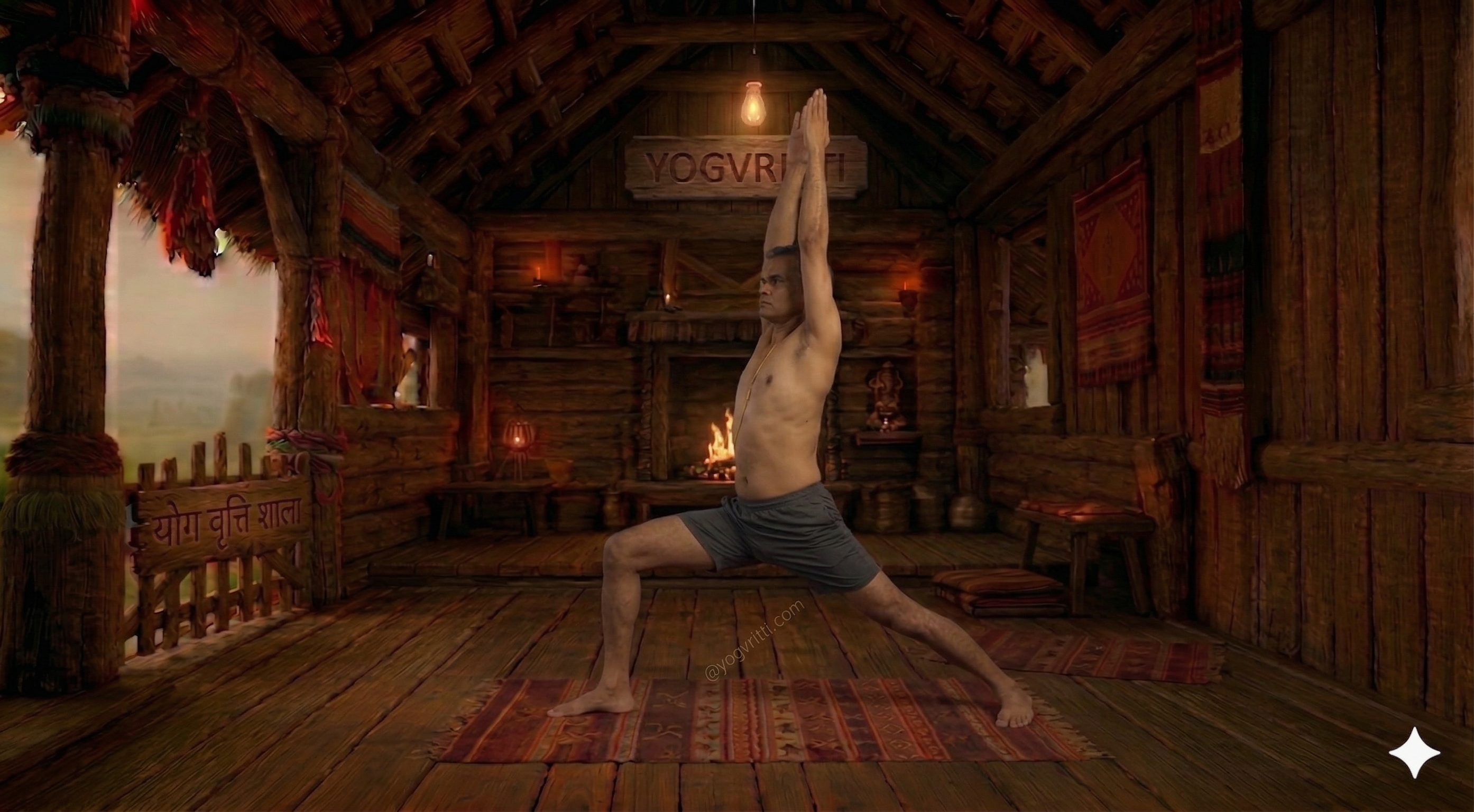
Warrior I
वीरभद्रासन १
Virabhadrasana I, or Warrior I, is a foundational standing posture that meticulously cultivates strength, stability, and an expansive sense of self. It deeply engages the powerful muscles of the legs and glutes, while simultaneously opening the chest and shoulders, creating a feeling of grounded determination. This pose harmonizes the body's energetic pathways, promoting a powerful upward flow of prana while rooting the lower body, making it invaluable for developing physical resilience and mental fortitude. For a teacher, understanding its layered benefits allows for a more profound guidance into a truly transformative experience.
Warrior I Pose, also called Warrior One is a classical yoga posture whose Sanskrit roots break down as: Virabhadra (Warrior (Divine Hero)) · Asana (Pose — I). From a standing position, the body roots firmly through the feet while the spine extends upward. The posture works to strengthen the quadriceps, activate the glutes and stretch the hip flexors. Improves balance and focus. Opens the chest and shoulders. It is particularly valued for building full-body strength and alleviating back discomfort. Suitable for beginners and regular practitioners alike, it is an excellent warm-up, particularly beneficial for beginners and athletes. Practitioners with hypertension and knee injury should approach with care or consult a qualified teacher.
Helps with
Muscles Worked
Quadriceps (front leg)
[Rectus femoris, Vastus lateralis, Vastus medialis, Vastus intermedius]
The muscles on the front of your leading thigh, the quadriceps, are working vigorously in this pose, particularly the vasti muscles.
They are primarily responsible for extending the knee, holding that deep bend against gravity, and supporting the body's weight.
This isometric strength building helps fortify the knee joint and builds endurance in the legs, grounding your energy and providing a stable foundation from which to grow.
Glutes (front leg)
[Gluteus maximus, Gluteus medius]
The large muscles of your front buttocks, especially the gluteus maximus, are powerfully engaged to stabilize the hip joint and assist in external rotation to keep the knee tracking safely.
The gluteus medius also plays a crucial role in maintaining hip alignment and preventing the knee from collapsing inward.
This engagement creates a strong, stable base, allowing the practitioner to feel deeply connected to the earth, fostering a sense of unshakeable inner power.
Hip Flexors (back leg)
[Iliopsoas, Rectus femoris]
On the straight back leg, the deep muscles at the front of the hip, the iliopsoas and rectus femoris (which is also a quad muscle), are receiving a profound stretch.
As the back leg extends and the hips square forward, these often-shortened muscles gently lengthen.
This release of chronic tension in the hip flexors can alleviate lower back strain and allows for a more open, free pelvis, enabling a smoother flow of prana through the lower abdomen.
Shoulder muscles
[Deltoids, Rotator Cuff (Supraspinatus, Infraspinatus, Teres minor, Subscapularis)]
With the arms extended overhead, the deltoids (the cap of your shoulder) and the smaller, stabilizing rotator cuff muscles are actively working to lift and maintain the arms' position.
This action helps to strengthen the shoulder girdle and improve range of motion, counteracting the effects of rounded shoulders from daily activities.
Energetically, reaching the arms skyward opens the heart space, inviting a sense of aspiration and connection to higher awareness.
Core muscles
[Transversus abdominis, Rectus abdominis, Obliques, Erector spinae]
The deep abdominal muscles (transversus abdominis) and the muscles along your spine (erector spinae) are critically engaged to stabilize the trunk and protect the lower back.
They work synergistically to keep the torso upright and prevent excessive arching or rounding, creating a strong central axis.
This core engagement generates inner heat (tapas), unifying the upper and lower body and translating into a feeling of centeredness and unwavering inner strength.
Joints Mobilized
Hip joints
mobilizingBoth hip joints are actively engaged, with the front hip in deep flexion and slight external rotation, and the back hip in extension with internal rotation and adduction to square the pelvis.
This complex action mobilizes the hips in multiple planes, improving their overall range of motion and functional strength.
Regular practice helps to release stiffness and improve pelvic alignment, creating a greater sense of freedom and ease in walking and movement, and fostering a balanced distribution of energy in the lower body.
Knee joints
stabilizingThe knee joint of the front leg is in a deep, weight-bearing flexion, while the back knee is in full extension.
Both require significant muscular engagement to stabilize the joint and protect the ligaments.
The front knee demands precise alignment, tracking directly over the ankle, which strengthens the surrounding musculature.
This mindful engagement educates the body in safe weight distribution, leading to more resilient knees and a greater feeling of physical security and confidence.
Ankle joints
stabilizingThe ankle joint of the front foot is in dorsiflexion, while the back ankle is in slight plantarflexion or neutral, depending on heel placement.
Both ankles are crucial for maintaining balance and providing a stable foundation for the entire pose.
The constant micro-adjustments required strengthen the muscles around the ankles, improving proprioception and balance.
This enhanced stability translates to a feeling of being firmly rooted, connecting the practitioner more deeply to the earth's energy.
Spine
extensionThe entire spine is encouraged into a gentle, yet powerful, extension, particularly in the thoracic and lumbar regions as the chest lifts and arms reach overhead.
This action helps to decompress the vertebral discs and strengthen the paraspinal muscles, counteracting the effects of prolonged sitting and poor posture.
The spinal extension creates an upward lift, allowing prana to flow freely along the sushumna nadi, promoting mental clarity and an expansive feeling of vitality.
Organ & System Benefits
Lungs and Heart
The expansive opening of the chest in Virabhadrasana I creates more space for the lungs to fully inflate, encouraging deeper and fuller breaths.
This increased thoracic capacity allows for enhanced oxygen intake and improved respiratory function, invigorating the entire system.
This opening around the heart center also cultivates a sense of courage and emotional openness, fostering a connection to the anahata chakra.
Abdominal Organs
There is a gentle compression of the lower abdominal organs on the front leg side and a lengthening on the back leg side, which can stimulate circulation and aid digestion.
This subtle massage and stretch promote healthy organ function and contribute to a balanced agni, or digestive fire.
A healthy digestive system is foundational in yoga, as it supports the body's ability to process not just food, but also experiences, fostering greater physical and mental well-being.
Nervous System
The inherent stability and grounding of Virabhadrasana I help to calm the 'fight or flight' response, shifting the nervous system towards a more parasympathetic state.
As the body finds its balance and the breath deepens, the mind becomes less agitated, allowing for greater presence and reduced anxiety.
This steadying effect on the 'chitta vritti' (mind fluctuations) allows for a profound sense of inner quiet and centeredness, even amidst physical effort.
The sustained isometric contractions in the legs and core, combined with the expansive chest opening, create a unique energetic balance that is both stimulating and soothing.
This balance between effort and surrender helps to regulate energy levels, preventing both lethargy and overstimulation.
The focused gaze (drishti) further enhances concentration, drawing awareness inward and fostering a state of mindful embodiment that quiets the external chatter.
Mental & Emotional
Warrior I is a powerful pose for cultivating mental strength and unwavering focus.
The physical challenge of holding the pose, maintaining alignment, and breathing deeply trains the mind to stay present and resilient, transforming physical effort into mental fortitude.
This practice of 'dharana' (concentration) strengthens the will and builds a quiet confidence, preparing the practitioner to face life's challenges with composure and determination.
The pose’s upward reach and grounded foundation instill a profound sense of courage and self-empowerment.
By embodying the warrior archetype, practitioners learn to stand tall and firm in their convictions, releasing self-doubt and fear.
This cultivates a stable and courageous mind, allowing one to connect with their inner strength and move through life with greater purpose and a clear sense of direction, embodying the spirit of Virabhadra himself.
Because of Its Shape
standing
Standing poses are fundamental in Iyengar yoga, serving as the basis for all other categories by building strength, stability, and alignment in the legs and spine.
They teach us how to root down through our feet, connecting us deeply to the earth's energy, which is essential for developing physical and mental balance.
This grounding foundation fosters a sense of security and presence, allowing the practitioner to feel strong and centered in the world.
As a standing pose, Warrior I is a powerful hip opener, albeit a complex one that requires intelligent action to square the hips forward while maintaining deep flexion in the front leg.
This specific hip action helps to release tension in the psoas and outer hips, improving mobility and reducing lower back stiffness.
Energetically, opening the hips facilitates the release of stored emotions and stagnant energy, allowing for greater freedom and fluidity in the pelvic region.
The upright torso and elevated arms in Warrior I create a significant chest opening, expanding the rib cage and uplifting the sternum.
This action counteracts the common postural habit of rounding the shoulders and collapsing the chest, improving lung capacity and spinal mobility.
From a yogic perspective, opening the chest stimulates the anahata chakra, fostering feelings of compassion, courage, and a profound sense of openness to life's experiences.
Fascial Lines
The fascial network, a continuous web of connective tissue throughout the body, is profoundly engaged in Virabhadrasana I.
The superficial front line, running from the tops of the feet up the front of the body, is lengthened on the back leg and strengthened on the front, while the superficial back line is extended through the back leg.
This integrated stretch and strengthening helps to release fascial restrictions that can limit movement and perpetuate poor posture, promoting greater fluidity and energetic flow along these myofascial meridians, fostering a feeling of integrated strength and ease throughout the entire body.
Breathing & Respiratory
The expansive chest opening in Virabhadrasana I naturally encourages a deeper and fuller breath, particularly enhancing the inhalation as the diaphragm has more space to descend.
This increased capacity allows for a more complete exchange of gases and a greater intake of prana, invigorating the entire system.
Practicing Ujjayi breath in this pose helps to maintain focus and internal heat, transforming the physical effort into a meditative experience and deepening the connection between body and mind.
Anatomical Caution
Teachers should guide students to be mindful of their front knee, ensuring it tracks directly over the ankle and doesn't collapse inward or extend past the toes, which can strain the joint.
Pay close attention to the lower back, encouraging core engagement to prevent excessive arching, especially as the arms lift overhead.
Forcing the back hip to square forward can also strain the sacroiliac joint, so prioritize spinal length and knee safety over perfect hip alignment.