5
Muscles
4
Joints
2
Organs
3
Mental
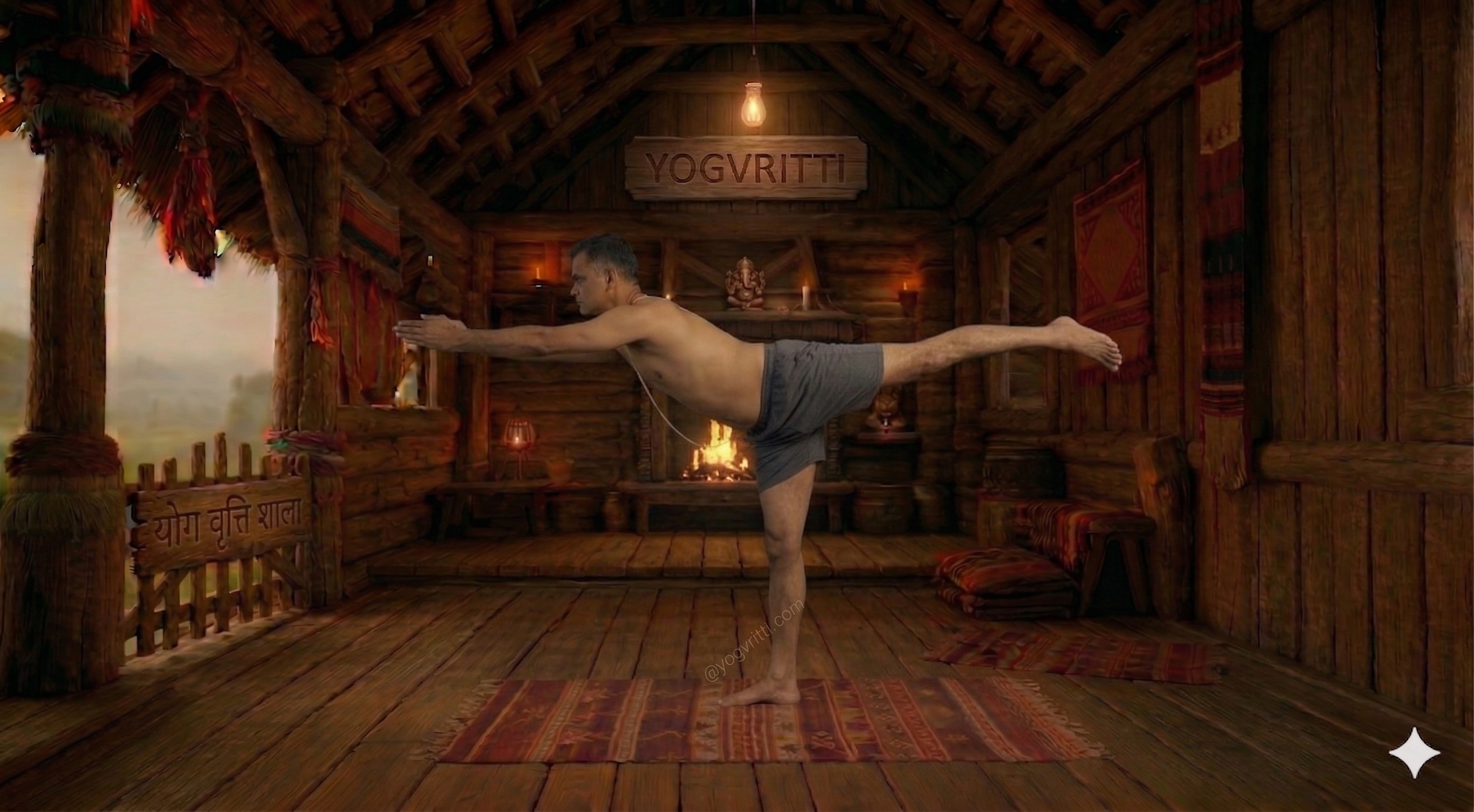
Warrior III
वीरभद्रासन ३
Virabhadrasana III is a profound standing balance pose that demands and cultivates complete integration of body and mind. It fiercely strengthens the entire posterior chain—from the glutes and hamstrings to the deep core and erector spinae—while simultaneously refining balance and proprioception. Energetically, this pose grounds the standing leg deeply into the earth, creating a powerful upward lift through the torso and extended leg, fostering a sense of lightness and unwavering focus. For any practitioner, it is a testament to inner strength, mental clarity, and the capacity to find stillness amidst dynamic effort, making it invaluable for both physical prowess and mental resilience.
Warrior III Pose, also called Warrior Three is a classical yoga posture whose Sanskrit roots break down as: Virabhadra (Warrior (Divine Hero)) · Asana (Pose — III). From a standing position, the body roots firmly through the feet while the spine extends upward. The posture works to activate the glutes, lengthen the hamstrings and engage the core. Improves balance and focus. Enhances coordination. It is particularly valued for building full-body strength and improving overall posture. Suitable for intermediate practitioners with foundational yoga experience, it is a meaningful addition to any practice, particularly beneficial for athletes and runners. A block and wall can be used to make the posture more accessible and support correct alignment. Practitioners with hypertension and back pain should approach with care or consult a qualified teacher.
Helps with
Muscles Worked
Glutes
[Gluteus Maximus, Medius, Minimus]
The muscles of your buttocks (gluteus maximus, medius, minimus) are powerfully engaged in both the standing and lifted legs.
On the standing side, they stabilize the hip joint, preventing collapse and providing a strong foundation for the entire pose.
On the lifted side, the gluteus maximus actively extends the leg straight back, creating length and power.
This deep engagement cultivates a profound sense of rootedness and stability, essential for balance and for channeling apana vayu downwards.
Hamstrings
[Biceps Femoris, Semitendinosus, Semimembranosus]
The muscles running along the back of your thighs (hamstrings) on the lifted leg experience a sustained, intelligent lengthening as the leg extends straight back.
Simultaneously, the hamstrings of the standing leg work eccentrically to prevent hyperextension of the knee and to stabilize the hip.
This dual action cultivates both flexibility and strength in the posterior chain, releasing chronic tension often held from prolonged sitting.
Yogically, this release allows for a freer flow of energy through the lower body, fostering a feeling of lightness and ease.
Core
[Transversus Abdominis, Rectus Abdominis, Obliques]
The deep muscles of your abdomen and waist (transversus abdominis, obliques) are intensely engaged to stabilize the pelvis and lumbar spine, preventing any sag or arching in the lower back.
This strong internal corset creates a solid central axis, which is paramount for maintaining balance and integrity in the pose.
This activation ignites your inner fire (agni) at the manipura chakra, building vital energy and mental focus, and supporting healthy digestion.
Back Muscles
[Erector Spinae, Multifidus]
The long, intricate muscles along your spine (erector spinae, multifidus) work tirelessly to extend the torso forward, creating a flat, horizontal line from the crown of the head to the lifted heel.
This action counters the pull of gravity and prevents rounding of the upper back.
By actively lengthening and strengthening these postural muscles, we cultivate an uprightness that supports the natural curves of the spine and allows prana to flow freely upwards, fostering alertness and vitality.
Quadriceps
[Rectus Femoris, Vastus Lateralis, Medialis, Intermedius]
The muscles on the front of your thigh (quadriceps) on the standing leg are strongly engaged to extend and stabilize the knee, creating a firm and unwavering base.
On the lifted leg, they activate to keep the knee straight and active, contributing to the powerful extension back.
This intelligent engagement of the quadriceps brings a sense of firmness and discernment to the legs, preventing passive hanging in the joints and ensuring a strong, active support.
Joints Mobilized
Hip Joint (standing leg)
stabilizingThe hip joint of your standing leg (acetabulofemoral joint) becomes the central pivot point, bearing the entire weight of your body.
It requires profound engagement of all surrounding musculature—glutes, deep rotators, and inner thigh muscles—to maintain stability and prevent lateral swaying.
This strengthens the joint capsule and ligaments, improving its long-term integrity and providing a firm connection to the earth.
Yogically, this cultivates a deep sense of rootedness and unwavering support, allowing for greater freedom and expansion in the upper body.
Hip Joint (lifted leg)
mobilizingThe hip joint of your lifted leg undergoes significant extension, actively opening the front of the hip.
This action mobilizes the joint capsule and provides a deep, intelligent stretch to the hip flexors, particularly the psoas.
Regular practice enhances range of motion and alleviates tightness that often contributes to lower back pain.
Yogically, releasing tension in the hips can free up emotional blockages, promoting a sense of liberation and openness.
Spinal Column
extendingThe small facet joints between your vertebrae are actively stacked and extended, creating significant length throughout the spinal column.
This action gently decompresses the intervertebral discs and strengthens the intrinsic postural muscles, improving spinal health and flexibility.
By creating this intelligent length, we ensure an unobstructed pathway for the upward flow of prana (sushumna nadi), fostering alertness and mental clarity.
Knee Joint (standing leg)
stabilizingThe knee joint of your standing leg (tibiofemoral joint) is held in a strong, extended, but never hyperextended position.
This demands balanced engagement from both the quadriceps and hamstrings, creating a 'lift' in the kneecap.
This intelligent action strengthens the muscles surrounding the knee, enhancing its stability and protecting the ligaments from undue strain.
It teaches a nuanced control, building a foundation of conscious support that prevents injury and promotes longevity in practice.
Organ & System Benefits
Abdominal Organs
The gentle yet firm engagement of the core muscles in Warrior III provides a subtle, internal massage to your abdominal organs.
This can stimulate peristalsis, aiding in the efficient movement of food through the digestive tract and improving elimination.
Therapeutically, this continuous, gentle compression and release can enhance circulation within the digestive system, supporting the agni (digestive fire) and alleviating common digestive sluggishness or discomfort, contributing to overall vitality.
Heart and Lungs
While not a full inversion, the horizontal alignment of the torso and lifted leg in Virabhadrasana III creates a mild shift in blood flow, requiring the heart to work efficiently to circulate blood throughout the body.
The open chest and lengthened spine encourage deeper, more expansive breaths, increasing vital lung capacity and oxygen uptake.
Yogically, this posture cultivates an expansive quality in the heart center (Anahata chakra), fostering courage, resilience, and an open-hearted approach to the challenges of life.
Nervous System
The constant, subtle micro-adjustments required to maintain balance in Warrior III intensely stimulate the proprioceptors located in your joints, muscles, and tendons.
This heightened sensory input refines your body's awareness in space, improving coordination, reflexes, and overall stability.
The unwavering focus demanded by the pose quietens the incessant mental chatter, bringing the mind into a profound state of present-moment awareness, calming the nervous system.
Despite its physical intensity, holding a challenging balance pose with a steady, conscious breath can paradoxically activate your parasympathetic nervous system over time.
The sustained concentration and controlled breathing send signals of safety and resilience to the brain, reducing the fight-or-flight response.
This cultivates a deep sense of inner calm and fortitude, teaching the body to remain steady and resourceful even under demanding physical conditions.
The unwavering attention required to embody Virabhadrasana III strengthens the neural pathways between your brain and the periphery of your body, enhancing the mind-body connection.
This deepens kinesthetic awareness, allowing you to perceive and direct subtle energetic flows (prana) more consciously throughout your form.
The experience of embodying strength, grace, and stillness in such a demanding posture can profoundly transform self-perception, boosting confidence and self-efficacy.
Mental & Emotional
Warrior III demands profound concentration (dharana) to maintain equilibrium, drawing the scattered mind (chitta vritti) into a single, unwavering point of focus.
This sustained mental effort is a powerful form of meditation in action, training the mind to be present and resilient amidst physical challenge.
Regular practice of this mental discipline strengthens your capacity for focus, translating into improved clarity and concentration in all aspects of your daily life.
The inherent challenge of balancing on one leg, especially as the body naturally wants to wobble, builds immense mental resilience and unwavering determination.
It teaches you to find stillness amidst instability, to persist with grace when faced with difficulty, and to trust your inner compass.
This cultivates a deep inner strength—a true 'warrior spirit'—that extends far beyond the mat, empowering you to face life's adversities with courage and equanimity.
By requiring intense internal sensing to maintain precise alignment and balance, Virabhadrasana III encourages pratyahara – the withdrawal of the senses from external distractions.
The practitioner becomes acutely aware of subtle shifts in the body, the rhythm of the breath, and the nuances of the mind.
This inward journey deepens self-understanding, cultivates profound introspection, and fosters a powerful connection to one's inner landscape, leading to greater self-mastery.
Because of Its Shape
balance
Balancing on one leg in Virabhadrasana III significantly challenges and refines both the vestibular system (inner ear) and proprioception (body's sense of position in space).
This intense neural feedback loop improves overall stability, coordination, and agility, dramatically reducing the risk of falls in daily life.
Yogically, cultivating physical balance mirrors the cultivation of mental equanimity (samatvam), teaching us to find our center and remain steady amidst life's inherent imbalances and fluctuations.
As a standing pose, Warrior III fundamentally builds foundational strength throughout the legs, core, and spine, grounding the body against the relentless pull of gravity.
This strengthens the skeletal structure, enhances bone density, and significantly improves overall posture and alignment.
Yogically, these postures connect us deeply to the earth (prithvi tattva), rooting us and allowing us to draw immense stability and unwavering strength from below, providing a solid base for all energetic and spiritual aspirations.
Fascial Lines
In Warrior III, the entire superficial back line (SBL) and the deep front line (DFL) of fascia are intelligently engaged and lengthened.
As the lifted leg extends powerfully back and the torso reaches forward, the fascial sheath encasing the hamstrings, glutes, and back muscles on the lifted side, and the quadriceps and hip flexors on the standing side, experiences a sustained, integrative stretch.
This intelligent engagement and release within the interconnected fascial network helps to free up restricted movement patterns, allowing for greater fluidity, improved posture, and an unobstructed flow of vital energy (prana) throughout the entire body, akin to clearing blockages in the energetic nadis.
Breathing & Respiratory
The intense concentration and physical effort demanded by Virabhadrasana III naturally encourage a steady, rhythmic, and diaphragmatic breath.
The extended torso and open chest facilitate deeper inhalations, while the sustained effort encourages longer, more controlled exhalations.
This conscious, controlled breathing (pranayama) serves as an internal anchor, calming the nervous system and providing a stable foundation that allows the practitioner to maintain the pose with greater ease, focus, and mental clarity.
The breath becomes the conscious bridge between physical form and inner stillness.
Anatomical Caution
Teachers must emphasize meticulous alignment, particularly in the standing knee and hip, to prevent hyperextension or unwanted rotation.
For students with existing knee, hip, or lower back sensitivities, providing props like a wall for balance or a block under the hands is paramount.
Always encourage students to prioritize stability and intelligent engagement over depth, listening attentively to their body's unique feedback to prevent strain.