Benefits· लाभ
What Half Bound Lotus Forward Bend does for you
अर्ध बद्ध पद्म पश्चिमोत्तानासन
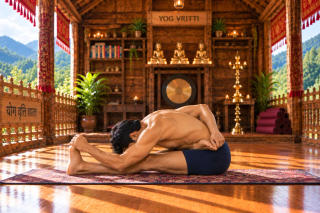
Ardha Baddha Padma Paschimottanasana is a profound seated forward bend that masterfully integrates deep hip opening with a lengthening of the entire posterior chain. This pose grounds the practitioner through the sit bones, while simultaneously releasing tension in the hamstrings, gluteals, and lower back, and deeply mobilizing the hip joint of the bent leg.
Muscles
- Hamstringsstretches
- Glutealsstretches
- Erector Spinaestretches
- Psoasstretches
- Rhomboids and Trapeziusstretches
Joints
- Hip Jointmobilises
- Hip Jointmobilises
- Knee Jointmobilises
- Spinal Jointsdecompressing
- Sacroiliac Jointstabilises
Inside the body
- Abdominal Organs
- Kidneys and Adrenal Glands
- Breathing
Mind
This deep forward bend inherently promotes introspection and self-reflection, guiding the mind away from external distractions and towards inner awareness.
Take care
Teachers must approach this posture with utmost care for students with knee or hip injuries, especially in the bent leg.
Guide them to avoid any sharp pain, especially around the knee joint or inner thigh, ensuring the heel does not press into the soft tissues of the groin. Emphasize using props like a blanket under the sit bones or a strap for the foot to support proper alignment and prevent overstretching, prioritizing safety over depth for vulnerable joints.
Muscles
Hamstrings
StretchesSemitendinosus, Semimembranosus, Biceps Femoris
The long muscles running along the back of your thighs (hamstrings) get a deep, sustained release here — not a forced stretch but a patient unwinding.
Read moreShow less
As you hold the pose and breathe, the nervous system gradually allows these muscles to let go of years of tension stored from sitting and stress.
In yogic understanding, this releases apana vayu — the downward-moving energy — allowing a feeling of groundedness and ease in the lower body.
Regular practice progressively lengthens this posterior chain, directly reducing the pull on the lower back.
Gluteals (bent leg)
StretchesGluteus Maximus, Medius, Minimus, and deep external rotators
The muscles of the buttocks (gluteals), particularly the deep external rotators under the gluteus maximus, receive a significant stretch in the bound lotus leg.
Read moreShow less
This targeted lengthening helps to release chronic tension often held in the hips from prolonged sitting or athletic activities.
From a yogic perspective, this action can free blocked energy in the root chakra (Muladhara), promoting a sense of stability and connection to the earth.
Releasing these deep rotators also improves overall hip mobility and reduces strain on the lower back.
Erector Spinae
StretchesIliocostalis, Longissimus, Spinalis
The long muscles running along either side of your spine (erector spinae) are gently elongated as you fold forward, creating space between the vertebrae.
Read moreShow less
This sustained, gentle traction helps to release compression and tension that often accumulates from upright postures and daily stressors.
In the yogic context, this lengthening promotes the free flow of prana along the spine, awakening the central energetic channel (Sushumna Nadi) and fostering a sense of lightness and ease in the back body.
It also directly contributes to improved spinal health and flexibility.
Psoas (straight leg side)
StretchesPsoas Major, Iliacus
The deep hip flexor muscle (psoas) on the side of the straight leg gets a subtle but significant release as the pelvis tilts forward over the thigh.
Read moreShow less
This gentle lengthening helps to counteract the chronic shortening of the psoas from prolonged sitting, which can contribute to lower back pain and hip stiffness.
From a yogic perspective, a released psoas is crucial for grounding and emotional freedom, as it is often considered a storage site for fear and trauma.
Its relaxation allows for deeper connection to the breath and a greater sense of inner spaciousness.
Rhomboids and Trapezius
StretchesRhomboid Major, Minor, Trapezius (middle and lower fibers)
When the arm reaches around to bind the foot, the muscles of the upper back and shoulders (rhomboids and trapezius) are engaged in a dynamic stretch, particularly on the side of the binding arm.
Read moreShow less
This action helps to release stiffness and improve mobility in the shoulder girdle, counteracting the effects of rounded shoulders from desk work.
Energetically, opening the upper back can alleviate feelings of burden and tension, fostering a sense of openness in the heart center (Anahata Chakra) and promoting a more expansive, confident posture.
Joints
Hip Joint (bent leg)
MobilisesThe hip joint of the bent leg undergoes a profound degree of flexion and external rotation, bringing the thigh bone (femur) deep into the hip socket (acetabulum) while rotating it outwards.
Read moreShow less
This specific alignment deeply mobilizes the joint capsule and surrounding ligaments, which can often become stiff and restricted over time.
Practitioners experience a significant opening and increased range of motion in the hip, feeling greater ease in seated postures and a release of stored emotional tension, often linked to the hips.
Regular practice improves overall hip health and prevents degenerative changes.
Hip Joint (straight leg)
MobilisesThe hip joint of the straight leg moves into a sustained flexion, as the torso folds forward over the thigh.
Read moreShow less
This action encourages a healthy articulation of the femoral head within the acetabulum, promoting lubrication and flexibility in the anterior structures of the hip.
Practitioners feel a deep stretch along the back of the leg and hip, which translates into greater freedom of movement in walking and other activities.
Over time, this improves the overall range of motion and reduces stiffness in the entire hip complex.
Knee Joint (bent leg)
MobilisesThe knee joint of the bent leg is held in deep flexion, a position that requires careful attention and preparation, especially in Iyengar yoga.
Read moreShow less
While it mobilizes the joint, it also places significant pressure on the meniscus and ligaments, making mindful alignment paramount.
When approached correctly, this deep flexion can enhance the health of the joint by promoting synovial fluid circulation, but it demands a subtle awareness to prevent strain.
Students learn to honor their knee's current capacity, fostering a deep respect for their body's boundaries and intelligence.
Spinal Joints
DecompressingAs the torso folds forward, the intervertebral discs and facet joints of the spine experience a gentle, sustained decompression and traction.
Read moreShow less
This action helps to create space between the vertebrae, alleviating pressure on the spinal nerves and improving the flexibility of the entire spinal column.
Yogically, a supple spine is considered the conduit for awakening higher consciousness, allowing prana to flow freely.
Practitioners often report a sense of lightness and release in the back, contributing to improved posture and reduced back pain over time.
Sacroiliac (SI) Joint
StabilisesThe pelvis, through the connection of the sacrum and ilium at the SI joint, is grounded and stabilized in this seated posture, particularly as the sit bones press down.
Read moreShow less
While the spine flexes, the broad base of support helps to maintain integrity in this often-vulnerable joint.
This foundational stability allows for a safe and effective stretch through the hamstrings and lower back, preventing undue strain.
Yogically, a stable pelvis connects to a sense of security and rooting (Muladhara Chakra), allowing the practitioner to feel deeply grounded and supported.
Inside the body
Abdominal Organs
The gentle compression of the front body against the thigh in this forward bend provides a subtle massage to the abdominal organs, including the stomach, intestines, and liver.
Read moreShow less
This internal compression can stimulate peristalsis and improve blood circulation to these vital digestive and excretory organs.
Yogically, this action helps to stoke Agni, the digestive fire, promoting efficient digestion and elimination, leading to a lighter, clearer feeling in the gut and an enhanced sense of vitality.
Kidneys and Adrenal Glands
The sustained forward bend applies a mild, continuous pressure to the lower back, subtly affecting the kidneys and the adrenal glands situated atop them.
Read moreShow less
This gentle compression and subsequent release upon exiting the pose can enhance blood flow to these organs, supporting their detoxification and hormone-regulating functions.
From a yogic perspective, nurturing the kidneys is vital for maintaining energy levels and vitality, as they are associated with our deepest energetic reserves and resilience against stress.
This action helps to calm an overactive nervous system.
Breathing
This deep forward bend naturally encourages a prolonged, smooth exhalation, as the torso's compression against the thighs restricts the full expansion of the inhalation.
Read moreShow less
This restriction, rather than being a hindrance, is a deliberate mechanism to train the breath to become softer and more controlled, emphasizing the release phase of the respiratory cycle.
Such an emphasis on exhalation is central to many pranayama practices, particularly those aimed at calming the nervous system and cultivating inner stillness, like Chandra Bhedana or Viloma Pranayama, which would complement this pose by deepening the experience of surrender and release.
Fascia (connective tissue)
The entire posterior fascial line, from the soles of the feet up through the hamstrings, gluteals, and erector spinae, receives a continuous and intelligent lengthening in this pose.
Read moreShow less
Additionally, the fascial sheaths around the deep hip rotators and adductors of the bent leg are specifically targeted, allowing for a release of long-held tension in the inner and outer hip.
This deep fascial unwinding helps to open energetic channels (nadis), releasing restricted movement patterns and promoting a more fluid, integrated sense of the body.
It allows the practitioner to let go of physical and energetic stagnation, enhancing overall mobility and vitality.
Mind and nervous system
- Nervous system
The sustained forward bend, combined with the deep hip opening, naturally encourages a longer, more passive exhalation, which is a direct pathway to calming the nervous system.
Read moreShow less
As the body folds inward, the vagus nerve is gently stimulated, shifting the system from a 'fight or flight' (sympathetic) response towards a 'rest and digest' (parasympathetic) state.
This internal focus helps to quiet the fluctuations of the mind (chitta vritti), fostering a profound sense of inner peace and reducing anxiety.
The deep hip opening in Ardha Baddha Padma Paschimottanasana can be very potent for releasing stored emotional tension, which often manifests as chronic muscular tightness and nervous system dysregulation.
Read moreShow less
As the physical body unwinds, the energetic body also begins to release stagnant prana, particularly in the pelvic region.
This release allows for a deeper sense of groundedness and emotional stability, helping to alleviate feelings of unease or restlessness often associated with an overstimulated nervous system.
The introspective nature of this forward bend cultivates a sense of quietude and introspection, which directly impacts mental chatter and anxiety.
Read moreShow less
By turning the senses inward (Pratyahara), the nervous system is less bombarded by external stimuli, allowing for a profound state of inner stillness.
This practice of sustained attention in a challenging yet yielding posture trains the mind to remain present and calm, building resilience against stress and enhancing overall mental well-being.
- Mind & mood
This deep forward bend inherently promotes introspection and self-reflection, guiding the mind away from external distractions and towards inner awareness.
Read moreShow less
As the body folds inward, the mental landscape naturally follows, encouraging a quiet contemplation of one's inner state.
This practice of turning inward (Pratyahara) is a powerful tool for developing mental clarity and fostering a deeper connection to one's authentic self, moving beyond superficial thoughts.
The sustained hold in Ardha Baddha Padma Paschimottanasana cultivates immense patience and mental fortitude, as the practitioner learns to remain present with intense sensations without reacting.
Read moreShow less
This disciplined focus strengthens the capacity for concentration (Dharana), training the mind to stay anchored in the moment despite discomfort or mental wandering.
Over time, this mental training translates into greater resilience and equanimity in daily life, enabling a more centered response to challenges.
By deeply opening the hips and releasing tension in the lower body, this pose can facilitate the release of deeply held emotional patterns and anxieties.
Read moreShow less
The physical act of surrendering into the forward bend encourages a mental surrender to what is, fostering acceptance and letting go.
This profound release, both physical and emotional, leaves the practitioner feeling lighter, less burdened, and more at peace, offering a tangible pathway to emotional freedom and mental tranquility.
Because it is a forward bend pose
Forward bends are inherently introspective and grounding, encouraging the senses to withdraw inward (Pratyahara) and the mind to quiet.
Read moreShow less
Physically, this shape creates length along the entire posterior chain, from the heels to the crown of the head, decompressing the spine and stretching the hamstrings and back muscles.
Energetically, forward bends direct prana downwards, fostering a sense of stability, humility, and surrender, allowing the practitioner to release external distractions and cultivate inner stillness.
The act of folding forward over the legs creates a gentle, internal compression of the abdominal organs, which stimulates circulation and aids digestion.
Read moreShow less
This internal massage is not only physically beneficial for organ function but also contributes to a feeling of lightness and purification within the body.
From a yogic perspective, this action helps to stoke Agni, the digestive fire, promoting efficient metabolism and a clearer energetic state within the core.
The sustained nature of a forward bend, particularly with the deep hip opening of Ardha Baddha Padma Paschimottanasana, promotes a deep relaxation response in the nervous system.
Read moreShow less
By gently compressing the front of the body and lengthening the back, the breath naturally deepens and slows, signaling safety and calm to the brain.
This cultivates a profound sense of inner peace, reducing stress and anxiety, and preparing the mind for deeper meditative states.