Benefits· लाभ
What Half Lotus Pose does for you
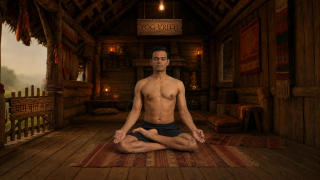
Ardha Padmasana · अर्ध पद्मासन
Ardha Padmasana is a foundational seated posture that roots the lower body, particularly through the sit bones, while allowing the spine to ascend with grace and stability. It gently coaxes openness into the hip rotators and adductors, while simultaneously engaging the subtle core muscles to support a lengthened axial skeleton.
Muscles
- Deep Hip Rotatorsstretches
- Hip Adductorsstretches
- Core Stabilizersstabilises
- Foot and Ankle Stabilizersstabilises
Joints
- Hip Jointmobilises
- Knee Jointmobilises
- Ankle Jointstabilises
- Sacroiliac Jointsstabilises
Inside the body
- Digestive Organs (Abdominal Viscera)
- Lungs and Diaphragm
- Pelvic Floor
- Breathing
Mind
This posture cultivates an immediate sense of grounded presence and mental clarity, a quiet sanctuary within.
Take care
Always approach Ardha Padmasana with a keen and compassionate awareness of the knees and ankles, particularly if a student reports any pre-existing injury, stiffness, or discomfort in these joints.
Never allow a student to force the knee down towards the floor; if it hovers high, provide ample support with a folded blanket or block to protect the delicate ligaments and menisci of the knee joint from undue strain. Similarly, ensure the ankle of the bent leg is stable and not twisted at an awkward angle, as overstretching or compressing these areas can lead to significant discomfort or injury. Encourage students to listen deeply to their bodies, backing off at the first sign of sharp pain, and reminding them that patience, gentle exploration, and appropriate props are their greatest allies in this pose.
Muscles
Deep Hip Rotators
StretchesPiriformis, Obturator internus, Obturator externus, Gemellus superior, Gemellus inferior, Quadratus femoris
These small yet powerful muscles are located deep within your buttocks, connecting your sacrum and pelvis to the top of your thigh bone (femur).
Read moreShow less
In Ardha Padmasana, with one leg externally rotated and abducted, these muscles experience a gentle, sustained lengthening, particularly on the side of the bent leg.
This patient release helps unwind chronic tightness often held from prolonged sitting and daily stresses, allowing the hip joint to find greater freedom and reducing referred pain into the lower back or glutes.
Yogically, this unwinds deep-seated tension, freeing up the flow of prana in the pelvic region and fostering a sense of release and openness.
Hip Adductors
StretchesAdductor longus, Adductor brevis, Adductor magnus, Pectineus, Gracilis
Located along the inner aspect of your thighs, these muscles are responsible for drawing your legs towards the midline.
Read moreShow less
In the half-lotus position, the knee of the bent leg is encouraged to release towards the earth, creating a mild, sustained stretch through the entire adductor group.
This gentle lengthening helps to create space within the groin and inner thigh, areas that often become tight from daily activities and can restrict hip mobility.
From a yogic perspective, releasing the adductors helps to open the root chakra (Muladhara), promoting a sense of security and stability, and allowing energy to flow more freely upwards from the base of the spine.
Core Stabilizers
StabilisesTransversus abdominis, Multifidus, Quadratus lumborum, Pelvic floor muscles
These subtle muscles form a deep cylindrical corset around your trunk, providing essential support for your spine.
Read moreShow less
In Ardha Padmasana, as you actively lift through the crown of your head and ground through your sit bones, these muscles engage in a gentle, sustained manner to maintain the natural curves of your spine and prevent slouching.
This subtle activation builds foundational strength for upright posture, protecting the lower back and promoting a sense of inner lift and centeredness.
Energetically, this engagement helps to lift Apana Vayu and establish a strong central channel, allowing for clarity and focus.
Foot and Ankle Stabilizers
StabilisesTibialis anterior, Peroneus longus, Peroneus brevis, Intrinsic foot muscles
The muscles surrounding your ankle and within your foot work to maintain the integrity and stability of the foot placement in the half-lotus position.
Read moreShow less
As the ankle of the bent leg is gently flexed and potentially slightly inverted or everted, these muscles engage subtly to prevent collapse and support the joint.
This gentle, isometric work helps to strengthen the ligaments and small muscles of the foot and ankle, improving balance and proprioception.
Regular practice in this pose builds resilience in the ankles, making them less prone to instability and providing a stable foundation for all weight-bearing activities.
Joints
Hip Joint (Coxal Joint)
MobilisesThe hip joint, where your thigh bone (femur) meets your pelvis (acetabulum), is a crucial ball-and-socket joint designed for extensive mobility.
Read moreShow less
In Ardha Padmasana, one hip undergoes a controlled external rotation and abduction, gently encouraging the joint capsule and surrounding ligaments to yield and increase range of motion.
This gradual opening helps release stiffness and improve circulation in the area, allowing the practitioner to feel greater ease in seated positions and a reduction in tightness that can radiate to the back.
Over time, this consistent, gentle mobilization can significantly improve overall hip flexibility and comfort in daily life.
Knee Joint (Tibiofemoral Joint)
MobilisesThe knee, primarily a hinge joint, is designed for flexion and extension, with limited rotational capacity.
Read moreShow less
In Ardha Padmasana, the bent knee experiences gentle pressure and a degree of internal rotation as it folds towards the floor, especially if the hip is tight.
The critical aspect here is to support the knee with props like a blanket or block so it is not unduly strained, allowing for a healthy, unforced release without compressing the medial meniscus or stretching the collateral ligaments.
When properly supported, the knee can safely find its edge of internal rotation, which, over time, can improve its overall mobility and reduce the feeling of stiffness, contributing to a more comfortable and stable seated posture.
Ankle Joint (Talocrural Joint)
StabilisesThe ankle joint, formed by the shin bones (tibia and fibula) and the top of the foot bone (talus), primarily allows for dorsiflexion and plantarflexion.
Read moreShow less
In Ardha Padmasana, the ankle of the bent leg is gently flexed and subtly stabilized by the surrounding ligaments and muscles to maintain the position of the foot against the inner thigh or groin.
This subtle engagement strengthens the intrinsic muscles of the foot and ankle, improving both static and dynamic balance, and enhancing proprioception.
Regular practice in this pose helps to build resilience and stability in the ankles, making them less prone to sprains and providing a strong, flexible foundation for all activities.
Sacroiliac (SI) Joints
StabilisesThe sacroiliac joints connect the sacrum (the triangular bone at the base of your spine) to the ilium (the large bones of your pelvis).
Read moreShow less
In a well-aligned Ardha Padmasana, with the sit bones evenly grounded and the spine lengthening, these joints are encouraged into a position of balanced stability.
This gentle, sustained engagement helps to strengthen the deep stabilizing muscles and ligaments around the SI joints, which are often a source of lower back discomfort due to hypermobility or hypomobility.
This stability translates into a feeling of groundedness and support in the entire pelvic region, fostering a sense of security and ease in the lower back.
Inside the body
Digestive Organs (Abdominal Viscera)
In a tall, upright seated posture like Ardha Padmasana, the abdominal cavity is neither compressed nor twisted, allowing the digestive organs such as the stomach and intestines to sit in their natural, unhindered alignment.
Read moreShow less
This gentle support and lack of constriction encourage optimal blood flow and nerve function to the gut.
From a yogic perspective, an uncompressed abdomen supports healthy Samana Vayu, the energy responsible for assimilation and digestion, leading to improved digestive efficiency, reduced bloating, and a lighter, more comfortable feeling in the belly.
Lungs and Diaphragm
With the spine lengthened and the chest broad and open, the diaphragm, our primary breathing muscle, has ample space to move freely up and down through its full excursion.
Read moreShow less
This optimal positioning allows for full, deep diaphragmatic breathing, maximizing lung capacity and promoting efficient oxygen exchange throughout the body.
This expansive, uninhibited breathing is crucial for calming the nervous system and is considered vital for cultivating Prana Vayu, the life force energy, leading to increased vitality, mental clarity, and a profound sense of inner spaciousness and well-being.
Pelvic Floor
In Ardha Padmasana, the pelvic floor muscles, which form a hammock at the base of the pelvis, are gently supported by the grounded sit bones and the upward lift of the spine.
Read moreShow less
This posture encourages a subtle engagement and awareness of these muscles, without creating tension or strain.
This gentle activation helps to improve blood flow to the region and strengthen the pelvic floor, which is crucial for stability, continence, and supporting the abdominal organs.
Yogically, a healthy pelvic floor is integral to balancing Muladhara Chakra, fostering a sense of grounding, security, and energetic containment in the lower body.
Breathing
The upright, lengthened spine and open, unconstrained chest in Ardha Padmasana create an ideal anatomical environment for deep, unhindered breathing.
Read moreShow less
This posture naturally encourages a fuller, more complete inhalation, allowing the diaphragm to descend completely into the abdominal cavity, and a more thorough exhalation, as the core muscles gently support the release of air.
The inherent stability of the seated base helps to quiet and refine the breath, making it smoother, longer, and more rhythmic.
This provides an excellent foundation for various pranayama practices, such as Ujjayi (Victorious Breath), as the body's openness allows the breath to become a powerful tool for calming the mind, directing vital energy, and deepening meditative states.
Fascia (connective tissue)
The intricate web of connective tissue, known as fascia, which envelops every muscle, organ, and bone, experiences a gentle yet profound release and hydration in Ardha Padmasana.
Read moreShow less
Specifically, the superficial back line and spiral lines around the hips, thighs, and lower back are subtly lengthened and encouraged to yield as the hips open and the spine extends.
This patient unwinding of the fascial network helps to release chronic restrictions and adhesions, which often contribute to stiffness, limited mobility, and even chronic pain patterns.
Yogically, this is akin to opening subtle energy channels (nadis), allowing prana to flow more freely and fostering a feeling of fluidity, interconnectedness, and spaciousness throughout the entire body.
Mind and nervous system
- Nervous system
You will often feel a profound sense of calm washing over you, a quiet settling of the inner chatter.
Read moreShow less
This occurs because the stable, symmetrical base of the posture, combined with the lengthened spine, naturally encourages a deeper, more rhythmic breath.
This slow, steady breathing directly stimulates the vagus nerve, signaling the parasympathetic nervous system to activate, overriding the 'fight-or-flight' response.
This shift from sympathetic to parasympathetic dominance quiets the mind (chitta vritti nirodha), allowing you to experience a state of inner peace and equilibrium.
The gentle yet firm grounding through the sit bones creates a feeling of security and stability, which directly translates to a calmer nervous system.
Read moreShow less
By establishing a strong, palpable connection to the earth, the body's proprioceptors send clear signals of safety and support to the brain, reducing the underlying baseline anxiety that many people carry.
This physical rootedness helps to stabilize Apana Vayu, the downward-moving energy, which in turn helps to calm an overactive mind and fosters a sense of being fully present and secure in the moment, enhancing overall well-being.
- Mind & mood
This posture cultivates an immediate sense of grounded presence and mental clarity, a quiet sanctuary within.
Read moreShow less
By consciously aligning the physical body – grounding the hips, lengthening the spine, and steadying the gaze – the scattered energies of the mind are naturally drawn inward and unified.
This physical discipline becomes a form of Pratyahara, withdrawing the senses from external distractions, and setting the stage for deeper concentration (Dharana).
For a teacher, understanding this connection allows them to guide students not just into a physical shape, but into a state of focused, embodied awareness and inner stillness.
Ardha Padmasana is a powerful antidote to an anxious, overthinking mind, fostering a profound sense of inner quietude and acceptance.
Read moreShow less
The act of patiently settling into the posture, accepting the body's current state without force or judgment, cultivates a quality of resilience and equanimity.
This practice of gentle persistence teaches the mind to release attachment to immediate results and embrace the process, building mental fortitude and a deeper capacity for patience.
For students, this means discovering that true flexibility extends beyond the physical, softening rigid thought patterns and opening to new possibilities for mental freedom.
Because it is a hip opener pose
The hip-opening aspect of Ardha Padmasana works to gently increase the range of motion in the hip joints, particularly in external rotation and abduction.
Read moreShow less
Anatomically, this involves a sustained lengthening of the deep hip rotators and adductors, which often hold significant tension from prolonged sitting, repetitive movements, or athletic activities.
Yogically, opening the hips is understood to release stored emotional tension and promote a sense of freedom and emotional release, allowing for a more uninhibited flow of energy (prana) throughout the lower body and fostering a feeling of lightness.
As a balanced seated posture, it promotes stability and structural integrity in the pelvic girdle, creating a solid, grounded base for the spine to ascend.
Read moreShow less
This foundational stability helps establish proper alignment throughout the entire axial skeleton, from the pelvis to the crown of the head.
This physical balance translates energetically into a profound sense of inner equilibrium and centeredness, fostering a calm mind and a steady, unwavering presence.
This quality is essential for deep introspective work, meditation, and cultivating a sense of inner peace.