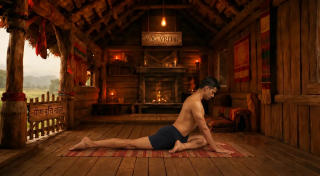
Benefits· लाभ
What Low Plank Pose does for you
Ardha Phalakasana · अर्ध फलकासन
Ardha Phalakasana, or Low Plank, offers a profound shift in how we engage with gravity and build foundational strength, primarily by transitioning the support from the hands to the forearms. This modification immediately lessens the direct weight-bearing demand on the wrists and significantly alters the leverage, making core and shoulder engagement more accessible and sustainable, particularly for those new to the practice or seeking a gentler progression.
What this version changes: Utilizing a blanket in Ardha Phalakasana can profoundly enhance accessibility and comfort, particularly when placed under the forearms or knees. Under the forearms, it cushions the elbows and reduces pressure, allowing for a softer, yet still stable, foundation. When placed under the knees, it provides gentle support, alleviating strain and enabling practitioners to focus more intently on cultivating core engagement and spinal length, making the pose approachable for a wider range of bodies and experience levels.
Muscles
- Deep Abdominal Musclesstrengthens
- Shoulder Stabilizersstabilises
- Chest Musclesstabilises
- Arm Extensorsisometric holding
- Thigh Musclesstrengthens
Joints
- Wristsstabilises
- Shouldersstabilises
- Spinestabilises
Inside the body
- Abdominal Organs
- Circulatory System
- Diaphragm and Lungs
- Breathing
Mind
Phalakasana is a powerful teacher of determination and inner strength.
Take care
Teachers should guide students with wrist pain to modify by coming onto their forearms (Forearm Plank) or using props like wedges under the heels of the hands to reduce the angle.
For shoulder sensitivity, ensure the shoulders are integrated and not shrugging towards the ears, actively pressing the floor away. Students with lower back issues should be cued to strongly engage the core to prevent the hips from sagging, which can strain the lumbar spine.
Muscles
Deep Abdominal Muscles
StrengthensWhile the Deep Abdominal Muscles are the core of both poses, Ardha Phalakasana offers a unique entry point for their cultivation.
Read moreShow less
With the reduced leverage from the forearms, the body's center of gravity feels slightly different, often making it easier for practitioners to isolate and engage the Transversus Abdominis and Multifidus without over-recruiting superficial muscles.
This allows for a more gradual and nuanced development of core strength, teaching intelligent engagement and a refined sense of internal support from the very first breath.
Shoulder Stabilizers
StabilisesThe Shoulder Stabilizers, including the Serratus Anterior and Rotator Cuff muscles, are intensely active in both poses, yet their precise recruitment pattern shifts with the change in arm position.
Read moreShow less
In Phalakasana, they stabilize the scapula against the rib cage with the arms fully extended.
In Ardha Phalakasana, with the forearms down, the humerus is in a different plane of flexion, often promoting a broader and more integrated engagement of the upper back.
This subtle shift can allow for a deeper exploration of scapular protraction and depression, fostering a more open and spacious feeling across the shoulder blades.
Chest Muscles
StabilisesPhalakasana calls upon the Chest Muscles, mainly Pectoralis Major and Minor, for a strong outward push, broadening the chest and actively lifting the sternum away from the mat.
Read moreShow less
In Ardha Phalakasana, while still vital for stabilizing the shoulder girdle and preventing the chest from sagging, their primary action is less about a powerful press.
Instead, they engage in a more subtle, isometric fashion, supporting the anterior rib cage and contributing to the overall integrity of the torso, fostering a sense of internal lift rather than an outward push.
Arm Extensors
Isometric HoldingIn Phalakasana, the Arm Extensors, primarily the Triceps Brachii, are powerfully engaged in an active, concentric contraction to straighten the elbows and push the body away from the floor.
Read moreShow less
In Ardha Phalakasana, with the forearms grounded, their action shifts to a sustained isometric hold, maintaining the integrity of the elbow joint and preventing the upper arm from collapsing.
While still active, their role is less about dynamic extension and more about static stabilization, allowing for a different quality of strength to be cultivated.
Thigh Muscles
StrengthensQuadriceps Femoris
The large muscles on the front of your thighs (quadriceps femoris) are actively engaged, lifting the kneecaps and firming the legs.
Read moreShow less
This engagement ensures the legs are straight and strong, preventing the hips from sagging and helping to create a long, straight line from head to heels.
This powerful activation in the lower body connects us deeply to the earth, anchoring the posture and allowing for an upward lift through the torso, embodying both groundedness and lightness.
Forearm Stabilizers
Stabilisese.g., Flexor Carpi Ulnaris, Extensor Carpi Radialis
In Ardha Phalakasana, the muscles within the forearms, such as the Flexor Carpi Ulnaris and Extensor Carpi Radialis, become newly and significantly engaged to create a stable foundation.
Read moreShow less
These muscles work to press the entire forearm and hand (or fist) evenly into the mat, preventing any collapse in the wrist or uneven weight distribution through the elbow.
This active pressing creates a firm base, allowing the energy to lift effectively through the arms and shoulders, establishing a grounded connection that supports the entire posture.
Joints
Wrists
StabilisesThe small bones and ligaments of your wrists (radiocarpal and intercarpal joints) bear significant weight in Phalakasana, requiring careful alignment to distribute the pressure evenly.
Read moreShow less
By spreading your fingers wide and pressing down through the knuckles, you learn to create a stable foundation, protecting these delicate joints from strain.
With consistent, mindful practice, the wrists become stronger and more resilient, improving overall joint integrity and preparing them for more advanced weight-bearing postures with greater ease.
Shoulders
StabilisesThe shoulder joint (glenohumeral joint) is a highly mobile ball-and-socket joint, and in Plank, it requires significant stabilization from the surrounding muscles.
Read moreShow less
Actively drawing the shoulder blades down the back and away from the ears helps to create space and prevent compression in the joint capsule.
This intelligent stabilization cultivates integrity and awareness in the shoulder girdle, fostering a sense of spaciousness and freedom in the upper body, reducing stiffness and improving range of motion over time.
Spine
StabilisesThe entire vertebral column is held in a neutral, elongated position, neither sagging nor arching excessively, through the intelligent engagement of the core muscles.
Read moreShow less
This isometric stabilization strengthens the muscles supporting the spine, promoting healthy spinal alignment and decompressing the intervertebral discs.
Yogically, a stable spine allows for the unimpeded flow of prana, fostering mental clarity and a sense of uprightness and dignity, translating into improved posture and reduced back discomfort in daily life.
Inside the body
Abdominal Organs
The gentle, sustained engagement of the core muscles in Phalakasana creates a subtle compression and toning effect on the abdominal organs.
Read moreShow less
This can stimulate digestion and improve circulation to these vital internal structures.
While not a dramatic 'wringing' action, the consistent support helps to maintain optimal organ position and function, contributing to a feeling of internal vitality and well-being, enhancing the body's natural detoxification processes.
Circulatory System
Holding Plank Pose requires sustained effort, increasing the heart rate and promoting healthy blood flow throughout the body, particularly to the extremities and core.
Read moreShow less
The isometric contractions in the limbs help to pump blood back towards the heart, improving venous return.
This enhanced circulation nourishes all tissues and organs, bringing fresh oxygen and nutrients, and is understood yogically to invigorate the entire system, awakening dormant energy and fostering a vibrant sense of aliveness.
Diaphragm and Lungs
While the core is engaged, the diaphragm is still free to move, encouraging deep and steady diaphragmatic breathing.
Read moreShow less
The stability of the torso provides a firm anchor for the diaphragm to work efficiently, promoting fuller lung capacity and more effective gas exchange.
This conscious breathing in a demanding posture teaches us to maintain a calm and expansive breath even under exertion, a key principle in pranayama for cultivating inner peace and resilience.
Breathing
In Phalakasana, the stable and elongated torso encourages a steady, diaphragmatic breath, even as the body works hard.
Read moreShow less
While the core is engaged, it's crucial not to hold the breath or shallow breathe into the chest; instead, one learns to breathe deeply into the lower lungs, expanding the rib cage laterally.
This conscious, deep breathing in a challenging posture helps to calm the nervous system, maintain mental focus, and prevent the build-up of unnecessary tension, making it an excellent preparation for more advanced pranayama practices where breath control is paramount.
Fascia (connective tissue)
Phalakasana engages and strengthens the entire fascial net, particularly the Superficial Front Line (from the tops of the feet, up the shins, quadriceps, abdomen, chest, and front of the neck) and the Superficial Back Line (from the soles of the feet, up the calves, hamstrings, glutes, back, and neck).
Read moreShow less
The deep core engagement also activates the Deep Front Line.
This integrated tension across these fascial lines creates a cohesive, resilient structure, teaching the body to act as a single, connected unit rather than isolated parts.
Yogically, this strengthens the energetic channels (nadis), allowing prana to flow more freely and powerfully throughout the body, enhancing structural integrity and overall vitality.
Mind and nervous system
- Nervous system
Phalakasana cultivates profound mental focus and presence, as the sustained effort required demands your full attention, drawing the mind away from external distractions.
Read moreShow less
This intense concentration on physical alignment and breath acts as a form of moving meditation, quieting the incessant chatter of the mind (chitta vritti).
The steady engagement of the body, combined with rhythmic breathing, helps to balance the sympathetic and parasympathetic nervous systems, reducing anxiety and promoting a calm, alert state of being.
The physical challenge of holding Plank, when approached with mindfulness, builds resilience in the nervous system.
Read moreShow less
By consciously choosing to stay present and breathe through moments of discomfort, we train our nervous system to respond to stress with greater equanimity rather than reactive tension.
This practice cultivates an inner steadiness (sthiram) that extends beyond the mat, enhancing our capacity to remain grounded and centered amidst life's challenges.
- Mind & mood
Phalakasana is a powerful teacher of determination and inner strength.
Read moreShow less
Holding the pose demands mental fortitude, as the mind often wants to give up before the body truly needs to.
By consciously choosing to remain present and engaged, we cultivate resilience and willpower, learning to push past perceived limitations.
This mental discipline directly translates into greater self-confidence and an unwavering resolve in facing life's obstacles.
The pose fosters a deep sense of body-mind integration, requiring unwavering focus (dharana) to maintain the precise alignment and sustained effort.
Read moreShow less
As the physical body works in unison, the mind becomes singularly absorbed in the present moment, creating a profound state of awareness.
This practice of bringing the mind to the body's sensations helps to quiet external distractions (pratyahara), leading to a clearer, more centered mental state and an enhanced capacity for concentration.
Because it is a standing pose
As a standing pose (on hands and feet), Phalakasana strengthens the entire skeletal and muscular system against gravity, building foundational bone density and muscular endurance.
Read moreShow less
The body learns to bear its own weight intelligently, distributing pressure evenly across the four points of contact.
This cultivation of integrated strength creates a stable physical structure, embodying the yogic principle of 'sthiram sukham asanam' – steadiness and ease in the posture.
This pose is a master class in full-body integration and alignment.
Read moreShow less
By creating a long, straight line from head to heels, it teaches the practitioner to align the major joints – wrists, elbows, shoulders, hips, knees, and ankles – in a unified structure.
This holistic alignment not only improves overall posture and body mechanics but also allows for a more efficient flow of prana, promoting a sense of energetic coherence and balance throughout the subtle body.
The steady, sustained hold of Plank Pose builds immense stamina and endurance, both physically and mentally.
Read moreShow less
It challenges the practitioner to remain present and breathe steadily even as fatigue sets in, cultivating an inner fire (tapas) and a strong will.
This practice of sustaining effort with awareness is crucial for developing resilience and perseverance, qualities that support not only a deeper yoga practice but also a more disciplined and focused approach to life.