Benefits· लाभ
What Dolphin Pose does for you
Ardha Pincha Mayurasana · अर्ध पिञ्च मयूरासन
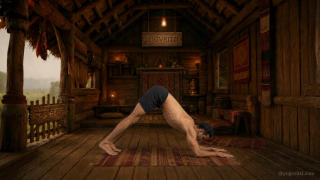
Ardha Pincha Mayurasana is a profound posture that skillfully blends strength and release, acting as a preparatory inversion and a full-body invigorator. It profoundly strengthens the entire shoulder girdle and core, creating a stable foundation while simultaneously lengthening the posterior chain from the hamstrings to the calves.
Muscles
- Shouldersstrengthens
- Corestrengthens
- Hamstringsstretches
- Upper Backstrengthens
- Forearmsstrengthens
Joints
- Shoulder Jointstabilises
- Elbow Jointstabilises
- Wrist Jointstabilises
- Hip Jointmobilises
- Spinedecompressing
Inside the body
- Brain/Head
- Abdominal Organs
- Heart
- Breathing
Mind
Ardha Pincha Mayurasana cultivates profound mental focus and concentration (Dharana) as the practitioner must maintain precise alignment and a steady breath throughout the hold.
Take care
Teachers should always approach this pose with care, especially for students with pre-existing shoulder injuries, such as rotator cuff issues or impingement, as significant weight is borne through the shoulders.
Likewise, individuals with neck pain must be guided to keep the neck long and relaxed, avoiding any compression or collapse of the head towards the floor. It is crucial to prioritize intelligent alignment over depth, ensuring the shoulders are broad and the head is free from strain.
Muscles
Shoulders
StrengthensDeltoids, Rotator Cuff, Serratus Anterior
The large muscles capping your shoulders (deltoids) and the deeper stabilizing muscles around the shoulder blade (rotator cuff, serratus anterior) are powerfully engaged here.
Read moreShow less
As you press your forearms down and lift your hips, these muscles work synergistically to create a broad, stable foundation, preventing the shoulders from collapsing towards the ears.
This action builds incredible strength and intelligent awareness in the shoulder girdle, fostering a sense of grounded power that radiates through the upper body.
Core
StrengthensRectus Abdominis, Transverse Abdominis, Obliques
The deep abdominal muscles, particularly the transverse abdominis and obliques, are actively drawn inward and upward in this pose.
Read moreShow less
This intrinsic engagement supports the lumbar spine, preventing it from arching excessively and creating a lift through the pelvis.
This vital activation of our energetic core (Manipura Chakra) not only strengthens the body's center but also cultivates a profound sense of inner stability and willpower, allowing energy to flow more freely.
Hamstrings
StretchesBiceps Femoris, Semitendinosus, Semimembranosus
The powerful muscles running along the back of your thighs (hamstrings) receive a deep, sustained lengthening as you lift your hips high and draw your heels towards the floor.
Read moreShow less
This is not a forceful stretch but a gradual unwinding, encouraged by the sustained hold and mindful breath.
Therapeutically, this release helps alleviate tension in the lower back and pelvis, allowing apana vayu—the downward moving energy—to settle, bringing a profound sense of groundedness and ease.
Upper Back
StrengthensTrapezius, Rhomboids, Erector Spinae
The muscles spanning your upper back and between your shoulder blades (trapezius, rhomboids) and along the spine (erector spinae) are actively engaged to broaden the shoulder blades and lift the chest away from the floor.
Read moreShow less
This intelligent action counters the tendency to round the upper back, creating length and space in the thoracic spine.
This strengthens the postural muscles, fostering an upright and open quality, which yogically translates to an open heart and a lifted spirit.
Forearms
StrengthensFlexors and Extensors
The muscles of the forearms, both the flexors on the underside and the extensors on the top, are powerfully engaged as you press your entire forearm and palm into the earth.
Read moreShow less
This firm connection through the arms creates a stable base, allowing for the upward lift of the hips and the lengthening of the spine.
This grounding through the forearms cultivates a sense of rooted strength and stability, translating into a feeling of unwavering support throughout the pose.
Calves
StretchesGastrocnemius, Soleus
As the heels draw towards the mat and the hamstrings lengthen, the calf muscles (gastrocnemius and soleus) also experience a significant stretch.
Read moreShow less
This release in the lower legs helps to fully extend the posterior chain, enhancing flexibility in the ankles and feet.
From a yogic perspective, releasing tension in the calves contributes to a greater sense of grounding and stability, allowing the energy in the lower limbs to flow unhindered.
Joints
Shoulder Joint
StabilisesThe shoulder joint (glenohumeral joint) is actively stabilized in Ardha Pincha Mayurasana, as the muscles of the rotator cuff work to keep the head of the humerus centered in the socket.
Read moreShow less
By pressing the forearms down and broadening the shoulder blades, we create intelligent space within the joint, preventing compression and encouraging healthy alignment.
This stabilization not only protects the joint but also frees up the energetic pathways around the heart and arms, promoting a feeling of openness and strength.
Elbow Joint
StabilisesThe elbow joints (humeroulnar and humeroradial joints) are held in a stable, slightly flexed position, preventing hyperextension and distributing the weight evenly through the forearms.
Read moreShow less
This mindful engagement ensures that the joint is supported by surrounding musculature rather than relying on passive ligamentous stability.
This cultivates awareness of the integrity of our support structures, allowing us to find a balance between effort and ease in the pose.
Wrist Joint
StabilisesWhile the forearms bear the primary weight, the wrist joints (radiocarpal joints) are still engaged, especially if the hands are clasped or pressing down firmly.
Read moreShow less
The even pressure through the palms and fingers helps to distribute the load, preventing excessive strain on the wrists.
This firm connection to the earth through the hands and forearms grounds the entire upper body, channeling a steady flow of energy from the earth upwards.
Hip Joint
MobilisesThe hip joints (acetabulofemoral joints) are gently mobilized as the pelvis lifts and tilts, allowing for increased flexibility in the hamstrings and inner thighs.
Read moreShow less
The action of drawing the inner thighs towards each other and lifting the sit bones creates space in the hip crease, encouraging external rotation and release.
This release in the hips can help to unblock stagnant energy and emotions, fostering a sense of freedom and openness in the pelvic region.
Spine
DecompressingIn this inversion, the entire vertebral column experiences a gentle decompression, as gravity assists in lengthening the spine from the tailbone to the crown of the head.
Read moreShow less
By actively lifting the hips and drawing the shoulder blades down the back, we create space between each vertebra, alleviating compression.
This axial extension promotes the upward flow of prana along the sushumna nadi, aligning the energetic centers and fostering a sense of lightness and clarity.
Inside the body
Brain/Head
The gentle inversion in Ardha Pincha Mayurasana encourages a fresh flow of oxygenated blood to the brain and scalp.
Read moreShow less
This increased circulation can awaken the mind, enhance cognitive function, and alleviate mental fatigue, bringing a sense of clarity and focus.
From a yogic perspective, this nourishes the Sahasrara Chakra, promoting a deeper connection to inner wisdom and higher awareness.
Abdominal Organs
The subtle engagement of the core and the inverted nature of the pose provide a gentle massage and compression to the abdominal organs.
Read moreShow less
This can stimulate peristalsis, aiding in digestion and detoxification processes, promoting a healthy gut.
Energetically, this activation supports the Agni (digestive fire) and helps to balance the Manipura Chakra, strengthening our center of personal power and vitality.
Heart
While not a full inversion, the slight elevation of the hips above the heart in Dolphin Pose offers a gentle inversion effect on the cardiovascular system.
Read moreShow less
It temporarily reduces the gravitational pull on the heart, allowing it to work with less effort and encouraging venous return.
This subtle shift can be deeply calming, fostering a sense of ease and opening the energetic channels around the Anahata Chakra, promoting compassion and emotional balance.
Breathing
In Ardha Pincha Mayurasana, the position of the body naturally encourages a deeper, more expansive breath, particularly into the back and sides of the rib cage.
Read moreShow less
The engagement of the core muscles supports the diaphragm, allowing for a fuller exhalation and a more complete inhalation.
This conscious, diaphragmatic breathing (Ujjayi pranayama is often encouraged here) helps to calm the nervous system, regulate the flow of prana, and sustain the pose with greater ease.
The steady rhythm of the breath becomes an anchor for the mind, transforming physical effort into meditative awareness.
Fascia (connective tissue)
The body's intricate web of connective tissue, known as fascia, is deeply engaged and released in Ardha Pincha Mayurasana.
Read moreShow less
The Posterior Superficial Line of fascia, running from the soles of the feet up the calves, hamstrings, and along the entire back, receives a profound, sustained lengthening.
Simultaneously, the Arm Lines, connecting through the forearms and shoulders, are strengthened and organized.
This intelligent engagement and release help to unbind adhesions, improve fascial hydration, and open energetic channels, releasing deeply held physical and emotional patterns that restrict movement and vitality.
Mind and nervous system
- Nervous system
The sustained hold and the controlled breath in Ardha Pincha Mayurasana help to shift the nervous system from a state of sympathetic arousal towards parasympathetic dominance.
Read moreShow less
As the body works to stabilize and lengthen, the mind is drawn into the present moment, quietening the 'chitta vritti' or mental fluctuations.
This intentional focus and steady breathing cultivates a profound sense of inner calm and reduces overall stress and anxiety.
The inversion aspect of the pose, even a partial one, subtly alters the flow of blood and energy, providing a novel stimulus to the brain and nervous system.
Read moreShow less
This can reset neurological patterns, promoting a sense of mental clarity and emotional equilibrium.
Practitioners often report feeling more centered and grounded after practicing Dolphin Pose, as if the mind has been gently recalibrated.
By actively engaging the entire body and requiring precise alignment, Ardha Pincha Mayurasana significantly enhances proprioception – your body's awareness of its position in space.
Read moreShow less
This heightened sensory input helps to refine neuromuscular coordination and body mapping in the brain.
This increased body awareness deeply connects us to our physical form, acting as a powerful tool for present moment awareness and mindfulness.
- Mind & mood
Ardha Pincha Mayurasana cultivates profound mental focus and concentration (Dharana) as the practitioner must maintain precise alignment and a steady breath throughout the hold.
Read moreShow less
The challenge of the pose demands full presence, effectively drawing the senses inward (Pratyahara) and quieting external distractions.
This sustained mental effort builds resilience and mental fortitude, helping to develop a more disciplined and unwavering mind.
The inverted nature of the pose, even a partial one, offers a unique opportunity to shift perspective, both physically and metaphorically.
Read moreShow less
By literally turning the world upside down, we can gain new insights and release rigid thought patterns, fostering adaptability and openness to change.
This subtle reorientation can be incredibly uplifting, helping to alleviate low mood and fostering a sense of renewed possibility.
Holding this strong, foundational pose builds a deep sense of inner strength and self-reliance.
Read moreShow less
Overcoming the physical demands fosters mental courage and determination, translating into a greater capacity to face life's challenges with equanimity.
This cultivation of inner power and stability helps to reinforce a positive self-image and a profound trust in one's own capabilities.
Because it is a inversion pose
Inversions gently reverse the gravitational pull on the body, encouraging fresh, oxygenated blood flow to the brain and endocrine glands, particularly the pituitary and pineal glands.
Read moreShow less
This increased circulation can revitalize the mind, enhance clarity, and balance hormonal functions.
Yogically, inversions are revered for calming the nervous system, shifting perspective, and stimulating the crown chakra, leading to a sense of peace and heightened awareness.
This pose profoundly strengthens the entire upper body and core, building a robust foundation that is essential for more advanced inversions and arm balances.
Read moreShow less
The sustained engagement of the shoulders, arms, and deep abdominal muscles creates intelligent strength and stability.
This physical fortitude translates into mental resilience and a feeling of being strongly rooted, cultivating a sense of unwavering inner power.
While strengthening the front and upper body, Ardha Pincha Mayurasana simultaneously lengthens the entire posterior chain, particularly the hamstrings and calves.
Read moreShow less
This active lengthening helps to release chronic tension in the back of the legs and hips, improving overall flexibility and spinal health.
From a yogic perspective, releasing these deep-seated tensions allows for a freer flow of energy (prana) throughout the body, promoting ease and lightness.