Benefits· लाभ
What Chair Revolved Triangle Pose does for you
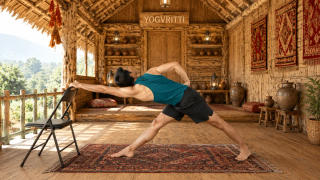
Chair Parivrtta Trikonasana · कुर्सी परिवृत्त त्रिकोणासन
Chair Parivrtta Trikonasana is a profound yet accessible twist that meticulously mobilizes the entire spinal column, creating vital space between the vertebrae. This posture deeply engages the core muscles, strengthening the abdomen and back, while simultaneously lengthening the hamstrings and the fascial lines along the side body.
Muscles
- Side abdominal musclesstrengthens
- Spinal extensorsstretches
- Back of the thighsstretches
- Outer hip musclesstabilises
Joints
- Spinemobilises
- Hipsstabilises
- Shouldersmobilises
Inside the body
- Digestive Organs (Intestines, Liver, Spleen)
- Kidneys and Adrenal Glands
- Breathing
Mind
This posture demands and cultivates a deep sense of focus and concentration (Dharana).
Take care
Teachers, always approach students with known spinal injuries, such as disc herniations or scoliosis, with extreme care.
The spine is vulnerable during rotation, so ensure the student maintains spinal length and twists gently from the upper back, not forcing the lower spine. For those with recent abdominal surgery or severe digestive issues, supervise closely and ensure the twist is very mild, as deep compression can be contraindicated. Always emphasize listening to the body and never pushing into pain.
Muscles
Side abdominal muscles
StrengthensObliques (Internal and External)
These powerful muscles on the sides of your torso are the primary movers in initiating and deepening the spinal twist.
Read moreShow less
As you rotate, the internal oblique on the side of the front leg and the external oblique on the side of the back leg work synergistically, drawing the rib cage and pelvis into a harmonious revolution.
This coordinated engagement not only strengthens your core but also allows for a safe, controlled rotation, preventing undue strain on the spine.
From a yogic perspective, this activation creates an internal fire, or Agni, which purifies and energizes the abdominal region.
Spinal extensors
StretchesErector Spinae
Running vertically along your back, these muscles are crucial for maintaining an elongated spine even as you twist.
Read moreShow less
In Chair Parivrtta Trikonasana, they work to lift and extend the torso, preventing slouching and ensuring that the twist occurs along an axis of length rather than compression.
This sustained lengthening helps to decompress the vertebral discs, promoting better spinal health and flexibility over time.
The energetic sensation is one of upward lift, supporting the flow of Prana Vayu and fostering a feeling of spaciousness and lightness in the upper body.
Back of the thighs
StretchesHamstrings
With one leg extended forward, the muscles at the back of your thigh receive a significant, yet supported, stretch.
Read moreShow less
This lengthening is crucial for maintaining a stable pelvis on the chair and allowing the spine to twist without pulling on the sacrum.
As you patiently hold the posture, these often-tight muscles gradually release, improving hip mobility and reducing tension that can contribute to lower back pain.
Yogically, this gentle release of the posterior chain helps to ground the apana vayu, promoting a sense of stability and ease in the lower body.
Outer hip muscles
StabilisesGluteus Medius and Minimus
Even while seated, these muscles on the outer aspect of your hips play a key role in stabilizing the pelvis, particularly the side of the extended leg.
Read moreShow less
They work subtly to prevent the hip from collapsing inward or outward, providing a firm foundation for the spinal rotation.
This grounded engagement ensures that the twist originates from the spine rather than the hips, protecting the sacroiliac joint.
The stability they provide allows for a more focused and effective spinal mobilization, enhancing the feeling of being rooted and centered in the pose.
Joints
Spine
MobilisesThe vertebral column, from the sacrum to the atlas, undergoes a profound rotational mobilization in this pose.
Read moreShow less
Each vertebra gently rotates upon the one below it, creating space and freeing up any stiffness in the intervertebral discs and facet joints.
This systematic unwinding enhances the spine's natural range of motion, improving its resilience and ability to absorb shock.
Practitioners often feel a deep sense of release and increased suppleness, fostering better overall posture and a more fluid movement quality in daily life.
Hips
StabilisesWhile the primary action is spinal rotation, the hip joints provide a crucial stable base when seated on the chair, particularly the hip of the extended leg.
Read moreShow less
The femur is held firmly within the acetabulum, allowing the pelvis to remain relatively still as the torso twists above it.
This stability ensures that the rotational forces are concentrated in the lumbar and thoracic spine, preventing unwanted strain on the lower back and sacroiliac joints.
The result is a feeling of being firmly rooted, which supports the upward lift and freedom of the spine.
Shoulders
MobilisesThe glenohumeral joints of the shoulders are actively involved as the arms are used to deepen and leverage the twist.
Read moreShow less
One arm presses against the extended leg or the back of the chair, while the other might reach back or up, creating an expansive opening across the chest.
This action mobilizes the shoulder girdle, releasing tension in the upper back and neck, and improving overall shoulder flexibility.
The opening of the chest allows for greater lung capacity and an energetic expansion, fostering a sense of fearlessness and open-heartedness.
Inside the body
Digestive Organs (Intestines, Liver, Spleen)
The twisting action provides a gentle yet effective compression and release to the abdominal organs, particularly the intestines, liver, and spleen.
Read moreShow less
This 'wringing out' motion stimulates blood flow, flushing out stagnant blood and allowing a fresh supply to replenish the tissues upon release.
This internal massage aids in detoxification, improves peristalsis, and supports overall digestive efficiency, alleviating issues like sluggish digestion and constipation.
Yogically, this purifies the Nabhi Chakra (navel center), enhancing vitality and metabolic function.
Kidneys and Adrenal Glands
Located in the posterior abdominal wall, the kidneys and the small adrenal glands nestled above them also experience a mild compression and release during a spinal twist.
Read moreShow less
This gentle stimulation is believed to improve circulation to these vital organs, supporting their role in filtering blood and regulating hormones.
The subtle energetic effect is one of revitalizing the body's internal systems, reducing fatigue, and helping to balance the body's stress response.
This contributes to a sense of internal calm and energetic equilibrium.
Breathing
In Chair Parivrtta Trikonasana, the twisting action naturally creates a gentle compression on one side of the torso, while simultaneously expanding the other.
Read moreShow less
This encourages a more directed and refined breath, often prompting practitioners to breathe into the 'open' side of the chest and back.
The slightly restricted full lung expansion on one side can deepen the exhalation, promoting a more complete release of residual air and fostering a calming effect on the nervous system.
This pose is an excellent preparation for gentle pranayama techniques like Ujjayi, as it enhances awareness of the breath's movement within the torso, making the breath more subtle and controlled.
Fascia (connective tissue)
The chair variation of Parivrtta Trikonasana expertly engages and releases the intricate fascial web that envelops the entire body, particularly the Superficial Back Line and the Spiral Lines.
Read moreShow less
As you twist and extend, the connective tissue running along the entire back of the body, from the heel of the extended leg up through the spine, receives a sustained lengthening.
Simultaneously, the spiral lines that wrap around the torso, connecting the shoulder to the opposite hip, are stretched and toned.
This multidirectional release and strengthening of fascia helps to unravel chronic tension patterns, improving overall mobility and allowing for a freer, more uninhibited flow of Prana through the body's energetic channels.
Mind and nervous system
- Nervous system
Practitioners often feel a profound sense of calm and mental clarity after a sustained twist, as the posture gently stimulates the vagus nerve.
Read moreShow less
This nerve, running from the brainstem through the neck and abdomen, plays a key role in the parasympathetic nervous system, responsible for 'rest and digest' functions.
The gentle compression and release in the abdominal area, combined with focused breath, helps to downregulate the sympathetic (fight-or-flight) response, promoting deep relaxation and reducing anxiety.
This shift allows the mind to settle, bringing a greater sense of presence and inner peace.
The intricate movements of the spine and the precise alignment required in Chair Parivrtta Trikonasana significantly enhance proprioception – your body's awareness of its position in space.
Read moreShow less
As you consciously rotate each segment of the spine, you become more attuned to subtle imbalances and areas of tension.
This heightened somatic awareness helps to refine motor control and improve overall coordination, translating into more graceful and efficient movement patterns in daily life.
From a yogic perspective, this cultivation of internal awareness is a form of Pratyahara, drawing the senses inward and focusing the mind.
- Mind & mood
This posture demands and cultivates a deep sense of focus and concentration (Dharana).
Read moreShow less
The practitioner must remain acutely aware of their spinal length, the engagement of their core, and the precise arc of their twist, preventing the mind from wandering.
This sustained mental engagement anchors the mind in the present moment, offering a respite from habitual thought patterns and mental chatter.
By channeling mental energy into the physical alignment, one can achieve a state of mental quietude and inner stability, which is invaluable for cultivating mindfulness.
Twisting postures, by their very nature, invite us to look back, metaphorically and physically, over our shoulder.
Read moreShow less
This can foster a subtle shift in perspective, encouraging introspection and a review of one's internal landscape without judgment.
The act of 'wringing out' tension from the body can also correspond to releasing mental and emotional baggage, creating a sense of psychological lightness.
This process of release and introspection cultivates a greater sense of emotional freedom and resilience, allowing the practitioner to approach challenges with a renewed outlook.
Because it is a twist pose
Twists are unparalleled in their ability to mobilize the entire spinal column, from the cervical to the lumbar regions.
Read moreShow less
The rotational movement gently massages the intervertebral discs, improving their hydration and nutrient supply, while simultaneously increasing the flexibility of the facet joints.
This action creates space between each vertebra, alleviating stiffness and enhancing the spine's natural elasticity and resilience.
The yogic understanding is that this frees the flow of Prana along the Sushumna Nadi, leading to a feeling of energetic lightness and mental clarity.
The compressive and de-compressive forces of a twist have a profound effect on the internal organs, particularly those in the abdominal cavity.
Read moreShow less
As the torso rotates, organs like the liver, spleen, and intestines are gently squeezed, promoting the expulsion of stagnant blood and toxins.
Upon release, a fresh supply of oxygenated blood rushes into these tissues, revitalizing their function and improving digestion and detoxification processes.
This internal cleansing is considered vital in yoga for maintaining optimal health and supporting the body's natural healing mechanisms.
Beyond the physical, twists are potent for energetic and mental cleansing.
Read moreShow less
The 'wringing out' action is believed to release accumulated physical and emotional tension stored in the torso and spine, often referred to as 'samskaras' or patterns of conditioning.
This release can lead to a feeling of renewed energy, mental clarity, and emotional equilibrium.
By purifying the internal channels, twists help to balance the five Vayus (energetic winds), particularly Samana Vayu, which governs digestion and assimilation, fostering a sense of harmony within the body and mind.