Benefits· लाभ
What Leg Rotation Pose does for you
Chakra Padasana · चक्र पादासन
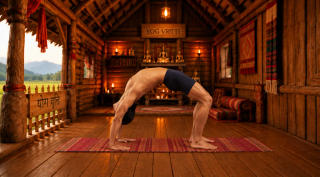
Chakra Padasana, a foundational supine hip mobilizer, brings a unique blend of core engagement and hip freedom, deeply rooted in the Iyengar tradition of precise action. It systematically rotates the leg within the hip socket, engaging the deep abdominal muscles (core stabilizers) while releasing tension in the often-tight hip flexors and rotators.
Muscles
- Deep Abdominal Musclesstrengthens
- Hip Flexorsmobilises
- Deep Hip Rotatorsstretches
- Quadricepsstabilises
Joints
- Hip Jointmobilises
- Sacroiliac Jointstabilises
Inside the body
- Digestive Organs (Intestines)
- Circulatory System (Lower Body)
- Breathing
Mind
Chakra Padasana demands a sustained, unwavering focus on the subtle internal movements of the hip and the rhythm of the breath, serving as a powerful exercise in concentration (dharana).
Take care
Teachers, please guide students with recent abdominal surgery or hip injuries to approach Chakra Padasana with extreme caution, or to modify significantly, perhaps starting with smaller circles or keeping the knee bent.
Any sharp pain in the lower back or hip is a clear signal to reduce the range of motion or stop the practice immediately, as forcing movement can exacerbate existing conditions or create new imbalances. The emphasis must always be on mindful, pain-free exploration rather than pushing to the edge of sensation.
Muscles
Deep Abdominal Muscles
StrengthensTransversus Abdominis, Internal Obliques
These deepest abdominal muscles, wrapping around your waist like a natural corset (transversus abdominis, internal obliques), are the silent anchors in Chakra Padasana.
Read moreShow less
As you slowly circle the leg, they engage subtly but profoundly to stabilize the pelvis and lower back, preventing unwanted rocking and protecting the lumbar spine.
This deep, isometric engagement cultivates an inner strength (agni) that supports the spine and allows for uninhibited movement in the hip joint, fostering a sense of centeredness and control from your very core.
Hip Flexors
MobilisesIliopsoas, Rectus Femoris
The primary hip flexor, deep within your pelvis (iliopsoas), is dynamically engaged and released here, depending on the phase of the leg circle.
Read moreShow less
On the circling leg, it gently contracts to lift and guide the leg, while on the stationary leg, it finds a subtle release as the pelvis remains grounded.
This dynamic interplay helps to free up this often-tight muscle, improving the flow of prana through the pelvic bowl and alleviating stiffness that can contribute to lower back discomfort and restricted movement.
Deep Hip Rotators
StretchesPiriformis, Gemelli, Obturators, Quadratus Femoris
These small but mighty muscles nestled deep in your buttocks (piriformis, gemelli, obturators, quadratus femoris) are gently massaged and mobilized as the leg rotates within the hip socket.
Read moreShow less
The controlled circular motion encourages a release of habitual tension often held in this region, which can restrict movement and even contribute to sciatic nerve discomfort.
This careful articulation brings a sense of spaciousness and freedom to the hip, allowing for a smoother flow of apana vayu and greater ease in daily movements like walking and sitting.
Quadriceps
StabilisesRectus Femoris, Vastus Lateralis, Vastus Medialis, Vastus Intermedius
The muscles on the front of your thigh (quadriceps) play a crucial role in maintaining the extension or controlled bend of the knee as the leg circles.
Read moreShow less
They engage isometrically to support the leg's weight and prevent excessive flexion or hyperextension of the knee joint.
This subtle engagement builds endurance in the thigh muscles, enhancing stability in the lower limb and contributing to a feeling of grounded strength and controlled movement, which is essential for precise action in all asanas.
Joints
Hip Joint
MobilisesThe hip joint, where your thigh bone meets your pelvis (acetabulofemoral joint), is the star of Chakra Padasana.
Read moreShow less
The controlled circular motion gently lubricates the joint capsule and encourages the synovial fluid to nourish the articular cartilage, improving its health and full range of motion.
Practitioners experience a profound sense of release and increased fluidity in the hips, translating into greater ease in all movements and a feeling of unburdened lightness in the lower body over time, enhancing overall mobility.
Sacroiliac (SI) Joint
StabilisesWhile not directly moving, the sacroiliac joint, connecting your sacrum to your pelvis, benefits immensely from the core engagement and pelvic stability cultivated in this pose.
Read moreShow less
The active engagement of the deep abdominal muscles creates a stabilizing force across the pelvis, preventing unwanted shearing or torsion in the SI joint.
This foundational stability helps to alleviate discomfort in the lower back and promotes a sense of structural integrity throughout the pelvic girdle, fostering a balanced energetic base for the spine.
Inside the body
Digestive Organs (Intestines)
The gentle, rhythmic engagement of the deep core muscles during Chakra Padasana provides a subtle internal massage to the abdominal organs, particularly the intestines.
Read moreShow less
This mild compression and release can stimulate peristalsis, the natural wave-like contractions that move food through the digestive tract, aiding in healthy elimination and reducing stagnation.
From a yogic perspective, this action helps to balance samana vayu, the energy responsible for assimilation, promoting a feeling of inner warmth and digestive ease.
Circulatory System (Lower Body)
The continuous, controlled movement of the leg in circles, especially when done slowly and mindfully, acts like a gentle pump for the venous return in the lower limbs.
Read moreShow less
This encourages fresh, oxygenated blood to flow into the hip and leg tissues while helping to move stagnant blood and lymphatic fluid away from the extremities.
Practitioners often feel a warming sensation and a reduction in leg fatigue, signifying improved prana flow and vital circulation to the lower body, supporting overall vitality and reducing swelling.
Breathing
In the supine position of Chakra Padasana, the diaphragm has optimal space to move, naturally encouraging deeper, more expansive abdominal breathing (diaphragmatic breathing) without the constraint of gravity.
Read moreShow less
The slow, rhythmic movement of the leg helps to synchronize breath with motion, fostering a steady, even flow of inhalation and exhalation, creating a meditative quality.
This conscious, deep breathing not only calms the nervous system but also purifies the nadis (energy channels), preparing the practitioner for more advanced pranayama practices like Ujjayi, where the breath becomes a continuous, meditative wave.
Fascia (connective tissue)
The intricate web of connective tissue (fascia) that envelops muscles, bones, and organs throughout the body receives profound attention in Chakra Padasana.
Read moreShow less
The slow, circular motion of the leg, meticulously guided by core control, creates a gentle shearing and stretching action through the fascial layers surrounding the hip joint, lower back, and deep abdominal wall.
This systematic release helps to untangle adhesions and improve the glide between fascial planes, enhancing the flow of prana and releasing long-held patterns of physical and energetic restriction in the pelvic girdle and lumbar region.
Mind and nervous system
- Nervous system
The slow, deliberate, and rhythmic circling of the leg in a supine position naturally invites a profound sense of calm and groundedness, drawing awareness inward.
Read moreShow less
This focused, repetitive motion acts as a moving meditation, gradually quieting the restless fluctuations of the mind (chitta vritti) and reducing sympathetic nervous system arousal.
The practitioner feels a release of subtle anxieties and a deeper connection to their physical body, fostering a state of relaxed alertness and inner peace.
By moving with precision and breath awareness, the proprioceptors in the hip joint and surrounding muscles are highly stimulated, sending detailed feedback to the brain about the body's position in space.
Read moreShow less
This heightened sensory input enhances body map awareness, improving coordination and motor control, which translates to greater confidence in movement both on and off the mat.
This deep internal sensing cultivates pratyahara, the withdrawal of the senses, allowing for profound self-observation and a refined sense of bodily intelligence.
- Mind & mood
Chakra Padasana demands a sustained, unwavering focus on the subtle internal movements of the hip and the rhythm of the breath, serving as a powerful exercise in concentration (dharana).
Read moreShow less
The mind is drawn away from external distractions and into the immediate experience of the body, cultivating a profound sense of presence and mental clarity.
This practice builds mental discipline and the capacity to observe internal sensations without judgment, a valuable skill for navigating daily life with greater equanimity and mindfulness.
The meticulous, unhurried execution of each circle cultivates patience and a deep respect for the body's current limitations and capabilities.
Read moreShow less
There's no room for rushing or forcing; instead, one learns to work with gentle persistence, allowing changes to unfold organically over time.
This fosters a resilient and compassionate attitude towards oneself, recognizing that mastery comes through consistent, mindful effort rather than aggressive striving, translating into greater self-acceptance and inner peace.
Because it is a hip opener pose
Being supine means the body is fully supported by the ground, allowing for a complete release of gravitational pull on the spine and joints.
Read moreShow less
This reduces compressive forces, enabling the deep core muscles and those surrounding the hips to engage more effectively without the added challenge of maintaining an upright posture.
This grounding contact with the earth promotes a deep sense of security and stability (sthira), inviting the nervous system to relax and the body to surrender more fully into the movement, fostering profound relaxation.
As a hip opener and mobilizer, Chakra Padasana systematically moves the head of the thigh bone within the hip socket through its full range of circumduction, both internal and external rotation.
Read moreShow less
This action targets the complex network of muscles, ligaments, and fascia surrounding the hip, gently increasing their elasticity, strength, and overall functional range.
From a yogic perspective, opening the hips helps to release stored emotional tension and blockages in the apana vayu region, fostering greater freedom, fluidity, and energetic flow in the pelvic bowl.