Benefits· लाभ
What Wheel Pose does for you
चक्रासन
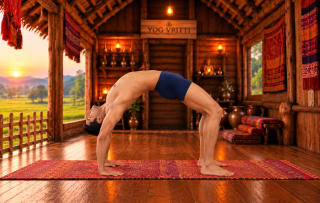
Chakrasana, the Wheel Pose, is a profound backbend that meticulously lengthens the entire front body while dynamically strengthening the posterior chain. It specifically targets the deep hip flexors, abdominal wall, and pectoral muscles for release, simultaneously engaging the spinal extensors, glutes, and triceps for powerful support.
Muscles
- Spinal Erectorsstrengthens
- Glutesstrengthens
- Shoulder Stabilizersstrengthens
- Deep Hip Flexorsstretches
- Abdominalsstabilises
Joints
- Spinemobilises
- Shoulder Girdlemobilises
- Hip Jointmobilises
- Wrist Jointstabilises
Inside the body
- Lungs
- Heart
- Abdominal Organs
- Breathing
Mind
Chakrasana is a potent posture for cultivating courage and confidence, as it requires a significant leap of faith and a willingness to move beyond perceived limitations.
Take care
A teacher must always approach Chakrasana with careful observation and preparation, especially regarding the wrists, neck, and lower back.
Ensure students have sufficient shoulder and wrist flexibility and strength to avoid compression, and guide them to lift from the hips and chest rather than collapsing into the lower back or straining the neck. Listen intently to any student reporting sharp pain, especially in the joints, and offer modifications or alternative poses if needed to protect their delicate structures.
Muscles
Spinal Erectors
StrengthensErector Spinae, Transversospinalis group
These deep muscles run along either side of your spine, from your tailbone all the way up to your neck.
Read moreShow less
In Wheel Pose, they work intensely to extend and lift the spine against gravity, creating the beautiful arch of the back.
This sustained isometric contraction builds remarkable strength and endurance in the core of your being, translating into a feeling of unwavering support and vitality in your everyday upright posture.
Glutes
StrengthensGluteus Maximus
The large muscles of your buttocks, the glutes, are powerful engines for hip extension in Chakrasana.
Read moreShow less
By actively engaging them, you create an upward thrust, lifting the pelvis higher and deepening the backbend from the foundation of your lower body.
This action not only strengthens the glutes but also grounds your effort, allowing a stable and powerful ascent into the pose, connecting you to a sense of rooted strength and upward energy.
Shoulder Stabilizers
StrengthensRotator Cuff muscles (Supraspinatus, Infraspinatus, Teres Minor, Subscapularis), Serratus Anterior
These smaller, crucial muscles around your shoulder blades and joint work diligently to stabilize the shoulder in its elevated and externally rotated position.
Read moreShow less
The Serratus Anterior, in particular, protracts the scapula, helping to lift the chest and create space, preventing compression in the neck and upper back.
This intelligent engagement fosters a sense of lightness and freedom in the shoulder girdle, allowing the heart to open without strain.
Deep Hip Flexors
StretchesPsoas Major, Iliacus (Iliopsoas)
The psoas muscle, a deep core muscle connecting your lower spine to your inner thigh, is significantly lengthened in this posture.
Read moreShow less
Often tight from prolonged sitting, this muscle's release allows the pelvis to tilt anteriorly, deepening the lumbar curve and opening the front of the hips.
This deep unwinding can release stored emotional tension, fostering a sense of freedom and spaciousness in the core of the body, allowing prana to flow more freely.
Abdominals
StabilisesStretchesRectus Abdominis, Obliques
While typically associated with flexion, the abdominal muscles are eccentrically lengthened in Chakrasana, meaning they stretch under tension.
Read moreShow less
This controlled lengthening across the entire front of the torso creates immense space in the abdominal cavity, rather than just passively stretching.
This active expansion of the front body stimulates the internal organs and allows for a fuller, more expansive breath, contributing to a feeling of openness and energetic upliftment.
Triceps
StrengthensTriceps Brachii
The triceps, located on the back of your upper arms, are instrumental in extending the elbows and pressing your hands firmly into the floor.
Read moreShow less
This powerful engagement creates the necessary leverage to lift the body off the ground, forming a strong foundation for the pose.
By actively straightening the arms, you create stability and lift, translating into a feeling of grounded power and a sustained upward thrust throughout the posture.
Joints
Spine
MobilisesThe entire vertebral column undergoes a profound extension in Chakrasana, mobilizing each segment of the spine into a graceful arch.
Read moreShow less
This movement helps to decompress the intervertebral discs, particularly in the thoracic and lumbar regions, by creating space between the vertebrae.
Regular practice enhances spinal flexibility and resilience, often alleviating stiffness and fostering a feeling of lightness and fluidity along the central axis of the body.
Shoulder Girdle
MobilisesStabilisesThe shoulder joints experience significant flexion and external rotation, opening the chest and creating space across the collarbones.
Read moreShow less
While opening, the surrounding muscles must actively stabilize the shoulder blades against the back, preventing impingement.
This dual action improves range of motion and strengthens the often-neglected muscles that support the shoulders, releasing chronic tension and cultivating a sense of openness and ease in the upper body and heart center.
Hip Joint
MobilisesThe hip joints move into deep extension, a crucial counter-movement to our predominantly seated modern lifestyle.
Read moreShow less
This action stretches the front of the hip capsule and lengthens the hip flexor muscles, which are often chronically tight.
Regular mobilization in this plane can improve pelvic alignment and reduce lower back strain, leading to a greater sense of freedom and unburdening in the lower body, allowing for a more harmonious flow of apana vayu.
Wrist Joint
StabilisesThe wrist joints bear significant weight in Chakrasana, requiring strength and flexibility in extension.
Read moreShow less
The hands are placed firmly on the mat, fingers pointing towards the shoulders, which mobilizes the carpal bones and stretches the flexor tendons.
This weight-bearing action, when performed mindfully, strengthens the bones and connective tissues of the wrists, fostering a sense of groundedness and stability in the foundation of the pose and improving overall hand and wrist health.
Inside the body
Lungs
In Chakrasana, the significant expansion of the rib cage and the stretching of the intercostal muscles create vast space for the lungs.
Read moreShow less
This allows for deeper, more expansive inhalations, increasing vital lung capacity and promoting efficient oxygen exchange.
The increased space and breath capacity lead to a feeling of invigoration and heightened prana, deeply nourishing every cell in the body and uplifting the spirit.
Heart
The heart, positioned in the expanded chest cavity and gently inverted, receives a fresh surge of blood flow, enhancing circulation without undue strain.
Read moreShow less
This mild inversion combined with the heart-opening action can stimulate the cardiovascular system in a gentle yet profound way.
Practitioners often report a feeling of emotional release and openness in the heart center, fostering compassion and reducing mental constriction.
Abdominal Organs
The deep stretch across the entire front of the abdomen gently massages and stimulates the internal digestive organs.
Read moreShow less
This lengthening can encourage peristalsis and improve circulation to the digestive tract, aiding in nutrient absorption and waste elimination.
The internal stimulation contributes to a sense of internal cleansing and revitalization, supporting overall digestive health and energetic balance within the manipura chakra.
Breathing
In Chakrasana, the expansive opening of the chest and the deep stretch of the abdominal wall naturally invite a profound diaphragmatic and thoracic breath.
Read moreShow less
The posture's shape encourages deeper inhalations, allowing the lungs to fill completely and the diaphragm to descend fully.
This deep, uninhibited breath invigorates the entire system, enhancing the flow of prana and cultivating a sense of inner spaciousness and calm even within this challenging asana.
It is an excellent pose to explore Ujjayi breath, using its regulating quality to steady the mind and body.
Fascia (connective tissue)
Chakrasana profoundly stretches the entire Superficial Front Line of fascia, from the tops of the feet, up the shins, across the quadriceps, abdominals, chest, and arms, all the way to the hands.
Read moreShow less
It also engages and lengthens parts of the Deep Front Line, particularly around the psoas and inner thighs.
This comprehensive fascial release helps to unwind long-held patterns of tension and stiffness, allowing for greater fluidity of movement and an uninhibited flow of prana through these energetic channels, fostering a feeling of profound liberation.
Mind and nervous system
- Nervous system
Chakrasana, as a deep backbend, powerfully stimulates the sympathetic nervous system, leading to an immediate feeling of alertness, energy, and even exhilaration.
Read moreShow less
This initial activation is followed by a profound sense of calm and release as the nervous system rebalances after the effort, often tapping into parasympathetic responses.
The conscious engagement and release within the pose helps to regulate the 'fight or flight' response, fostering resilience and a deeper connection to one's inner strength.
The expansive nature of the pose, particularly the open chest and diaphragm, directly influences the breath, encouraging deeper and fuller inhalations.
Read moreShow less
This increased oxygen intake invigorates the brain and nervous system, combating fatigue and mental dullness.
By bringing conscious awareness to the breath within the challenging shape, practitioners learn to manage sensations and cultivate a steady mind (chitta vritti nirodha), fostering clarity and presence.
- Mind & mood
Chakrasana is a potent posture for cultivating courage and confidence, as it requires a significant leap of faith and a willingness to move beyond perceived limitations.
Read moreShow less
The act of lifting the body into such an open and vulnerable position challenges the mind's habitual fears and self-doubt.
Successfully entering and holding the pose builds immense self-trust and mental fortitude, helping practitioners to face life's challenges with greater resilience and an open heart.
This deep backbend encourages a profound shift in perspective, both physically and psychologically.
Read moreShow less
By literally turning the world upside down and opening the front of the body, it can release deeply held emotional patterns and anxieties often stored in the chest and hips.
This energetic release allows for a greater sense of emotional freedom and expansion, fostering joy and a more optimistic outlook on life, aligning with the yogic principle of 'sukha' or ease.
The intense focus required to align and sustain Chakrasana naturally draws the mind inward, facilitating a state of deep concentration (dharana).
Read moreShow less
The challenge of the pose demands full presence, effectively quieting mental chatter and distractions.
This cultivated awareness in the face of intensity is a powerful tool for developing mindfulness, allowing teachers to guide students to find stillness amidst effort, and students to experience a profound sense of 'being' in the present moment.
Because it is a backbend pose
Backbends like Chakrasana are incredible for lengthening the entire anterior (front) chain of the body, including the hip flexors, abdominals, and pectorals, which often become shortened from daily activities.
Read moreShow less
Simultaneously, they powerfully strengthen the posterior (back) chain, particularly the spinal extensors and glutes, creating a balanced and resilient spine.
This dual action restores postural integrity and counteracts the effects of gravity, promoting an upright and confident physical presence.
Energetically, backbends are considered highly uplifting and heart-opening, stimulating the anahata chakra and fostering a sense of joy, compassion, and courage.
Read moreShow less
The expansive nature of the pose helps to release emotional blockages and fear, encouraging a more open and receptive state of being.
This energetic activation brings a profound sense of vitality and enthusiasm, inspiring practitioners to live more fully and authentically.
The unique shape of Chakrasana places the spine in full extension, challenging its flexibility and mobility in a safe, supported manner when approached correctly.
Read moreShow less
This mobilization helps to maintain the natural curves of the spine and improves the health of the intervertebral discs by promoting fluid exchange.
The increased spinal flexibility translates into a feeling of youthful agility and a greater capacity for movement in all directions, enhancing overall body awareness.