Benefits· लाभ
What Elephant Trunk Pose does for you
Dwi Hasta Bhujasana · द्वि हस्त भुजासन
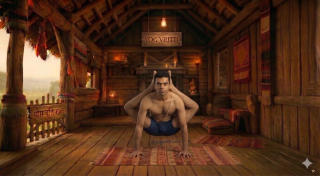
Dwi Hasta Bhujasana, or Elephant Trunk Pose, is a powerful seated arm balance that profoundly cultivates full-body strength and integrated awareness. It demands deep engagement of the core and hip flexors to lift the legs, while simultaneously requiring significant strength and stability from the shoulders and wrists to support the body's weight.
Muscles
- Core Abdominalsstrengthens
- Hip Flexorsstrengthens
- Shoulder Stabilizersstrengthens
- Tricepsstrengthens
- Forearm and Wrist Stabilizersstrengthens
Joints
- Shoulder Jointstabilises
- Elbow Jointstabilises
- Wrist Jointstabilises
- Hip Jointmobilises
- Spinedecompressing
Inside the body
- Abdominal Organs
- Kidneys and Adrenals
- Breathing
Mind
Dwi Hasta Bhujasana requires unwavering concentration and mental resolve to maintain balance and strength throughout the hold.
Take care
Teachers should advise students with existing wrist or shoulder injuries to approach Dwi Hasta Bhujasana with extreme caution, or to avoid it entirely.
The significant weight-bearing on the hands and the intense shoulder stabilization required can easily exacerbate existing conditions. It's crucial to ensure students have developed foundational wrist and shoulder strength from preparatory poses before attempting this posture, always prioritizing proper alignment and pain-free movement over depth.
Muscles
Core Abdominals
StrengthensRectus Abdominis, Obliques, Transverse Abdominis
The deep muscles along the front and sides of your torso (rectus abdominis, obliques, and transverse abdominis) are intensely engaged, drawing the abdominal wall inward and upward.
Read moreShow less
This co-contraction stabilizes the pelvis and lumbar spine, creating the necessary lift to bring the legs off the floor and into the chest.
This profound engagement cultivates inner fire (agni), enhancing digestive function and fostering a sense of centered power and stability in the body's core.
Hip Flexors
StrengthensIliopsoas (Psoas Major, Iliacus), Rectus Femoris
The powerful muscles connecting your spine and pelvis to your thigh bone (iliopsoas) and the quadriceps muscle running down the front of your thigh (rectus femoris) are concentrically contracting to lift the legs.
Read moreShow less
This action brings the knees towards the chest, demanding significant strength in the anterior hip chain.
Building this strength helps to release chronic stiffness in the hip flexors often associated with prolonged sitting, creating a feeling of lightness and freedom in the lower body.
Shoulder Stabilizers
StrengthensDeltoids, Rotator Cuff (Supraspinatus, Infraspinatus, Teres Minor, Subscapularis)
The muscles surrounding your shoulder joint, including the large deltoids and the deeper rotator cuff group, work synergistically to stabilize the shoulder girdle as you press down through your hands.
Read moreShow less
They create a broad, firm foundation, allowing the torso to lift and the legs to be supported.
This continuous engagement strengthens the entire shoulder complex, improving upper body posture and cultivating a sense of empowered support and openness through the chest.
Triceps
StrengthensTriceps Brachii
The large muscle on the back of your upper arm (triceps brachii) is crucial for extending the elbows and maintaining a strong, locked-out position against the ground.
Read moreShow less
It works isometrically to resist the body's weight, preventing the elbows from collapsing and providing a stable platform.
This sustained effort builds significant arm strength and endurance, fostering a sense of unwavering support and steady resolve throughout the posture.
Forearm and Wrist Stabilizers
StrengthensFlexors and Extensors of the Wrist and Fingers
The intricate network of muscles in your forearms and hands, encompassing both the flexors and extensors of the wrist and fingers, are highly active in gripping the floor and stabilizing the wrist joint.
Read moreShow less
They work to distribute weight evenly across the palms, protecting the delicate carpal structures from undue strain.
This consistent pressure and engagement significantly strengthen the wrists and forearms, improving grip strength and cultivating a deep sense of rootedness and connection to the earth through the hands.
Joints
Shoulder Joint
StabilisesThe ball-and-socket joint of your shoulder (glenohumeral joint) is powerfully stabilized as the arm bones (humeri) are pressed firmly into their sockets.
Read moreShow less
The surrounding muscles co-contract to maintain the integrity of the joint under the body's weight, preventing unwanted movement.
This action builds deep stability within the joint capsule, fostering a sense of secure foundation in the upper body and enhancing overall shoulder health.
Elbow Joint
StabilisesThe hinge joint of your elbow (humeroulnar and humeroradial joints) is held in a strong, extended position, resisting the tendency to buckle under the body's weight.
Read moreShow less
The triceps brachii muscle works continuously to maintain this extension, creating a rigid lever for support.
This isometric engagement strengthens the musculature surrounding the elbow, protecting the joint and fostering an unwavering sense of support from the ground up.
Wrist Joint
StabilisesYour wrist joints (radiocarpal joints) bear significant body weight, requiring strong engagement from the forearm muscles to maintain a neutral or slightly extended position.
Read moreShow less
While the carpal bones are compressed, the even distribution of pressure through the entire palm helps to protect these delicate structures.
This continuous weight-bearing strengthens the ligaments and muscles around the wrist, enhancing stability and preparing them for more complex arm balances.
Hip Joint
MobilisesThe hip joint (acetabulofemoral joint) undergoes profound flexion as the thighs are lifted towards the torso, drawing the head of the thigh bone (femur) deeper into the hip socket (acetabulum).
Read moreShow less
This active range of motion strengthens the hip flexor muscles while simultaneously improving mobility within the joint capsule.
The sensation is one of powerful engagement that ultimately releases stiffness, leading to greater freedom and lightness in the lower body.
Spine
DecompressingThough seated, the spine is actively lengthened in Dwi Hasta Bhujasana, lifting away from the pelvis through the strong engagement of the core muscles and an upward thrust of the crown of the head.
Read moreShow less
This action creates a subtle but effective decompression between the individual vertebrae, creating space between the intervertebral discs.
This cultivation of a tall, unencumbered spine allows for the free flow of prana, fostering a sense of inner spaciousness and alertness.
Inside the body
Abdominal Organs
The intense engagement of the core muscles in Dwi Hasta Bhujasana creates a gentle but firm internal compression of the abdominal organs, including the stomach, intestines, and liver.
Read moreShow less
This internal massage stimulates peristalsis, aiding digestion and elimination, and encourages fresh blood flow to these vital areas upon release.
From a yogic perspective, this action effectively stokes the digestive fire (agni), enhancing metabolism and purifying the internal system.
Kidneys and Adrenals
The consistent abdominal engagement and the slight forward tilt of the torso can create a subtle, stimulating pressure around the kidney area in the lower back.
Read moreShow less
This gentle compression and subsequent release promotes circulation to these vital organs, supporting their detoxifying functions and overall health.
Energetically, this can help to balance the adrenal glands, fostering a sense of calm strength and resilience against stress.
Breathing
In Dwi Hasta Bhujasana, the strong abdominal engagement naturally restricts the full downward excursion of the diaphragm, encouraging a more refined and subtle breath.
Read moreShow less
The focus shifts towards a horizontal expansion of the rib cage and a gentle lift of the sternum, rather than deep belly breathing.
This requires conscious control, inviting a Ujjayi breath that is steady, measured, and quiet, helping to sustain the effort without strain.
This precise breath control (pranayama) calms the nervous system, allowing the practitioner to remain present and focused even in challenging moments, cultivating inner stillness amidst physical intensity.
Fascia (connective tissue)
The intricate fascial web, a continuous matrix of connective tissue that wraps and connects everything in the body, is profoundly engaged and toned in Dwi Hasta Bhujasana.
Read moreShow less
Specifically, the deep front line, running from the inner thighs, through the hip flexors, and into the core, is intensely activated and strengthened.
Simultaneously, the superficial back line, particularly the spinal erectors and hamstrings, is lengthened and extended, creating a balanced tension.
This coordinated action helps to realign the body's tensegrity system, improving posture and creating a sense of integrated strength and fluidity.
Regular practice helps to release restrictions in these lines, promoting freer movement and a more fluid energetic flow (prana).
Mind and nervous system
- Nervous system
The initial effort to lift and hold the body in Dwi Hasta Bhujasana can momentarily activate the sympathetic nervous system, building heat and sharp focus.
Read moreShow less
However, the sustained hold, coupled with a steady, controlled breath, gradually coaxes the system towards a state of balanced alertness, integrating strength with calm.
This process teaches the practitioner to find stillness and presence even within a challenging physical demand, cultivating deep inner fortitude and equanimity.
This pose demands intense proprioception, the body's awareness of its position in space, and kinesthetic awareness, the perception of effort and movement.
Read moreShow less
The brain receives constant feedback from the joints and muscles, refining the body's internal map and enhancing coordination.
This heightened self-awareness helps to quiet the fluctuations of the mind (chitta vritti), drawing attention inwards and fostering a state of deep meditative focus (dharana).
- Mind & mood
Dwi Hasta Bhujasana requires unwavering concentration and mental resolve to maintain balance and strength throughout the hold.
Read moreShow less
The mind must be fully present to coordinate the multiple actions of pressing down, lifting up, and extending.
This intense focus acts as a powerful tool for pratyahara, withdrawing the senses from external distractions and anchoring awareness firmly in the present moment and the internal experience of the pose.
Successfully holding this challenging posture fosters a profound sense of accomplishment and inner power, cultivating mental resilience.
Read moreShow less
Overcoming the physical demands of the pose translates into a stronger mindset, teaching the practitioner to approach difficulties with courage and determination.
This experience builds self-belief and a quiet confidence, demonstrating one's capacity to meet challenges head-on, both on and off the mat.
Because it is a balance pose
Balance poses, even seated ones like Dwi Hasta Bhujasana, demand intricate coordination between the muscular and nervous systems, challenging our center of gravity.
Read moreShow less
They require constant micro-adjustments to maintain stability, which refines proprioception—our body's internal sense of position.
This leads to enhanced overall coordination and agility, improving movement patterns in daily life.
Beyond the physical, cultivating balance in a demanding pose fosters mental equilibrium and emotional steadiness.
Read moreShow less
When we learn to find our center amidst physical challenge, we train the mind to remain calm and focused when faced with life's inevitable fluctuations.
This deepens our capacity for inner peace (santosha) and equanimity, teaching us to trust our inner resources.