Benefits· लाभ
What Flying Pigeon Pose does for you
Eka Pada Galavasana · एक पाद गालवासन
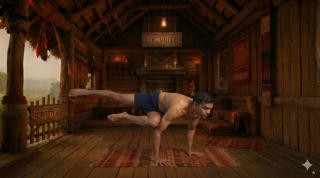
Eka Pada Galavasana, or Flying Pigeon Pose, is an advanced arm balance that profoundly integrates full-body strength, flexibility, and unwavering mental focus. It demands significant engagement from the core stabilizers and shoulder girdle, while simultaneously cultivating deep external rotation in the hip of the bent leg.
Muscles
- Core Musclesstrengthens
- Shoulder Stabilizersstrengthens
- Wrist and Forearm Flexorsstrengthens
- Hip External Rotatorsstretches
- Gluteal Musclesstrengthens
Joints
- Hip Jointmobilises
- Shoulder Jointstabilises
- Wrist Jointstabilises
- Spinal Columnstabilises
Inside the body
- Abdominal Organs
- Kidneys and Adrenal Glands
- Breathing
Mind
Eka Pada Galavasana demands an extraordinary level of mental fortitude and single-pointed concentration (dharana).
Take care
Teachers should approach this pose with careful observation, especially for students with any wrist or shoulder vulnerabilities.
Ensure students have sufficient core strength and hip mobility before attempting, as forcing the pose can strain the delicate wrist joints or exacerbate existing shoulder issues. Always prioritize proper alignment and stability over depth, encouraging students to listen to their bodies and respect their current limitations to prevent injury.
Muscles
Core Muscles
StrengthensTransversus Abdominis, Obliques, Rectus Abdominis, Multifidus
These deep and superficial abdominal muscles wrap around your midsection, acting as your body's natural corset.
Read moreShow less
In Eka Pada Galavasana, they strongly contract to lift your hips and legs off the ground, stabilizing your spine and pelvis against gravity.
This intense engagement builds inner power, connecting you to your core vitality and a sense of centeredness (Manipura Chakra).
Shoulder Stabilizers
StrengthensSerratus Anterior, Pectoralis Minor, Rhomboids, Trapezius
These muscles anchor your shoulder blades to your rib cage and spine, providing a stable platform for your arms.
Read moreShow less
In this pose, the serratus anterior protracts and upwardly rotates the scapulae, preventing winging, while the pectoralis minor depresses them.
This creates the broadness and lift across the upper back, allowing prana to flow freely, preventing compression and fostering a feeling of spaciousness and strength in the chest.
Wrist and Forearm Flexors
StrengthensFlexor Carpi Radialis, Flexor Carpi Ulnaris, Palmaris Longus, Flexor Digitorum Superficialis/Profundus
Located on the underside of your forearms, these muscles are crucial for gripping and stabilizing your hands.
Read moreShow less
They work eccentrically to control the wrist extension as you bear weight through your palms, protecting the wrist joint.
Strengthening these muscles builds resilience not only in the physical structure but also instills a sense of unwavering support and groundedness, allowing energy to flow from the earth up through the arms.
Hip External Rotators
StretchesPiriformis, Gemelli (superior/inferior), Obturators (internus/externus), Quadratus Femoris
These deep muscles are nestled beneath your glutes, responsible for turning your thigh bone outward.
Read moreShow less
In Eka Pada Galavasana, they are deeply engaged in the bent leg to facilitate the external rotation and abduction of the hip, allowing the ankle to hook over the opposite arm.
This sustained action creates a profound opening in the hip joint, releasing tension and emotional holding often stored in this region, thus freeing apana vayu for a greater sense of ease.
Gluteal Muscles
StrengthensGluteus Maximus, Gluteus Medius, Gluteus Minimus
The gluteus maximus, the largest muscle in your buttocks, extends and externally rotates the hip, particularly active in the extended leg to keep it lifted and engaged.
Read moreShow less
The gluteus medius and minimus, located on the sides, stabilize the pelvis.
Together, these muscles provide powerful support for the legs, contributing to the lift and stability of the entire lower body, which translates to a feeling of rooted strength and confidence in the posture.
Triceps Brachii
StrengthensTriceps Brachii
This large muscle on the back of your upper arm is responsible for extending your elbow.
Read moreShow less
In Eka Pada Galavasana, the triceps work powerfully to keep your arms straight and strong, resisting the downward pull of gravity as you lift your body.
This sustained isometric contraction builds unwavering arm strength, a physical manifestation of inner resolve and the capacity to support oneself with stability and grace.
Joints
Hip Joint
MobilisesThis ball-and-socket joint connects your leg to your pelvis.
Read moreShow less
In this pose, the hip of the bent leg undergoes significant external rotation and flexion, while the extended leg's hip is in extension and slight abduction.
This action mobilizes the joint capsule, enhancing the range of motion and releasing stiffness.
The deeper opening allows for a freer flow of energy through the pelvic region, often associated with releasing emotional blockages and improving overall mobility for daily life.
Shoulder Joint
StabilisesThe shoulder joint, where your arm bone (humerus) meets your shoulder blade (scapula), is crucial for supporting your body weight.
Read moreShow less
Here, it is held in a position of strong adduction and internal rotation relative to the torso, stabilized by the surrounding musculature.
This posture demands active stabilization, strengthening the rotator cuff and surrounding muscles, which in turn improves overall shoulder integrity and awareness, fostering a sense of resilience and stability in the upper body.
Wrist Joint
StabilisesThe wrist joint, connecting your forearm bones (radius and ulna) to your hand bones (carpals), bears significant weight in Eka Pada Galavasana.
Read moreShow less
It is held in a position of extension, with the body's weight distributed evenly across the palms.
This pose strengthens the muscles and connective tissues around the joint, enhancing its stability and resilience, while teaching the practitioner how to root deeply and consciously through the hands, cultivating a sense of unwavering support.
Spinal Column
StabilisesYour spine, the central axis of your body, is maintained in a lengthened, neutral position in this arm balance, resisting flexion or excessive arching.
Read moreShow less
The deep core muscles stabilize each vertebra, promoting optimal alignment and creating space between the discs.
This active engagement strengthens the postural muscles, fostering a sense of uprightness and inner poise, which translates to improved posture and a feeling of lightness and ease throughout the entire torso.
Inside the body
Abdominal Organs
During Eka Pada Galavasana, the deep engagement of the core muscles creates a gentle compression and massage for the abdominal organs.
Read moreShow less
This internal pressure helps to stimulate peristalsis and improve circulation within the digestive system.
The fresh blood flow invigorates these organs, supporting their natural functions and contributing to a feeling of inner cleansing and vitality, aligning with the yogic principle of Agni (digestive fire).
Kidneys and Adrenal Glands
Positioned on either side of your spine, the kidneys and adrenal glands receive a gentle stimulation from the deep core engagement and subtle internal lift of the pose.
Read moreShow less
This action can enhance blood flow to these vital organs, supporting their roles in detoxification and hormone regulation.
Energetically, this strengthens the root and sacral chakras, fostering a sense of groundedness, stability, and resilience against stress.
Breathing
In Eka Pada Galavasana, the engaged core and compressed abdomen naturally encourage a more diaphragmatic and controlled breath.
Read moreShow less
The challenge of the pose demands a conscious lengthening of both inhalation and exhalation, preventing shallow, panicked breathing.
This deep, steady Ujjayi breath not only stabilizes the physical body but also calms the nervous system, allowing the practitioner to maintain focus and poise.
The rhythmic flow of prana through controlled breathing becomes an anchor, transforming a difficult posture into a moving meditation and enhancing the overall energetic experience.
Fascia (connective tissue)
The intricate web of connective tissue, or fascia, that encases every muscle, organ, and bone, plays a crucial role in Eka Pada Galavasana.
Read moreShow less
This pose creates a lengthening and release through the superficial back line of the extended leg and the spiral lines wrapping around the bent leg's hip.
Concurrently, it strengthens the deep front line and arm lines, particularly around the core and shoulder girdle.
This integrated action helps to unwind long-held fascial restrictions, improving fluidity of movement and allowing prana to flow more freely through the body's energetic channels, restoring a sense of lightness and interconnectedness.
Mind and nervous system
- Nervous system
Achieving and holding Eka Pada Galavasana demands intense concentration, which naturally draws the mind inward, away from external distractions.
Read moreShow less
This focused attention activates the parasympathetic nervous system, promoting a state of calm alertness rather than fight-or-flight, allowing the practitioner to experience a profound sense of presence and mental quietude.
The controlled breathing required to maintain this challenging balance helps to regulate the nervous system, transforming potential anxiety into a steady, unwavering focus.
Read moreShow less
As the breath becomes smooth and even, the fluctuations of the mind (chitta vritti) begin to subside, leading to a deeper state of inner peace and mental clarity.
The act of balancing on the hands while lifting the body requires significant proprioceptive feedback, constantly informing the brain about body position in space.
Read moreShow less
This heightened sensory input refines neural pathways, improving coordination and body awareness, which in turn cultivates a more integrated and harmonious connection between mind and body, enhancing overall nervous system regulation.
- Mind & mood
Eka Pada Galavasana demands an extraordinary level of mental fortitude and single-pointed concentration (dharana).
Read moreShow less
The challenge of lifting the entire body into balance compels the mind to be fully present, drawing awareness away from external thoughts and into the immediate experience of the pose.
This practice cultivates mental discipline and the ability to focus amidst difficulty, which is invaluable both on and off the mat.
Mastering an advanced arm balance like Flying Pigeon builds immense self-confidence and a sense of accomplishment.
Read moreShow less
Overcoming the initial fear or perceived impossibility of the pose fosters a belief in one's own capabilities and resilience.
This mental shift empowers the practitioner to approach other life challenges with greater courage and an unwavering spirit, knowing they possess the inner strength to achieve their goals.
The process of learning Eka Pada Galavasana teaches patience and perseverance, as it often requires many attempts and much dedication.
Read moreShow less
This journey cultivates a non-attachment to immediate results and an appreciation for the gradual unfolding of practice.
This yogic perspective helps to quiet the restless mind (chitta vritti nirodha), fostering equanimity and a deeper acceptance of the present moment, regardless of perceived success or failure.
Because it is a balance pose
This arm balance type profoundly strengthens the entire upper body, including the wrists, forearms, shoulders, and core.
Read moreShow less
By lifting the full body weight against gravity, it builds intrinsic strength and stability, creating a powerful foundation from the ground up.
This physical empowerment translates to a sense of inner strength and self-reliance, giving the practitioner a feeling of being firmly rooted in their own power.
Balancing postures inherently cultivate deep mental focus and concentration, requiring the practitioner to be fully present in the moment.
Read moreShow less
The intricate coordination needed to maintain equilibrium sharpens the mind, drawing attention inward and calming the fluctuations of thought.
This practice of dharana (concentration) not only refines physical balance but also fosters emotional stability and mental clarity, allowing for a more centered state of being.
The act of balancing challenges our perceptions of stability and invites us to find our center amidst dynamic forces.
Read moreShow less
This physical exploration mirrors our journey in life, teaching us to adapt and find poise even when things feel precarious.
Energetically, it helps to balance the five Vayus, particularly Samana Vayu, integrating and harmonizing the energies within the body for a more unified and stable sense of self.