Benefits· लाभ
What One-Legged King Pigeon Pose II does for you
Eka Pada Rajakapotasana II · एक पाद राजकपोतासन २
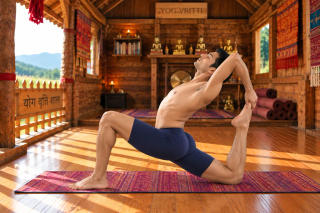
Eka Pada Rajakapotasana II elevates the foundational King Pigeon Pose by demanding a significantly deeper spinal extension and an intensified opening across the anterior chain. This variation challenges the practitioner to draw the back foot much closer to the head, often with both hands, cultivating an unparalleled sense of openness in the heart and a profound release in the hip flexors and quadriceps.
What this version changes: The strap in this variation becomes even more crucial for bridging the gap between hands and foot, facilitating the deeper backbend without compromising spinal integrity or shoulder alignment. It allows the practitioner to gradually intensify the quadriceps and hip flexor stretch at their own pace. Simultaneously, the blanket continues to support the kneeling knee, cushioning the joint and enabling a more comfortable and sustained hold in this profoundly advanced expression.
Muscles
- Hip Flexorsstretches
- Quadricepsstretches
- Spinal Erectorsstrengthens
- Pectoralsstretches
- Deltoidsstretches
Joints
- Hip Jointsmobilises
- Spinemobilises
- Shoulder Girdlemobilises
- Knee Jointmobilises
Inside the body
- Abdominal Organs
- Lungs and Heart
- Breathing
Mind
Eka Pada Rajakapotasana demands immense focus and mental fortitude, cultivating dharana (concentration) as the practitioner navigates the pose's complexities with awareness and precision.
Take care
Given the significantly amplified depth of the backbend and the intensity of the quad and hip flexor stretch, Eka Pada Rajakapotasana II carries a heightened risk for lumbar compression and knee strain if not approached with extreme care.
Practitioners must possess exceptional body awareness and spinal mobility, ensuring the backbend is distributed throughout the thoracic spine rather than collapsing into the lower back. This variation is not suitable for those with existing disc issues, sacroiliac joint instability, or significant knee injury.
Muscles
Hip Flexors
StretchesIn Eka Pada Rajakapotasana II, the demand for hip extension is profoundly amplified as the back leg's foot is drawn much closer to the head.
Read moreShow less
This necessitates a more intense lengthening and release of the hip flexors, particularly the Psoas and Iliacus, extending their stretch beyond what is typically achieved in the foundational pose.
The deeper engagement here not only enhances physical flexibility but also encourages a greater energetic surrender in the anterior hip, allowing for increased spinal freedom.
Quadriceps
StretchesThe quadriceps, specifically Rectus Femoris, experience a far more intense and sustained stretch in Eka Pada Rajakapotasana II due to the extreme knee flexion and hip extension of the back leg.
Read moreShow less
This variation demands a greater capacity for the quadriceps to lengthen, facilitating the foot's journey towards the head and deepening the anterior thigh release.
It transforms the stretch into a powerful opening for the entire front of the thigh, cultivating both elasticity and resilience in these large muscle groups.
Spinal Erectors
StrengthensWhile engaged in the root pose, the Spinal Erectors are called upon with significantly greater intensity and precision in Eka Pada Rajakapotasana II to support the deeper spinal extension.
Read moreShow less
They work concentrically to lift and lengthen the spine, counteracting gravity and allowing for the profound arch required.
This heightened activation builds robust strength and endurance in the entire posterior chain, crucial for maintaining integrity and stability in such advanced backbends.
Pectorals
StretchesThe Pectoralis Major and Minor are stretched more profoundly in this variation, as the arms often reach further back and overhead to grasp the foot, sometimes with both hands.
Read moreShow less
This deepens the opening across the chest and anterior shoulders, demanding greater elasticity from these muscles.
The increased stretch helps to broaden the collarbones and expand the rib cage, fostering a sense of immense spaciousness and energetic release in the heart center.
Deltoids
StretchesThe Deltoids, particularly the anterior and medial heads, undergo a more intense stretch in Eka Pada Rajakapotasana II, contributing to the broader shoulder girdle opening.
Read moreShow less
As the arms move into a more extreme overhead and external rotation to facilitate the deeper grip, these muscles are challenged to release profoundly.
This action cultivates greater mobility and spaciousness in the shoulder joint, preparing it for more complex arm balances and inversions.
Core Muscles
StabilisesStrengthensTransversus Abdominis, Obliques, Multifidus
In Eka Pada Rajakapotasana II, the intelligent engagement of the deep core muscles, particularly the Transversus Abdominis and Obliques, becomes paramount for spinal protection and integrity.
Read moreShow less
These muscles work synergistically to stabilize the lumbar spine, preventing compression and ensuring the backbend is distributed evenly throughout the vertebral column.
Their mindful activation creates a powerful internal support system, allowing for the deeper spinal extension to occur safely and with greater control and energetic lift.
Joints
Hip Joints
MobilisesThe hip joint of the front leg is in external rotation and flexion, while the hip joint of the back leg is in deep extension.
Read moreShow less
This asymmetrical action profoundly mobilizes the articulation between the femur and the pelvis, increasing range of motion in multiple planes.
Mechanically, it helps to release tension around the joint capsule, improving synovial fluid distribution and nutrient supply.
Yogically, this deep opening in the hips is said to release deeply held emotional tension and samskaras (subtle impressions), leading to a feeling of emotional liberation and greater fluidity in daily movement.
Spine (Vertebral Column)
MobilisesThe entire vertebral column undergoes a deep and progressive extension, particularly in the lumbar and thoracic regions, creating a long, even arc.
Read moreShow less
This gentle traction and extension help to decompress the intervertebral discs, promoting hydration and nutrient exchange while strengthening the surrounding musculature.
Practitioners often experience a sense of increased height and lightness in the torso, feeling the energetic lift of prana moving freely up the sushumna nadi.
Regular practice enhances spinal mobility, resilience, and vitality, contributing to a more youthful and energetic posture.
Shoulder Girdle
MobilisesThe shoulder joint (glenohumeral) of the arm reaching back is in deep extension and external rotation, while the shoulder blades (scapulae) retract and depress to support the chest opening.
Read moreShow less
This combined action mobilizes the entire shoulder girdle, increasing flexibility and stability crucial for overhead movements and deeper backbends.
Mechanically, it helps to free up frozen shoulders and improve rotator cuff health.
The yogic experience is one of profound heart opening and emotional release, as the chest expands and the shoulders draw back, symbolizing the shedding of burdens and the embrace of vulnerability.
Knee Joint
MobilisesThe knee joint of the back leg undergoes significant flexion, with the heel drawing towards the head, requiring healthy patellofemoral tracking and collateral ligament integrity.
Read moreShow less
This deep bend helps to maintain mobility in the knee, but requires careful attention to alignment to prevent undue strain on the ligaments and menisci.
From a yogic perspective, working with the knees in this manner encourages patience and discernment, as one must listen closely to the body's limits.
Over time, it can improve the range of motion and flexibility necessary for seated meditation postures.
Inside the body
Abdominal Organs
In this deep backbend, the abdominal organs are gently stretched and massaged as the front body lengthens extensively.
Read moreShow less
This action stimulates the digestive system, encouraging peristalsis and improving circulation to organs like the stomach, liver, and intestines.
Yogically, this activation of Manipura Chakra (navel center) is believed to stoke agni, the digestive fire, enhancing metabolism and the body's ability to process both food and experiences.
It can alleviate sluggishness and promote a feeling of internal cleansing and renewed energy.
Lungs and Heart
The expansive opening of the chest in Eka Pada Rajakapotasana creates significant space for the lungs to expand, allowing for deeper and fuller inhalations.
Read moreShow less
This increased capacity improves oxygen uptake and invigorates the entire cardiovascular system, promoting healthy blood flow to the heart.
From a yogic perspective, this heart-opening posture stimulates Anahata Chakra, cultivating compassion, love, and emotional freedom.
It can alleviate feelings of constriction and anxiety, replacing them with a sense of spaciousness and joy.
Breathing
The expansive chest and abdominal opening inherent in Eka Pada Rajakapotasana naturally encourages a deeper, fuller diaphragmatic breath, particularly on the inhalation.
Read moreShow less
The arch in the spine lifts the sternum, providing more space for the lungs to fill from the bottom up, promoting maximal oxygenation and a heightened sense of vitality.
This deep, sustained breathing in a challenging posture helps to calm the nervous system and anchor the mind, making it an excellent preparation for pranayama practices like Ujjayi, as it cultivates a profound awareness of the breath's capacity to create space and release tension.
Fascia (connective tissue)
Eka Pada Rajakapotasana profoundly influences the fascial network, particularly the Superficial Front Line and the Deep Front Line on the extended leg side, as well as the Spiral and Arm Lines in the upper body.
Read moreShow less
This pose creates a continuous, lengthening stretch through these interconnected myofascial meridians, releasing adhesions and improving the fluid dynamics within the connective tissue.
By unwinding these fascial restrictions, we open up energetic channels (nadis), allowing for a more unhindered flow of prana and a greater sense of bodily freedom and integration, extending from the toes to the fingertips.
Mind and nervous system
- Nervous system
This deep backbend, while challenging, can be deeply calming once the body begins to surrender into the shape, shifting the nervous system from sympathetic (fight-or-flight) to parasympathetic (rest-and-digest) dominance.
Read moreShow less
The sustained opening of the front body and the emphasis on a full, deep breath directly influence the vagus nerve, promoting a sense of ease and reducing physiological stress responses.
As the practitioner settles, the scattered mental chatter (chitta vritti) begins to quiet, fostering a profound sense of inner peace and presence.
The intense stretch in the hip flexors and quadriceps, often areas of stored trauma and tension, can trigger a release in the nervous system.
Read moreShow less
As these deep tissues unwind, the body's protective mechanisms can soften, leading to a felt sense of liberation from chronic holding patterns.
This physical release translates into emotional and mental lightness, allowing for a more harmonious flow of prana throughout the body and mind, reducing anxiety and promoting emotional balance.
- Mind & mood
Eka Pada Rajakapotasana demands immense focus and mental fortitude, cultivating dharana (concentration) as the practitioner navigates the pose's complexities with awareness and precision.
Read moreShow less
The sustained effort required to open the body, particularly the heart and hips, builds resilience and courage, encouraging the mind to move beyond perceived limitations.
This process directly challenges self-doubt and fosters a powerful sense of accomplishment and self-efficacy, translating into greater confidence in daily life.
The expansive nature of this heart-opening backbend can evoke feelings of vulnerability and openness, inviting the practitioner to release emotional armor and embrace a more compassionate connection with themselves and others.
Read moreShow less
By consciously surrendering to the pose's intensity, one practices pratyahara (withdrawal of the senses), turning attention inward to observe and integrate deep emotional releases.
This profound engagement with the self cultivates emotional intelligence and a capacity for greater joy and empathy.
Because it is a backbend pose
Backbends, like Eka Pada Rajakapotasana, extend the spine, counteracting the effects of prolonged sitting and forward flexion, which often lead to a rounded upper back and stiff lower back.
Read moreShow less
Anatomically, this action strengthens the posterior spinal muscles while stretching the anterior body, improving spinal mobility and posture.
Yogically, backbends are considered invigorating and uplifting, stimulating the heart chakra and fostering courage, enthusiasm, and a sense of fearlessness, allowing prana to flow freely upwards.
This pose also functions as a profound hip opener, particularly for the extended leg, targeting the hip flexors and quadriceps in deep extension.
Read moreShow less
This release in the hips helps to free up the pelvis, which is often a repository for emotional tension and stress, improving overall lower body mobility.
From a yogic perspective, opening the hips facilitates the release of apana vayu, the downward-moving energy, promoting grounding while simultaneously allowing for the upward flow of prana, creating a balanced energetic state.
The deep chest and shoulder opening in this advanced backbend helps to expand the rib cage, improving respiratory function and lung capacity.
Read moreShow less
Anatomically, it stretches the pectoral muscles and encourages better alignment of the shoulder girdle, counteracting kyphosis and promoting an upright posture.
Energetically, it opens Anahata Chakra, the heart center, fostering qualities of love, compassion, and emotional resilience, allowing for a more expansive and joyful experience of life.