Benefits· लाभ
What Eagle Arms Variation does for you
Garudasana Arms Variation · गरुड़ासन हाथ विविध
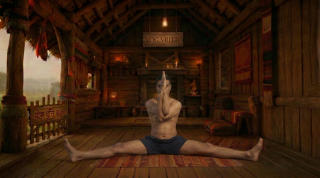
This variation strips away the intricate leg bind of full Garudasana, allowing practitioners to isolate and deeply explore the profound opening and strengthening actions of the Eagle arms. By removing the balance challenge of the leg wrap, the focus shifts entirely to releasing tension in the upper back and shoulders, cultivating greater range of motion and postural awareness in the upper body.
What this version changes: The most significant positional change is the removal of the leg bind, which fundamentally alters the energetic and physical demands of the posture, transforming it from a complex balancing act into a focused exploration of upper body mobility. By unbinding the legs, the practitioner gains greater stability, allowing for a more profound and sustained engagement with the shoulder girdle and thoracic spine, making the arm bind accessible to a wider range of practitioners.
Muscles
- Calves and shinsstabilises
- Shouldersstretches
- Core musclesstabilises
- Upper backstretches
Joints
- Anklesstabilises
- Kneesstabilises
- Hipsmobilises
- Shouldersmobilises
- Spinestretches
Inside the body
- Kidneys and Adrenal Glands
- Abdominal Organs
- Breathing
Mind
Garudasana profoundly cultivates Dharana, or concentrated focus, as the mind must remain entirely present to maintain equilibrium.
Take care
This variation reduces the direct strain on the knees that can be present in the full leg wrap of Garudasana, making it a safer option for those with knee sensitivities.
However, the intense focus on the arm bind requires mindful awareness, especially for individuals with existing shoulder injuries or limited range of motion in the shoulder girdle. It's crucial to approach the bind with care, stopping before any sharp pain, and consulting with a teacher if there are pre-existing shoulder conditions.
Muscles
Calves and shins (standing leg)
StabilisesGroundingWhile the calves and shins remain active to ground the body, their role here is less about intricate balance and more about foundational stability for a steady stance.
Read moreShow less
Without the additional compression and counter-leverage of the wrapped legs, these muscles can engage with a different quality, promoting a sense of firm rooting through the feet.
This allows the practitioner to feel deeply connected to the earth, creating a stable base from which the upper body can expand and release.
Shoulders
StretchesStrengthensWhile both the root pose and this variation engage the shoulders, here the action intensifies and becomes the primary focus.
Read moreShow less
Without the complex leg wrap demanding balance, practitioners can dedicate their full attention to drawing the shoulder blades apart on the back, creating profound space across the upper trapezius and rhomboids.
This deep internal rotation and adduction of the arms specifically targets the rotator cuff muscles, promoting both release and strength in the often-tight deltoids and pectoralis major.
Core muscles
StabilisesStrengthensIn the full Eagle, the core is intensely engaged to stabilize the entire balancing structure.
Read moreShow less
In this arm variation, while still crucial for spinal integrity, the core's role subtly shifts from dynamic stabilization for balance to supporting an elongated, uplifted spine.
It provides a stable foundation for the arm bind, allowing the upper back to round gently and lengthen without compromising lumbar support, thus deepening the stretch and strengthening the postural muscles.
Upper back (Rhomboids, Trapezius, Erector Spinae)
StretchesRhomboideus major/minor, Trapezius (middle/lower fibers), Erector Spinae (thoracic portion)
This variation places a heightened emphasis on opening and lengthening the upper back, particularly the muscles between the shoulder blades and along the thoracic spine.
Read moreShow less
The arm bind creates a gentle traction that encourages the rhomboids and trapezius to stretch, releasing chronic tension often held from daily activities or poor posture.
This targeted action fosters greater spinal mobility in the often-stiff thoracic region, promoting a sense of spaciousness and ease in the upper body.
Joints
Ankles
StabilisesThe ankle joint of the standing leg bears the entire body's weight, requiring intricate engagement of surrounding muscles to maintain micro-adjustments for balance.
Read moreShow less
This constant, subtle movement mobilizes the joint, improving its range of motion and strengthening the ligaments and tendons.
Over time, this practice enhances proprioception and stability, translating to more confident movement in daily life and a feeling of groundedness in one's being.
Knees
StabilisesBoth knees are in a state of deep flexion in Garudasana, with the standing knee stabilizing the entire posture and the wrapped knee often pressing into the back of the calf or shin.
Read moreShow less
This deep bend, when practiced mindfully, strengthens the muscles surrounding the knee joint, improving its resilience and flexibility.
From a yogic perspective, it teaches us to find comfort and steadiness even in positions of deep compression, cultivating patience and acceptance.
Hips
MobilisesAdductingThe hips are in a complex position: the standing hip is flexed, abducted, and externally rotated, while the wrapped leg is strongly adducted and internally rotated.
Read moreShow less
This intricate arrangement profoundly stretches the outer hip and gluteal muscles of the wrapped leg, while strengthening the standing hip stabilizers.
This balanced action releases tension often stored in the hips, symbolically freeing emotional blockages and fostering a sense of openness and fluidity in the pelvic region.
Shoulders
MobilisesAdductingThe shoulder joints are deeply flexed, adducted, and internally rotated as the arms cross and wrap, creating a significant stretch across the posterior capsule of the shoulder.
Read moreShow less
This action helps to release stiffness and improve the range of motion in the shoulder girdle, counteracting the effects of prolonged forward posture.
This opening in the upper body allows for a greater sense of freedom in the chest, inviting deeper breaths and a more expansive energetic flow through the heart center.
Spine
StretchesThe spine is encouraged to remain long and neutral in Garudasana, with the core muscles actively engaged to prevent slumping or excessive arching.
Read moreShow less
While there isn't a dramatic flexion or extension, the pose demands spinal stability and a subtle upward lift through the crown of the head.
This mindful alignment strengthens the postural muscles along the spine, promoting better posture and creating a clear channel for the upward flow of Prana Vayu, enhancing alertness and mental clarity.
Inside the body
Kidneys and Adrenal Glands
The gentle compression of the lower back area in Garudasana, particularly when the wrapped leg presses against the standing leg, can create a subtle internal massage for the kidneys and adrenal glands.
Read moreShow less
This mild stimulation is believed to improve circulation to these organs, supporting their function in fluid balance and stress response.
From a yogic perspective, this gentle compression can help to calm the nervous system, reducing feelings of anxiety and promoting a sense of inner peace by regulating energetic flow in the lower back.
Abdominal Organs
The deep engagement of the core and the slight compression of the lower abdomen in Garudasana provide a gentle internal toning and massage to the digestive organs.
Read moreShow less
This subtle compression and release can stimulate peristalsis, aiding in digestion and elimination.
Energetically, this action helps to stoke Agni, the digestive fire, promoting better assimilation of nutrients and a feeling of lightness and vitality in the abdominal region.
Breathing
The deep compression of the chest and abdomen in Garudasana naturally encourages a more refined and controlled breath, often inviting a longer exhalation to release the inner constriction.
Read moreShow less
While initially challenging, this shape can teach the practitioner to breathe deeply and calmly even under physical constraint, promoting diaphragmatic breathing.
This mindful breathing (Pranayama) in a constricted space helps to regulate the nervous system, transforming potential tension into a profound sense of inner calm and resilience.
Fascia (connective tissue)
Garudasana provides a unique and comprehensive stretch to several fascial lines, particularly the Spiral Line and the Superficial Back Arm Line.
Read moreShow less
The deep wrapping of the legs stretches the outer hip and IT band fascia, while the crossing of the arms provides a profound release across the upper back and posterior shoulder girdle.
This intricate unraveling of the fascial web releases chronic tension patterns, improving elasticity and range of motion, and energetically opens channels (nadis) for freer prana flow, promoting a sense of liberation and ease within the body's connective tissues.
Mind and nervous system
- Nervous system
The intense focus required to maintain balance in Garudasana naturally draws the senses inward, initiating a process akin to Pratyahara, the fifth limb of yoga.
Read moreShow less
This intentional narrowing of attention quiets the incessant chatter of the mind (chitta vritti), shifting the nervous system from a sympathetic 'fight or flight' state towards a more parasympathetic 'rest and digest' response.
As the mind settles, a profound sense of calm and mental clarity emerges, reducing anxiety and promoting inner peace and a feeling of centeredness.
The intricate coordination demanded by the crossing of both arms and legs stimulates both hemispheres of the brain, enhancing neural pathways and improving overall brain-body communication.
Read moreShow less
This cross-lateral movement is particularly beneficial for integrating left-brain logical thinking with right-brain creativity and intuition.
From a yogic perspective, this fosters a more harmonious flow of prana throughout the nadis, leading to greater mental agility and a more balanced energetic state.
- Mind & mood
Garudasana profoundly cultivates Dharana, or concentrated focus, as the mind must remain entirely present to maintain equilibrium.
Read moreShow less
The challenge of balancing on one leg while intricately wrapping the limbs demands unwavering attention, effectively training the mind to stay in the moment and quiet external distractions.
This sustained mental effort strengthens willpower and develops a profound inner stillness, translating into greater mental clarity and reduced anxiety off the mat.
The intricate wrapping of the limbs in Eagle Pose creates a feeling of containment and drawing inward, which can be profoundly grounding and calming for an overactive mind.
Read moreShow less
This physical encapsulation encourages a psychological turning inward, fostering introspection and self-awareness.
It teaches us to find stability and peace within our own contained space, offering a powerful antidote to mental fragmentation and a path towards inner quietude.
Because it is a balance pose
Balance poses like Garudasana demand profound concentration, drawing the mind into a singular point of focus, which is a powerful form of meditation in action.
Read moreShow less
This intense mental engagement strengthens the neural pathways responsible for proprioception and spatial awareness, improving coordination and reducing the risk of falls.
Yogically, cultivating balance on the mat translates to finding equilibrium in life, helping to navigate challenges with greater steadiness and grace.
Standing balance poses significantly strengthen the muscles of the feet, ankles, and legs, building a strong and stable foundation for the entire body.
Read moreShow less
The constant micro-adjustments required to maintain the pose engage deep stabilizing muscles that are often neglected in daily life.
This physical grounding helps to anchor the energetic body, fostering a deep connection to the earth and a sense of security (Muladhara Chakra).