Benefits· लाभ
What Cow Face Pose with Belt does for you
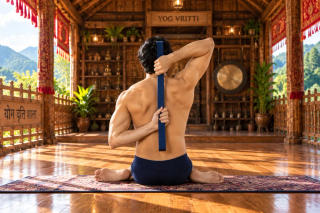
Gomukhasana (seated, modifications with belt) · गोमुखासन (बैठे, बेल्ट के साथ संशोधन)
This variation, explicitly incorporating the belt, transforms the shoulder action from an intense clasp to a supported, gradual opening. It prioritizes accessibility for those with limited shoulder mobility, allowing them to experience the profound benefits of Gomukhasana without strain.
What this version changes: The strap fundamentally transforms the shoulder action by acting as an accessible bridge between the hands, extending the reach and facilitating a gentle, sustained opening of the shoulder joint. This allows practitioners with limited mobility to engage the upper body without strain, gradually developing flexibility. Simultaneously, a block or blanket under the sit bones subtly elevates the pelvis, easing the intensity of the hip rotation and adduction, making the posture more comfortable and sustainable.
Muscles
- Gluteals & Deep Hip Rotatorsstretches
- Adductorsstretches
- Deltoids & Rotator Cuffstrengthens
- Tricepssustained
Joints
- Hip Jointmobilises
- Shoulder Jointmobilises
- Knee Jointstabilises
- Ankle Jointmobilises
Inside the body
- Abdominal Organs (Digestive System)
- Lungs & Heart (Cardiopulmonary System)
- Breathing
Mind
Gomukhasana demands a focused, sustained attention to the intricate alignment of the hips and shoulders, drawing the mind away from external distractions and into the present moment.
Take care
Always approach Gomukhasana with mindful awareness, especially if students have pre-existing knee issues or significant shoulder stiffness.
Never force the knees to stack perfectly if it causes any discomfort, pinching, or lateral strain; prioritize knee safety over aesthetic depth, perhaps by placing a block between the knees. For the shoulders, listen carefully for pinching or sharp pain, and always offer a strap to bridge the hands if they don't meet comfortably, ensuring a gradual and safe opening without impingement.
Muscles
Gluteals & Deep Hip Rotators
StretchesWhile still experiencing a deep stretch (external rotation in one hip, internal in the other), the explicit support from a blanket or block beneath the sit bones in this variation subtly alters the angle of the pelvis.
Read moreShow less
This can reduce the intensity of the stretch on the Gluteals and Deep Hip Rotators, making the posture more accessible for tighter hips.
It allows for a more gradual release in these powerful muscles, fostering a sustainable and comfortable exploration of hip mobility.
Adductors (Inner Thighs)
StretchesThe support provided by a blanket or block under the hips in this variation can slightly elevate the pelvis, thereby decreasing the acute angle of hip adduction and the intensity of the stretch on the inner thighs.
Read moreShow less
This adjustment lessens the deep lengthening demand on the Adductors, allowing for a more gentle and gradual release.
It makes the pose more approachable for individuals experiencing significant tightness in these muscle groups.
Deltoids & Rotator Cuff (Shoulders)
StrengthensWhile still actively engaged, the Deltoids and Rotator Cuff muscles in this variation shift from a potentially intense isometric contraction or forceful pulling action to a more supported, lengthened engagement.
Read moreShow less
The belt allows for a gradual opening of the shoulder joint, encouraging these muscles to release and extend without the strain of an immediate deep bind.
This fosters a more accessible and therapeutic stretch, promoting flexibility with less risk of overexertion.
Triceps (Back of Upper Arm)
SustainedGentle ExtensionIn the standard pose, the Triceps of the upper arm are strongly engaged to extend the elbow and facilitate the hand clasp behind the back.
Read moreShow less
Here, with the use of a belt, their engagement becomes less about a forceful pulling and more about a sustained, gentle extension to reach and hold the prop.
This allows for a progressive lengthening of the muscle without the intense activation required for a deep bind, fostering a more accessible and controlled stretch.
Joints
Hip Joint
MobilisesThe hip joints (coxal joints) are undergoing significant and reciprocal rotation, with one thigh bone (femur) externally rotating and the other internally rotating within the hip socket (acetabulum).
Read moreShow less
This intense mobilization helps to break up adhesions and improve the range of motion, particularly in those tight deep rotators and the hip capsule.
The sustained stretch encourages synovial fluid production, lubricating the joint and releasing emotional and energetic stagnation often stored in the hips, leading to greater freedom in movement and spirit.
Shoulder Joint
MobilisesThe shoulder joints (glenohumeral joints) are actively mobilized in a complex manner, with one arm in deep external rotation and abduction, and the other in internal rotation and adduction.
Read moreShow less
This reciprocal action systematically stretches the joint capsule and surrounding ligaments, enhancing flexibility and stability in the shoulder girdle.
This opening in the upper body can release physical and emotional burdens, promoting a sense of expansion and lightness, allowing prana to flow more freely through the chest and arms.
Knee Joint
StabilisesGentle CompressionMobilisesThe knee joints (tibiofemoral joints) are deeply flexed and subjected to some degree of rotation and compression in Gomukhasana, particularly the knee of the internally rotated hip.
Read moreShow less
While the primary action is hip opening, proper alignment is crucial to ensure the knee remains stable and free from any twisting strain, which could damage ligaments or menisci.
This deep flexion, when mindful, can gently stimulate circulation around the joint, and from a yogic perspective, encourages a humble, grounded posture, connecting us to the root and reinforcing stability.
Ankle Joint
MobilisesThe ankle joints (talocrural joints) are deeply plantarflexed as the tops of the feet rest against the floor beside the hips, gently stretching the front of the ankle and shin.
Read moreShow less
This action helps to improve the flexibility of the ankle complex, which is often restricted due to footwear or lack of movement.
Enhancing ankle mobility contributes to a more stable and comfortable seated foundation, allowing the practitioner to feel more rooted and settled in their practice and promoting better circulation in the lower extremities.
Inside the body
Abdominal Organs (Digestive System)
The deep flexion and slight compression of the lower body against the abdominal area provide a gentle internal massage to the digestive organs.
Read moreShow less
This mild, sustained pressure can stimulate peristalsis and improve circulation to the stomach, intestines, and liver, aiding in the detoxification process.
From a yogic perspective, this gentle compression helps to stoke Agni (digestive fire), enhancing metabolism and promoting a sense of inner cleanliness and vitality, contributing to overall well-being.
Lungs & Heart (Cardiopulmonary System)
The expansive opening of the chest and shoulders in Gomukhasana creates more space for the lungs to expand, encouraging deeper and fuller breaths, particularly into the side and back body.
Read moreShow less
This direct increase in thoracic capacity allows for a more efficient exchange of oxygen and carbon dioxide, benefiting the entire cardiopulmonary system and increasing energy levels.
Energetically, this chest opening stimulates Anahata Chakra, fostering feelings of compassion, love, and emotional openness, while calming the heart and settling the breath.
Breathing
The unique architecture of Gomukhasana, with its deep hip opening and expansive chest lift, naturally encourages a fuller, deeper diaphragmatic breath, particularly into the side and back ribs.
Read moreShow less
While the lower body is compressed and grounded, the upper body is lifted and open, inviting a more complete inhalation and a longer, more releasing exhalation.
This natural deepening of the breath helps to calm the nervous system and is an excellent preparation for pranayama practices like Ujjayi, as it cultivates a sense of spaciousness within the torso and allows prana to permeate every cell, bringing mental clarity and emotional balance.
Fascia (connective tissue)
Gomukhasana provides a comprehensive release and lengthening across multiple fascial lines, particularly targeting the deep lateral line of the hips, the superficial back arm line, and the deep front arm line.
Read moreShow less
The intricate crossing of the legs and arms creates a spiraling stretch through the connective tissue that encases muscles, bones, and organs, releasing long-held tension patterns and improving inter-tissue glide.
This unwinding of the fascial web helps to restore elasticity and fluidity to the body, allowing for greater freedom of movement and a more unobstructed flow of prana throughout the subtle body channels, enhancing overall vitality.
Mind and nervous system
- Nervous system
The deep hip and shoulder opening, combined with the grounded seated position, signals safety to the nervous system, initiating a profound shift towards parasympathetic dominance.
Read moreShow less
This allows the body's 'rest and digest' functions to take over, reducing the fight-or-flight response often active in daily life.
You'll feel a profound sense of calm washing over you, as the constant mental chatter (chitta vritti) begins to subside, inviting a state of inner peace and deep relaxation.
Holding Gomukhasana with conscious breath encourages a prolonged exhalation, which is a direct pathway to calming the vagus nerve and downregulating the sympathetic nervous system.
Read moreShow less
This sustained exhale slows the heart rate and quiets the mind, fostering a deep sense of relaxation, reducing anxiety, and promoting presence.
This practice teaches the nervous system to release stored tension, allowing for greater resilience and a more balanced emotional state, both on and off the mat.
- Mind & mood
Gomukhasana demands a focused, sustained attention to the intricate alignment of the hips and shoulders, drawing the mind away from external distractions and into the present moment.
Read moreShow less
This intense focus cultivates pratyahara, the withdrawal of the senses, and dharana, concentration, as the practitioner becomes absorbed in the internal landscape of the pose.
This deep introspection helps to quiet the fluctuations of the mind, leading to a profound sense of mental clarity and inner stillness, preparing the mind for meditation.
The challenge inherent in Gomukhasana, particularly in finding balance between effort (sthira) and surrender (sukha), builds mental resilience, patience, and humility.
Read moreShow less
As you learn to breathe through the intensity and find comfort within the stretch, you develop a stronger capacity to face discomfort with equanimity and acceptance.
This practice translates directly into daily life, equipping you with the mental fortitude to navigate challenges with grace, a steady mind, and a more compassionate outlook.
Because it is a seated pose
This shape profoundly mobilizes the hip joints, encouraging both external and internal rotation in a reciprocal fashion, which is unique and highly effective for releasing deep tension.
Read moreShow less
Anatomically, it targets the deep hip rotators and adductors, releasing chronic tightness that can restrict movement and contribute to lower back pain and sciatica.
Yogically, opening the hips is believed to release stored emotions and energetic blockages (granthis), fostering a sense of freedom, emotional release, and allowing apana vayu to move more freely through the pelvic region.
The intricate arm bind and upright spine in Gomukhasana actively expand the chest and shoulders, counteracting the common posture of rounded shoulders and thoracic kyphosis.
Read moreShow less
This action stretches the pectoral muscles and mobilizes the shoulder girdle, improving lung capacity and promoting a more open, confident posture.
Energetically, this opening stimulates the Anahata Chakra, the heart center, cultivating feelings of compassion, self-acceptance, and emotional spaciousness, inviting a deeper connection to oneself and others.
As a seated posture, Gomukhasana inherently cultivates grounding and stability, connecting the practitioner deeply to the earth and establishing a firm foundation.
Read moreShow less
This stable base allows for an upward energetic lift through the spine (uddiyana bandha and mula bandha), promoting a sense of rootedness while simultaneously encouraging expansion and lightness in the upper body.
From a yogic perspective, this seated foundation helps to quiet the mind, making it an excellent pose for meditation and pranayama, fostering a sense of inner peace and profound presence.