Benefits· लाभ
What Abdominal Twist II does for you
Jathara Parivartanasana II · जठर परिवर्तासन II
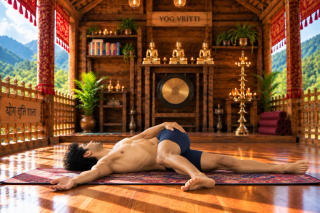
Jathara Parivartanasana II, or Reclining Twist II, introduces a profound shift by extending one leg, creating a longer lever that intensifies the spinal rotation and deepens the stretch through the side body and posterior chain. This modification challenges the core with greater demand for stability and allows for a more comprehensive release of tension in the hip and hamstring of the extended leg.
What this version changes: In Jathara Parivartanasana II, the wall becomes even more crucial for grounding the shoulder opposite the twist, preventing it from lifting excessively due to the longer lever of the extended leg, thus deepening the spinal rotation. A blanket placed under the head maintains cervical alignment, while a folded blanket under the crossing knee or hip provides essential support, preventing strain and allowing for a more complete release into the twist.
Muscles
- Obliquesstrengthens
- Erector Spinaestretches
- Quadratus Lumborumstretches
- Gluteus Medius & Minimusstrengthens
- Hamstringsstretches
Joints
- Spinal Jointsmobilises
- Sacroiliac Jointstabilises
- Hip Jointsmobilises
Inside the body
- Abdominal Organs (Stomach, Intestines, Liver, Spleen)
- Kidneys and Adrenal Glands
- Breathing
Mind
This pose cultivates deep introspection and surrender, as the body is fully supported and the mind is invited to release control and effort.
Take care
Due to the increased leverage and deeper spinal rotation afforded by the extended leg, practitioners with sciatica must approach Jathara Parivartanasana II with extreme care, as the stretch can potentially exacerbate nerve irritation.
Similarly, pregnant individuals should avoid this specific variation due to the intense abdominal compression and potential strain on the sacroiliac joint, opting for gentler, modified twists instead.
Muscles
Obliques (Internal and External)
StrengthensWhile still the primary movers for spinal rotation, in Jathara Parivartanasana II, the obliques are called upon for a more profound and sustained engagement.
Read moreShow less
The extended leg creates a longer lever, demanding increased isometric strength from the obliques to stabilize the torso against the pull, while simultaneously facilitating a deeper rotational stretch on the opposite side.
This enhanced demand cultivates greater core integrity and a more integrated twist through the abdominal wall.
Erector Spinae (Spinal Extensors)
StretchesIn this variation, the Erector Spinae muscles are challenged to maintain axial length and prevent compression with greater vigilance against the increased rotational forces.
Read moreShow less
They work actively to create space between each vertebra as the spine twists more deeply due to the extended limb's leverage.
This conscious lengthening ensures the twist unfolds safely and effectively, promoting greater spinal decompression rather than jamming.
Quadratus Lumborum (QL)
StretchesThe Quadratus Lumborum experiences a more specific and intense lengthening on the side of the extended leg, particularly if that leg is the lower one in the twist.
Read moreShow less
Concurrently, the QL on the opposite side engages more actively to stabilize the lumbar spine against the deeper lateral flexion and rotation inherent in the pose.
This dual action helps to release deep-seated tension in the lower back while strengthening its capacity for subtle stabilization.
Gluteus Medius & Minimus
StrengthensThe gluteus medius and minimus of the crossing leg become more actively engaged in external rotation and abduction, drawing the leg further across the midline to deepen the twist and stretch the outer hip.
Read moreShow less
Conversely, the gluteus medius and minimus of the extended leg experience a more significant lengthening, particularly if the leg is actively extending away from the hip.
This dual engagement refines hip mobility and releases tension often held deep within the hip complex.
Hamstrings
StretchesBiceps Femoris, Semitendinosus, Semimembranosus
The hamstrings of the extended leg undergo a substantial lengthening in Jathara Parivartanasana II, particularly as the leg actively straightens and extends away from the hip.
Read moreShow less
This targeted stretch releases tightness along the entire posterior chain, improving overall leg flexibility and contributing to better pelvic alignment.
The conscious extension cultivates a deeper connection to the subtle energetic lines running through the back of the leg.
Adductors
StretchesPectineus, Adductor Brevis, Adductor Longus, Adductor Magnus, Gracilis
The adductor muscles of the extended leg are significantly lengthened as the leg extends away from the midline and potentially drops further from the hip, intensifying the stretch along the inner thigh and groin.
Read moreShow less
This action helps to release chronic tension in the inner thighs, which often restricts hip mobility and can contribute to lower back discomfort.
The stretch opens the inner energetic channels, promoting a sense of release and expansion.
Transversus Abdominis
StabilisesTransversus Abdominis
As part of the 'core' engagement, the Transversus Abdominis (TVA) is called upon for a more intense and nuanced stabilization in Jathara Parivartanasana II due to the increased leverage of the extended leg.
Read moreShow less
This deep engagement acts like a natural corset, protecting the lumbar spine and pelvis, allowing for a safer and more integrated spinal rotation.
Cultivating this deep core support is essential for progressing into more complex twists and maintaining spinal health.
Joints
Spinal (Vertebral) Joints
MobilisesThese are the small facet joints between each vertebra in your spine, from your neck to your tailbone.
Read moreShow less
Jathara Parivartanasana systematically mobilizes the entire spinal column through gentle rotation, particularly in the thoracic (mid-back) and lumbar (lower back) regions.
This rotational movement encourages synovial fluid production, nourishing the intervertebral discs and improving the range of motion in the spine.
Practitioners feel a sense of 'unsticking' and greater fluidity along the central axis, leading to improved posture and reduced stiffness over time.
Sacroiliac (SI) Joint
StabilisesThis joint connects the sacrum (triangular bone at the base of your spine) to the ilium (large pelvic bones).
Read moreShow less
While primarily a mobilizing pose for the spine, the gentle pull in the lower back and hips can subtly encourage a healthy, stable articulation of the SI joints by releasing surrounding musculature.
By elongating the lower back and creating space, it can alleviate undue compression or torque that might irritate this joint.
Over time, this helps to establish a more balanced foundation for the spine, reducing common sources of lower back pain and promoting a feeling of grounded stability.
Hip Joints (Acetabulofemoral Joints)
MobilisesThese are the strong ball-and-socket joints where your thigh bone meets your pelvis.
Read moreShow less
As the legs drop to one side, the hip joints are gently mobilized in a rotational manner, with the top leg's hip often experiencing a mild internal rotation and the bottom leg's hip experiencing a mild external rotation.
This movement, while secondary to the spinal twist, helps to release tension in the hip flexors and rotators, improving overall hip mobility.
This gentle opening in the hips can release deep-seated tension, fostering a sense of freedom and lightness in the lower body.
Inside the body
Abdominal Organs (Stomach, Intestines, Liver, Spleen)
The gentle compression and release action of this twist acts like a soft internal massage for the abdominal organs.
Read moreShow less
As you twist, organs on the compressed side are gently squeezed, encouraging the expulsion of stale blood and metabolic waste.
Upon release, fresh, oxygenated blood flows back in, revitalizing these organs and enhancing their function, particularly digestion and elimination.
This 'wring and refresh' action is central to yogic cleansing (kriya) and supports the healthy flow of apana vayu, leaving a feeling of lightness and internal clarity.
Kidneys and Adrenal Glands
Located in the posterior abdominal wall, the kidneys and their associated adrenal glands also receive a gentle, indirect massage during this twist.
Read moreShow less
The subtle compression and release can stimulate blood flow to these vital organs, supporting their detoxification processes and hormonal balance.
From a holistic perspective, this can help to calm the nervous system, as the adrenals are responsible for stress hormone production, leading to a feeling of greater internal peace and resilience.
Breathing
In Jathara Parivartanasana, the twist naturally creates a gentle compression on one side of the torso while opening the other, which subtly guides and deepens the breath.
Read moreShow less
This shape encourages a lengthening of the exhalation, as the compressed side assists in expelling air, while the open side invites a fuller, more expansive inhalation.
This natural rhythm supports a meditative state and is an excellent preparation for gentle pranayama practices like viloma (interrupted breath) or ujjayi, as it enhances breath awareness and capacity, calming the nervous system.
Fascia (connective tissue)
Fascia is the intricate, interconnected web of connective tissue that wraps around every muscle, bone, organ, and nerve in your body, providing support and allowing movement.
Read moreShow less
In Jathara Parivartanasana, the gentle, sustained twist lengthens the superficial and deep fascial lines running along the sides of the torso and back, particularly the spiral line and parts of the superficial back line.
This unwinding releases chronic tension patterns held within the fascial matrix, improving overall flexibility and reducing restriction.
From a yogic perspective, releasing fascial adhesions helps to open up energetic channels (nadis), allowing prana to flow without obstruction and promoting a sense of integration and ease throughout the body.
Mind and nervous system
- Nervous system
The sustained, gentle nature of Jathara Parivartanasana immediately signals safety to the nervous system, shifting it from a sympathetic (fight-or-flight) to a parasympathetic (rest-and-digest) state.
Read moreShow less
This deep relaxation is facilitated by the supine position and the rhythmic, unforced breath encouraged by the twist, creating a profound sense of inner calm.
As the body unwinds, the mind naturally follows, reducing mental chatter (chitta vritti) and promoting a quiet, meditative state.
The gentle traction on the spine, combined with the release of deeply held muscular tension, directly impacts nerve roots emerging from the spinal column.
Read moreShow less
This decompression alleviates irritation and promotes optimal nerve function, reducing sensations of pain or numbness and improving communication throughout the body.
This physical release translates into a clearer flow of prana throughout the body, fostering a feeling of energetic lightness and mental clarity, crucial for alleviating anxiety and insomnia.
- Mind & mood
This pose cultivates deep introspection and surrender, as the body is fully supported and the mind is invited to release control and effort.
Read moreShow less
The act of twisting, while held with gentle intention, encourages a letting go of rigidity, both physical and mental, fostering adaptability and resilience in the face of life's challenges.
This quiet internal focus is a foundational step towards pratyahara, drawing awareness inward away from external distractions and cultivating inner peace.
By systematically releasing tension in the back, core, and hips, Jathara Parivartanasana helps to alleviate the physical manifestations of stress and anxiety, which often present as tightness and holding in these areas.
Read moreShow less
This physical release creates mental space, allowing for a more optimistic and less reactive mental state, improving emotional regulation.
Teachers can guide students to observe this profound connection, empowering them to use the pose for self-soothing and cultivating a sense of inner peace and equilibrium.
Because it is a twist pose
Twists are unparalleled for mobilizing the entire length of the spine, from the cervical to the lumbar regions.
Read moreShow less
The rotational movement gently decompresses the intervertebral discs, nourishing them with vital fluids and improving their shock-absorbing capacity.
In yogic terms, this unwinds blockages along the sushumna nadi, allowing prana to flow more freely and invigorating the entire central nervous system, enhancing overall flexibility.
The 'wringing' action of a twist compresses and then releases the abdominal organs, promoting detoxification and improving their function.
Read moreShow less
This internal massage stimulates digestion, circulation, and elimination, supporting the body's natural cleansing processes.
Energetically, twists help to balance the digestive fire (agni) and release stagnant energy, particularly apana vayu, fostering a sense of lightness and clarity that is beneficial for digestive problems.
Twisting poses effectively lengthen the often-contracted muscles and fascia along the sides of the torso, including the obliques and quadratus lumborum.
Read moreShow less
This release creates space in the side body, improving breath capacity and alleviating tension that can contribute to back pain or stiffness.
This opening facilitates a feeling of expansion and freedom, both physically and energetically, allowing for deeper, more expansive breaths and a greater sense of ease in the body.