Benefits· लाभ
What Crow Pose does for you
Kakasana · काकासन
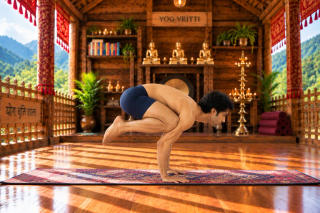
Kakasana, or Crow Pose, is a foundational arm balance that demands integrated strength from the entire body, particularly the core, shoulders, and wrists. It teaches us to find lightness and lift by rooting firmly through the hands, engaging the deep abdominal muscles, and broadening across the collarbones.
Muscles
- Deep Core Stabilizersstrengthens
- Shoulder Girdle Stabilizersstrengthens
- Tricepsstrengthens
- Forearm Flexors and Extensorsstrengthens
Joints
- Wrist Jointstabilises
- Elbow Jointstabilises
- Shoulder Girdlestabilises
- Sacroiliac Jointstabilises
Inside the body
- Abdominal Organs (Digestive System)
- Lungs and Diaphragm
- Breathing
Mind
Kakasana is a powerful posture for cultivating unwavering focus and concentration (dharana).
Take care
Teachers should guide students to approach Kakasana with mindful awareness, particularly regarding the wrists and shoulders.
Ensure students distribute weight evenly across the entire hand, pressing through the fingertips and knuckles to protect the wrist joints from excessive strain. Encourage active engagement of the shoulder girdle to avoid collapsing into the shoulders, which can lead to injury. For students with pregnancy or uncontrolled hypertension, the abdominal compression and potential increase in intracranial pressure make this pose contraindicated or require significant modification under expert supervision.
Muscles
Deep Core Stabilizers (Abdominals)
StrengthensTransversus Abdominis, Rectus Abdominis, Obliques
The deep core muscles, wrapping around your trunk like a natural corset, are intensely engaged to lift and stabilize the pelvis.
Read moreShow less
They work synergistically to draw the knees high onto the upper arms, creating a compact and buoyant foundation for the pose.
This strong activation ignites your inner furnace, known as Agni or Manipura Chakra, fostering a sense of inner power, stability, and digestive vitality from your very center.
Shoulder Girdle Stabilizers
StrengthensDeltoids, Rotator Cuff muscles (Supraspinatus, Infraspinatus, Teres Minor, Subscapularis), Serratus Anterior
These muscles, surrounding the shoulder joint and beneath your shoulder blades, are paramount in creating a stable and lifted platform for your body.
Read moreShow less
The deltoids work to keep the upper arm bone (humerus) in its socket, while the serratus anterior protracts the shoulder blades, preventing them from 'winging' and creating a broad, stable upper back.
This integrated strength allows the chest to remain open and expansive, fostering a sense of fearlessness and an open heart, energetically linked to Anahata Chakra.
Triceps
StrengthensTriceps Brachii
Located on the back of your upper arm, the triceps are crucial for extending and stabilizing the elbow joint against the downward pull of gravity.
Read moreShow less
They work powerfully to create the 'shelf' upon which your knees rest, providing the necessary leverage to lift the body.
This active engagement cultivates a sense of lightness and upward mobility, allowing the practitioner to defy gravity and experience a lift that extends beyond the physical, into the energetic realm of udana vayu.
Forearm Flexors and Extensors
StrengthensFlexor Carpi Radialis, Extensor Carpi Ulnaris, etc.
The muscles running along the front and back of your forearms are deeply engaged to grip the earth firmly and create a stable foundation through your hands.
Read moreShow less
They work to protect the wrist joint by distributing weight evenly across the palms, allowing the fingers to 'claw' the floor.
This strong connection to the earth instills a deep sense of grounding and stability, allowing prana to flow from the earth up through the arms, supporting the entire posture.
Joints
Wrist Joint
StabilisesThe wrist joint (radiocarpal and intercarpal joints) becomes the primary point of weight-bearing, requiring significant strength and mobility to support the entire body.
Read moreShow less
It's crucial to distribute the weight evenly across the palm, pressing through the knuckles and fingertips, to protect this delicate articulation.
Over time, this practice enhances wrist stability and resilience, deepening the connection to the earth and cultivating a steady foundation for all arm balances.
Elbow Joint
StabilisesWhile the elbows remain slightly bent in Kakasana, they are actively stabilized by the triceps to create a solid 'shelf' for the knees.
Read moreShow less
This engagement prevents collapse and ensures that the force is transmitted efficiently through the arms into the hands.
Maintaining this subtle bend and active stabilization protects the joint from hyperextension, fostering intelligent strength and a smooth channel for upward energy flow through the limbs.
Shoulder Girdle
StabilisesThe complex shoulder girdle (glenohumeral and scapulothoracic joints) is profoundly engaged to lift and support the torso, requiring integrated strength from many surrounding muscles.
Read moreShow less
This action draws the shoulder blades down the back and broadens the collarbones, creating space and protecting the delicate rotator cuff.
This active stabilization promotes a sense of openness and courage in the chest, allowing for free movement of prana and a feeling of empowerment.
Sacroiliac Joint (SIJ)
StabilisesThe strong engagement of the deep core muscles in Kakasana directly contributes to the stabilization of the sacroiliac joint, where the spine meets the pelvis.
Read moreShow less
By creating a firm connection between the front body and the back body, the pelvis remains integrated and protected.
This stability in the foundation of the spine allows for a sense of groundedness and integrity in the lower trunk, reducing strain and promoting energetic balance in the pelvic region.
Inside the body
Abdominal Organs (Digestive System)
The gentle yet firm compression of the knees into the abdomen provides a subtle massage to the digestive organs, including the stomach, intestines, and liver.
Read moreShow less
This internal pressure can stimulate peristalsis and enhance blood circulation to these areas, aiding in detoxification and improving digestive function.
In yogic terms, this action stokes Agni, the digestive fire, promoting efficient assimilation and elimination, thereby fostering vitality and a clear mind.
Lungs and Diaphragm
While the abdominal compression might initially feel restrictive, the strong core engagement in Kakasana actually provides a stable foundation from which the diaphragm can work more efficiently.
Read moreShow less
This encourages a more conscious and controlled breath, often leading to a refined Ujjayi pranayama.
This diaphragmatic support allows for a steady flow of prana, enhancing oxygenation and bringing a sense of calm focus despite the physical exertion.
Breathing
In Kakasana, the unique compression of the abdomen and the intensity of the balance naturally encourage a more refined and controlled breath, often leading to a sustained Ujjayi pranayama.
Read moreShow less
The engagement of the core creates a stable platform for the diaphragm, allowing for a steady, rhythmic flow of breath.
This conscious regulation of the breath not only calms the nervous system but also channels prana efficiently, sustaining the pose with grace and focus, fostering a deep meditative quality.
Fascia (connective tissue)
Kakasana profoundly engages the Superficial Front Line and the Deep Front Line of the fascial web, particularly through the intense activation of the abdominal muscles and hip flexors to lift the legs.
Read moreShow less
This engagement creates an integrated 'hoop' of strength around the core, connecting the pelvis to the rib cage and allowing for a unified lift.
This action helps to release stagnant energy and open energetic channels (nadis) along the front of the body, fostering a sense of internal cohesion and fluidity.
Mind and nervous system
- Nervous system
Kakasana is a profound teacher of balance and proprioception, as the body and mind constantly make minute adjustments to maintain equilibrium.
Read moreShow less
This intense focus stimulates the vestibular system and heightens body awareness, drawing the mind into the present moment and quieting the incessant 'chitta vritti' or mental chatter.
The sustained concentration required cultivates dharana, or one-pointed focus, leading to a profound sense of inner stillness and mental clarity.
Initially, the challenge of lifting into Kakasana can activate the sympathetic nervous system, creating a surge of energy.
Read moreShow less
However, as the practitioner finds stability and connects to a steady breath, the parasympathetic nervous system begins to engage, fostering a sense of calm determination.
This mastery over the initial fear and the subsequent achievement of balance trains the nervous system to remain steady and composed even in demanding situations, translating into greater resilience in daily life.
- Mind & mood
Kakasana is a powerful posture for cultivating unwavering focus and concentration (dharana).
Read moreShow less
The absolute necessity to be fully present and responsive to subtle shifts in balance naturally draws the senses inward (pratyahara), quieting external distractions and mental noise.
This intense absorption in the task at hand strengthens the mind's ability to concentrate, a skill invaluable both on and off the yoga mat.
Overcoming the initial apprehension of lifting off the ground and trusting one's own strength in Kakasana builds immense courage and self-confidence.
Read moreShow less
Each successful lift reinforces a belief in one's capabilities, fostering a sense of empowerment and resilience that extends beyond the physical realm.
This inner fortitude, often referred to as tapas, helps practitioners face challenges with greater determination and self-assurance.
The journey to mastering Kakasana often involves repeated attempts and occasional tumbles, teaching invaluable lessons in patience, humility, and non-attachment to outcomes.
Read moreShow less
It cultivates an acceptance of the process rather than solely focusing on the end result, fostering a deeper understanding of growth and progress.
This practice of 'ishvara pranidhana' (surrender to the process) softens the ego and deepens one's connection to the cyclical nature of learning.
Because it is a balance pose
As an arm balance, Kakasana fundamentally shifts the body's center of gravity, requiring the entire upper body to bear and support the full weight of the torso and legs.
Read moreShow less
This action dramatically strengthens the shoulder girdle, arms, and wrists, building integrated strength throughout the upper kinetic chain.
In yogic philosophy, this ability to support oneself cultivates a profound sense of self-reliance and inner strength (tapas), empowering the practitioner to stand firm in life's challenges.
The characteristic shape of Kakasana, with the knees drawn high into the armpits and the pelvis lifting, demands intense engagement of the deep core muscles.
Read moreShow less
This activation not only stabilizes the spine and pelvis but also creates a compact, buoyant center from which the body can lift.
This strong core engagement ignites the Manipura Chakra, our energetic center of power and transformation, fostering self-discipline, willpower, and a vibrant sense of vitality.