Benefits· लाभ
What Revolved Side Angle Pose Variation does for you
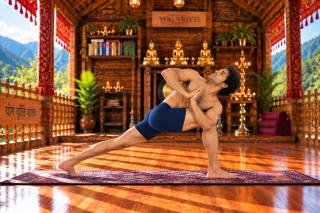
Parivrtta Parsvakonasana Variation · परिवृत्त पार्श्वकोणासन भिन्नता
This variation of Parivrtta Parsvakonasana distinguishes itself by extending the top arm forward, parallel to the floor, alongside the ear. This subtle yet profound alteration creates a longer lever, intensifying the pose's demands on the core and shoulder girdle.
What this version changes: While a block continues to offer accessibility and support for the bottom hand, the primary shift in this variation comes from the positional change of the extended top arm. This extension creates a longer lever, significantly increasing the demand on core stability and requiring a more active engagement of the shoulder girdle. It redistributes the energetic focus, deepening the stretch along the entire side body and challenging the practitioner to maintain balance and spinal length against the increased leverage.
Muscles
- Quadricepsstrengthens
- Hamstringsstretches
- Obliquesstrengthens
- Shouldersstrengthens
Joints
- Spinemobilises
- Hip jointsmobilises
- Knee jointsstabilises
- Shoulder jointsmobilises
Inside the body
- Abdominal Organs (Digestive System)
- Kidneys and Adrenal Glands
- Breathing
Mind
This pose demands unwavering focus and concentration, drawing the mind away from external distractions and into the present moment.
Take care
Teachers, always guide students to prioritize spinal length over depth of twist to protect the lower back.
Ensure the front knee is directly over the ankle and not collapsing inward to safeguard the knee joint. For students with neck issues, advise them to keep the head in a neutral position or look down, rather than forcing the gaze upwards, to avoid strain.
Muscles
Quadriceps
StrengthensWhile still fundamentally strengthening, the quadriceps in the front leg must now engage with heightened precision to stabilize the knee and maintain the deep lunge.
Read moreShow less
The extended arm shifts the center of gravity, demanding a more active and integrated connection to the earth through the front foot, preventing the knee from collapsing inward or outward.
This refined engagement fosters a deeper sense of grounding and stability, anchoring the twist from the foundation.
Hamstrings
StretchesStabilisesThe hamstrings in the front leg, while lengthening, are called upon to provide enhanced stability to the pelvis, grounding the sit bone and preventing excessive anterior tilt as the torso extends forward.
Read moreShow less
In the back leg, they work in concert with the quadriceps to create a strong, stable base for the twist.
This increased demand for stability through the hamstrings deepens the connection to the earth, creating a more integrated and expansive foundation for the pose.
Obliques
StrengthensThe obliques remain primary drivers of the spinal twist, but with the top arm extended, their engagement must become more dynamic and integrated with the entire core.
Read moreShow less
They are now working against a longer lever, requiring a sustained effort to deepen and maintain the rotation without sacrificing spinal length.
This intensifies the 'wringing out' action, enhancing detoxification and cultivating a profound sense of internal strength and energetic purification.
Shoulders
StrengthensStabilisesDeltoids, Rotator Cuff, Serratus Anterior, Trapezius
The extension of the top arm introduces significant engagement of the shoulder girdle muscles, particularly the deltoids for lifting and holding the arm, and the rotator cuff muscles for stabilizing the humerus within the shoulder joint.
Read moreShow less
The serratus anterior plays a crucial role in protracting and upwardly rotating the scapula, allowing for a broad, expansive reach.
This integrated shoulder action lengthens the entire side body, creating an unbroken line of energy from the back heel through the extended fingertips.
Joints
Spine (Vertebral joints)
MobilisesThe many small joints between your vertebrae (intervertebral joints) are actively mobilized through axial rotation in Parivrtta Parsvakonasana.
Read moreShow less
This deep twist helps to de-compress the spinal discs by creating space and then nourishing them with fresh synovial fluid upon release.
Regular practice enhances spinal flexibility and suppleness, releasing chronic stiffness and allowing the vital energy, prana, to ascend more freely along the central energetic channel.
Hip joints
MobilisesThe hip joint of the front leg is deeply flexed, abducted, and externally rotated, while the hip of the back leg is extended and internally rotated.
Read moreShow less
This complex interplay of actions creates a significant opening and mobilization in both hips, challenging their range of motion and stability.
Releasing tension in the hips can unlock stored emotional patterns and facilitate a greater sense of freedom and ease in the lower body, deeply connecting to the earth element.
Knee joints
StabilisesThe knee joint of the front leg bears significant weight in a deep flexion, requiring strength and stability from the surrounding muscles to protect it.
Read moreShow less
The trailing knee is extended, emphasizing stability and alignment.
Conscious alignment, ensuring the front knee tracks over the ankle, prevents undue stress and builds resilience in these crucial weight-bearing joints, fostering a sense of steadfastness and unwavering support in the lower body.
Shoulder joints
MobilisesOne shoulder joint is typically in internal rotation and adduction (arm down), while the other is in flexion and external rotation (arm overhead).
Read moreShow less
This creates an asymmetrical opening and strengthening, challenging the mobility and stability of the shoulder girdle.
This expansion across the chest and shoulders helps to release tension stored in the upper back, creating more space for the breath and symbolically opening the heart center (Anahata chakra) to receive and give.
Inside the body
Abdominal Organs (Digestive System)
The deep twist of Parivrtta Parsvakonasana creates a gentle, compressive 'wringing' action on the abdominal organs such as the liver, spleen, pancreas, and intestines.
Read moreShow less
This compression on one side and subsequent release upon unwinding stimulates blood flow and lymphatic drainage to these vital organs.
This 'massage' effect is incredibly beneficial for improving digestion, alleviating constipation, and boosting metabolic functions, aligning with the yogic principle of agni (digestive fire) and detoxification.
Kidneys and Adrenal Glands
Situated in the posterior abdomen, the kidneys and their associated adrenal glands receive a gentle massage through the spinal rotation and compression in this pose.
Read moreShow less
This action is thought to stimulate blood circulation to these glands, supporting their function in fluid balance and stress hormone regulation.
From a yogic perspective, this stimulation can help to balance apana vayu and enhance overall vitality, reducing feelings of fatigue and supporting resilience in the face of stress.
Breathing
The deep twist of Parivrtta Parsvakonasana naturally compresses one side of the torso while expanding the other, which profoundly influences the breath.
Read moreShow less
This shape encourages a deeper, more conscious diaphragmatic breath, as the body seeks to find space for expansion within the twist.
The sustained hold often leads to a lengthening of the exhalation, which is inherently calming.
Practitioners can utilize Ujjayi breath to maintain focus and heat, and after the pose, Nadi Shodhana or Kapalabhati can further enhance the cleansing and balancing effects on the pranic body.
Fascia (connective tissue)
The intricate web of connective tissue, or fascia, that envelops muscles, bones, and organs, undergoes significant lengthening and release in Parivrtta Parsvakonasana.
Read moreShow less
Specifically, the spiral lines and functional lines connecting the opposite shoulder to the hip are deeply engaged and stretched, unwinding chronic tension patterns.
This targeted release of fascial restrictions improves overall body fluidity and energetic flow, allowing prana to move more freely through the body's subtle channels, releasing deeply held physical and emotional imprints.
Mind and nervous system
- Nervous system
The sustained effort and deep twisting action, coupled with focused breath, shifts the nervous system from a state of sympathetic arousal towards parasympathetic dominance.
Read moreShow less
As you hold the pose and breathe deeply, the body learns to remain calm amidst intensity, fostering a sense of inner quietude and reducing the 'chitta vritti' or fluctuations of the mind.
This cultivation of stillness under pressure is a direct pathway to pratyahara, the withdrawal of the senses, allowing for deeper introspection.
The intricate balance and proprioceptive demands of Parivrtta Parsvakonasana sharpen your body's self-awareness and spatial orientation.
Read moreShow less
Your brain constantly receives feedback from muscles and joints, enhancing your kinesthetic intelligence and refining your sense of where you are in space.
This heightened interoception allows practitioners to feel subtle shifts in their physical and energetic body, leading to a profound sense of presence and connection to their inner landscape.
- Mind & mood
This pose demands unwavering focus and concentration, drawing the mind away from external distractions and into the present moment.
Read moreShow less
The challenge of maintaining balance, depth, and breath simultaneously cultivates dharana, or one-pointed concentration, which is a foundational step towards meditation.
Through this sustained mental effort, practitioners develop mental discipline and resilience, learning to navigate discomfort with a steady and observant mind.
Engaging in a challenging pose like Parivrtta Parsvakonasana fosters a profound sense of determination and inner strength.
Read moreShow less
Facing the physical and mental intensity with a calm breath and steady gaze builds tapas – the inner fire of discipline and purification.
This experience translates off the mat, empowering students to approach life's challenges with greater courage, perseverance, and a firm belief in their own capabilities.
The deep twist in this pose can create a significant shift in mental perspective, inviting practitioners to 'unwind' rigid thought patterns and embrace new ways of seeing.
Read moreShow less
Just as the spine rotates to its maximum capacity, the mind is encouraged to release mental 'kleshas' or afflictions like attachment and aversion.
This energetic cleansing and reorientation can lead to a sense of mental clarity, lightness, and a more adaptable approach to life's complexities.
Because it is a twist pose
As a deep twisting pose, Parivrtta Parsvakonasana creates profound axial rotation along the spinal column, segmentally mobilizing each vertebra.
Read moreShow less
This 'wringing out' action is anatomically beneficial for stimulating circulation around the spinal discs and releasing tension in the deep spinal muscles.
Energetically, twists are considered highly purifying, releasing stagnant prana and emotional blockages, leaving the practitioner feeling cleansed, invigorated, and mentally clear.
The standing nature of this pose grounds the practitioner deeply through the feet and legs, creating a strong and stable foundation.
Read moreShow less
This engagement of the lower body strengthens the leg muscles, improves balance, and cultivates a sense of rootedness.
From a yogic perspective, standing poses connect us to the earth's energy, activating the Muladhara (root) chakra and fostering a sense of security, stability, and unshakeable presence in the world.