Benefits· लाभ
What Revolved Triangle Arm Overhead does for you
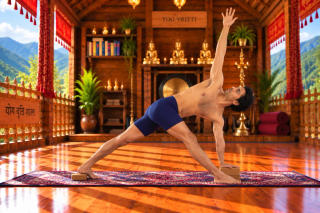
Parivrtta Trikonasana Variation Arm Overhead · परिवृत्त त्रिकोणासन विविध हाथ ऊपर
This variation intensifies the spinal rotation and challenges the practitioner's balance by extending the top arm overhead. The reaching arm creates a longer lever, deepening the twist and inviting more length into the side body, thereby refining the pose's energetic expansion and demanding greater core engagement for stability.
What this version changes: The block continues to serve as a vital support for the bottom hand, allowing the practitioner to maintain the length of the spine and prevent collapsing into the lower back. With the top arm extended overhead, the block becomes even more crucial in providing a stable foundation, enabling the practitioner to focus on the deeper spinal rotation and arm extension without compromising alignment or balance.
Muscles
- Hamstringsstretches
- Glutesstabilises
- Core musclesstrengthens
- Spinal Rotatorsstrengthens
- Obliquesstrengthens
Joints
- Hip Jointsmobilises
- Spinemobilises
- Knee Jointsstabilises
- Shoulder Jointsmobilises
Inside the body
- Abdominal Organs (Digestive System)
- Breathing
Mind
The precise alignment and sustained effort required in Revolved Triangle Pose demand intense concentration, cultivating the yogic principle of Dharana (focused attention).
Take care
Teachers, guide your students to approach this pose with great care, especially if they have any lower back issues, knee instability, or neck stiffness.
Emphasize lengthening the spine before twisting, and ensure the front leg's kneecap is lifted and the hip is stable to protect the knee joint. For those with neck concerns, advise them to keep the gaze neutral or down rather than forcing it upwards. Always prioritize spinal length and integrity over the depth of the twist, using a block generously to support the bottom hand.
Muscles
Hamstrings
StretchesBiceps femoris, Semitendinosus, Semimembranosus
The powerful muscles along the back of your front thigh (hamstrings) are asked to lengthen deeply here, not through force, but with sustained, intelligent extension from the hip.
Read moreShow less
As you maintain a straight front leg and hinge forward, these muscles release chronic tightness, often a legacy of sitting and habitual postures.
This unwinding creates a profound sense of spaciousness and grounding in the legs, allowing apana vayu to flow freely and root you more deeply into the earth.
Regular practice progressively lengthens this posterior chain, directly reducing the pull on the lower back and improving overall flexibility.
Glutes
StabilisesWhile still anchoring the standing leg, the glutes in this variation are called upon for even greater stabilizing effort.
Read moreShow less
With the top arm extending overhead, the center of gravity shifts and balance is challenged, demanding more precise engagement from the gluteus medius and minimus to maintain hip alignment and prevent tilting.
This ensures the foundation remains unshaken and symmetrical amidst the intensified twist, allowing the practitioner to lift and expand the torso with confidence.
Core muscles
StrengthensThe core muscles, particularly the transversus abdominis and the deeper layers of the rectus abdominis, must actively brace and lift to support the spine against increased rotational forces.
Read moreShow less
This sustained engagement creates a stable and elongated axis from which the spine can effectively lengthen and twist, preventing compression in the lower back.
It fosters a feeling of inner lift and integrity, crucial for both protection and expansion in this challenging variation.
Spinal Rotators
StrengthensWith the top arm extended overhead, the spinal rotators work against a longer lever, intensifying their engagement to deepen the twist.
Read moreShow less
This challenges the multifidus and rotatores, the deeper intrinsic spinal muscles, to initiate and sustain a more profound and even rotation through the thoracic spine, rather than relying solely on the larger superficial muscles.
The arm's extension helps to unbind the rib cage, allowing for greater freedom and precision in the twist, demanding greater awareness from these nuanced muscles.
Obliques
StrengthensExternal and Internal Obliques
The obliques become primary engines for deepening and sustaining the lateral twist in this variation.
Read moreShow less
The arm reaching overhead elongates the side body, creating a greater stretch and activation through the external oblique on the side of the front leg and the internal oblique on the side of the back leg, drawing the rib cage into a more profound rotation.
This enhanced engagement not only deepens the twist but also strengthens the lateral core, improving spinal mobility and overall stability while creating space.
Shoulders
StrengthensStabilisesDeltoids, Rotator Cuff Muscles (Supraspinatus, Infraspinatus, Teres Minor, Subscapularis)
Extending the arm overhead actively engages the shoulder girdle, demanding strength and precise stability from the deltoids and rotator cuff muscles to maintain the arm's position.
Read moreShow less
This action not only opens the chest and shoulder joint, preventing slouching, but also creates an upward energetic lift that counterbalances the grounding action of the legs.
It challenges the practitioner to maintain integrity in the shoulder joint while simultaneously facilitating a greater sense of expansion in the torso.
Joints
Hip Joints
MobilisesStabilisesThe ball-and-socket joints of your hips are deeply engaged; the front hip is in flexion and internal rotation, while the back hip is in extension and external rotation, creating a stable foundation.
Read moreShow less
This differential rotation requires intelligent muscular effort to maintain alignment and prevent locking the joint, especially in the front leg.
By understanding how to root through the legs and stabilize the pelvis, you protect these vital joints, enhance their range of motion, and cultivate a sense of groundedness from the base of the spine.
Consistent practice improves hip mobility and pelvic stability, essential for everyday movement and preventing lower back issues.
Spine
MobilisesDecompressingThe vertebral column undergoes a profound and multi-segmental rotation, particularly in the thoracic (mid-back) region, creating space between the vertebrae.
Read moreShow less
As you lengthen the spine upwards and then rotate, you gently decompress the intervertebral discs, encouraging nutrient flow and promoting spinal health.
This intelligent twisting action releases stiffness along the entire spinal column, enhancing the flow of prana and fostering a feeling of lightness and freedom in the torso.
Regular practice improves spinal mobility, reduces back pain, and cultivates a more upright, confident posture.
Knee Joints
StabilisesThe knee joints, particularly the front knee, require careful attention to remain stable and protected in this pose.
Read moreShow less
The front leg must be strong and straight, with the quadriceps (thigh muscles) actively engaged to lift the kneecap and prevent hyperextension.
This mindful engagement ensures the knee is stacked safely over the ankle, preventing any lateral strain or twisting at the joint itself.
By cultivating strength and awareness in the legs, you protect these crucial hinge joints, building a stable foundation that supports the entire structure of the pose and prevents injury.
Shoulder Joints
MobilisesStretchesThe shoulder joints are actively engaged, with the bottom arm pressing down into the block or floor for support, and the top arm reaching powerfully upwards, creating an expansive opening across the chest.
Read moreShow less
This action mobilizes the glenohumeral joint (shoulder joint) and scapulae (shoulder blades), improving range of motion and releasing tension held in the upper back and neck.
The open chest and upward reach cultivate a sense of lightness and freedom, allowing for deeper breathing and opening the anahata chakra (heart center), fostering feelings of courage and compassion.
Inside the body
Abdominal Organs (Digestive System)
This deep twisting action provides a gentle yet profound compression and then release to the internal organs of your abdomen, particularly the digestive system.
Read moreShow less
Imagine a subtle 'wringing out' effect, which then allows a fresh surge of oxygenated blood to flow through these vital areas when you release the twist.
This internal massage stimulates peristalsis and enhances digestive fire (agni), leading to better elimination and a lighter, more energetic feeling within the core.
Regular practice can alleviate sluggishness, improve nutrient absorption, and contribute to overall gut health and vitality.
Breathing
The deep twist of Parivrtta Trikonasana naturally compresses the side of the torso, challenging the breath and requiring a heightened awareness to maintain smooth, steady inhalations and exhalations.
Read moreShow less
This compression encourages a more focused and intentional breath, often inviting a longer, more complete exhalation to release stagnant air and impurities.
This conscious breathing within a restricted space trains the intercostal muscles, improving lung capacity and efficiency over time.
Practitioners often find that Ujjayi breath, with its gentle audible quality, becomes a powerful tool here, deepening the internal massage and enhancing the purifying effects of the twist.
Fascia (connective tissue)
In Parivrtta Trikonasana, the intricate web of connective tissue (fascia) throughout the body is profoundly stretched and released, particularly along the Superficial Back Line and the Spiral Line.
Read moreShow less
As you lengthen the front leg and twist the torso, these fascial chains, which connect everything from your feet to your head, are unwound and hydrated.
This deep release helps to unglue adhesions and improve the fluidity of movement, allowing for a more integrated and less restricted physical experience.
Energetically, freeing the fascia helps to open channels for prana to flow unimpeded, releasing long-held patterns of tension and emotional blockages.
Mind and nervous system
- Nervous system
The intense focus required to maintain balance and alignment in Parivrtta Trikonasana acts as a powerful anchor for the mind, drawing your attention inward and away from external distractions.
Read moreShow less
This sustained concentration helps to quiet the fluctuations of the mind (chitta vritti), promoting a state of calm alertness.
By stabilizing the body and breath in this challenging pose, you actively engage the parasympathetic nervous system, reducing the physiological symptoms of stress and anxiety.
The deep twist also helps to regulate vata dosha, bringing a sense of groundedness and mental equilibrium.
The controlled, steady breath cultivated within the twist directly influences the nervous system, acting as a bridge between the physical and subtle body.
Read moreShow less
Although the twist might initially restrict the breath, the conscious effort to breathe deeply and smoothly sends signals of safety and calm to the brain.
This deliberate breathing practice helps to release stored tension in the diaphragm and intercostal muscles, further activating the vagus nerve and promoting a profound sense of relaxation and inner peace.
Over time, this practice trains the nervous system to remain steady and resilient even in challenging situations.
- Mind & mood
The precise alignment and sustained effort required in Revolved Triangle Pose demand intense concentration, cultivating the yogic principle of Dharana (focused attention).
Read moreShow less
As you meticulously adjust each part of your body and synchronize it with your breath, the mind becomes fully absorbed in the present moment, leaving no room for distraction or rumination.
This mental discipline strengthens your ability to focus, enhancing clarity and mental fortitude, which extends beyond the mat into daily life.
It's a practice in unwavering presence.
Successfully navigating the physical challenge and balance demands of this pose cultivates mental resilience and a quiet confidence.
Read moreShow less
Overcoming the initial discomfort or wobbles builds a strong inner resolve, teaching you to stay with difficulty without succumbing to frustration.
This process of steady effort and eventual mastery fosters a sense of accomplishment and inner strength, helping to alleviate anxiety and self-doubt.
The act of twisting and opening also encourages a shift in perspective, allowing you to approach problems with a fresh, clearer mind.
Because it is a twist pose
Twisting poses like Parivrtta Trikonasana are profound for spinal health, promoting mobility and releasing tension segment by segment along the vertebral column.
Read moreShow less
This rotational movement gently massages the muscles surrounding the spine, increasing circulation and enhancing the flexibility of the spinal ligaments and discs.
Energetically, twists are believed to cleanse and purify the subtle energy channels (nadis), stimulating the manipura chakra and fostering a sense of inner fire and transformation.
They help to wring out stagnant energy, leaving you feeling refreshed and invigorated.
As a standing pose, Revolved Triangle builds immense strength and stability in the legs and core, grounding the practitioner firmly to the earth.
Read moreShow less
The strong engagement of the leg muscles (quadriceps, hamstrings, glutes) roots you deeply, creating a sense of unwavering foundation.
This connection to the earth helps to balance apana vayu, bringing a feeling of security and reducing mental scatteredness.
The stable base allows the upper body to find freedom and expansiveness, creating a beautiful interplay between grounding and upliftment.
The balancing aspect of this pose is not just physical but deeply mental, requiring acute proprioception and focused awareness to maintain equilibrium.
Read moreShow less
As you learn to find your center amidst the twist and extension, your brain and body communicate more efficiently, improving coordination and spatial awareness.
This cultivation of balance translates into greater mental steadiness and emotional equilibrium, teaching you to find calm and stability even amidst life's challenges.
It hones your ability to stay present and centered.