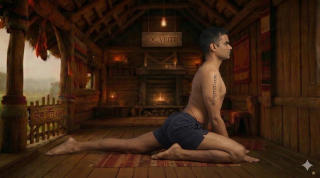
Benefits· लाभ
What Side Foot Pose does for you
पार्श्व पादासन
Side Foot Pose (पार्श्व पादासन) is a profound standing balance that cultivates deep stability and expansive mobility throughout the body. It meticulously strengthens the entire leg line, from the arches of the feet through the quadriceps and glutes, while simultaneously creating significant length and openness in the hamstrings and hip abductors.
Muscles
- Buttocks musclesstrengthens
- Front thigh musclesstrengthens
- Back thigh musclesstretches
- Outer hip musclesstrengthens
- Deep abdominal and back musclesstabilises
Joints
- Hip Jointmobilises
- Knee Jointstabilises
- Ankle Jointstabilises
- Spinedecompressing
Inside the body
- Abdominal Organs
- Circulatory System
- Breathing
Mind
Side Foot Pose demands unwavering concentration, training the mind to remain singularly focused amidst the challenge of balance.
Take care
Teachers should guide students with knee or ankle injuries to approach this pose with extreme care.
For knee issues, ensure the standing leg's quadriceps are engaged to protect the joint, and avoid forcing the hip opening. For ankle instability, emphasize rooting through the entire standing foot and consider using a wall for support to build strength gradually, rather than risking strain.
Muscles
Buttocks muscles
StrengthensGluteus Maximus, Medius, Minimus
The muscles forming your buttocks are powerfully engaged in this pose, particularly in the standing leg, where they work to stabilize the hip joint and maintain external rotation of the thigh bone (femur).
Read moreShow less
This activation creates a strong foundation, preventing the standing hip from collapsing inwards.
Yogically, engaging these deeper gluteal muscles awakens a sense of inner strength and 'rooting' that extends beyond the physical, fostering a feeling of unwavering support from within.
Front thigh muscles
StrengthensQuadriceps Femoris
The large muscles on the front of your thigh are intensely active, particularly in the standing leg, where they work to keep the knee joint extended and stable.
Read moreShow less
This isometric contraction builds tremendous strength in the thigh, protecting the knee and providing a solid pillar for the entire posture.
The sustained engagement teaches the body to find a balance between effort and ease, channeling vital prana upwards through the leg, creating a feeling of lightness and lift in the spine.
Back thigh muscles
StretchesHamstrings
The muscles running along the back of your lifted thigh experience a deep, sustained lengthening as you extend the leg out to the side.
Read moreShow less
This is not a passive stretch but an active extension, where the quadriceps engage to allow the hamstrings to release more fully.
From a yogic perspective, this patient unwinding of the posterior chain helps to release deeply held tension, often associated with the accumulation of apana vayu (downward energy), promoting a sense of freedom and openness in the hips and lower back.
Outer hip muscles
StrengthensGluteus Medius, Minimus, Tensor Fasciae Latae
These muscles, located on the outer side of your hip, are critically engaged in the lifted leg as you abduct (move away from the midline) and externally rotate the thigh.
Read moreShow less
They work synergistically to lift the leg and maintain its position, sculpting strength and stability around the hip joint.
This focused action builds resilience in the hip girdle, enhancing the flow of prana through the pelvic region and fostering a profound sense of openness and liberation in the groin.
Deep abdominal and back muscles
StabilisesTransversus Abdominis, Obliques, Erector Spinae
Your core muscles, encompassing the deep abdominals and muscles along the spine, are constantly engaged to maintain a stable torso and upright posture.
Read moreShow less
They act as a central pillar, integrating the actions of the legs and upper body, preventing any wobbling or collapsing.
This integrated core engagement not only protects the spine but also helps to centralize the prana, bringing a sense of calm focus and unwavering presence to the entire practice, allowing the breath to flow freely.
Lower leg and ankle muscles
StrengthensPeroneals, Tibialis Anterior, Gastrocnemius, Soleus
The muscles surrounding your ankle and lower leg in the standing foot are intensely active, constantly making micro-adjustments to maintain balance and stability.
Read moreShow less
This continuous engagement strengthens the ankles, improving proprioception and grounding the entire pose.
From a yogic perspective, strong and stable ankles provide a solid connection to the earth (prithvi tattva), allowing for a deeper sense of security and mental steadiness, preventing the mind from being easily swayed.
Joints
Hip Joint
MobilisesThe hip joint in the lifted leg undergoes significant mobilization, moving into abduction (away from the body) and external rotation, deeply opening the groin area.
Read moreShow less
In the standing leg, the hip is stabilized by the surrounding musculature, maintaining a neutral position.
This dual action enhances the range of motion in the lifted hip while building strength in the standing hip, creating a sense of spaciousness and freedom in the pelvic bowl, which is vital for healthy energy flow (apana vayu).
Knee Joint
StabilisesBoth knee joints are actively engaged for stability in this pose.
Read moreShow less
The standing knee is kept strong and extended by the quadriceps, preventing hyperextension or collapse, while the lifted knee may be extended or slightly bent depending on flexibility.
This conscious engagement protects the knee ligaments and cartilages, building muscular support around the joint.
It cultivates a sense of intelligent action, where the practitioner learns to find the perfect balance of firmness and softness in the joints, allowing prana to flow without obstruction.
Ankle Joint
StabilisesThe ankle joint of the standing foot is critical for balance, constantly making subtle adjustments to maintain equilibrium.
Read moreShow less
The muscles of the lower leg work together to keep the foot firmly rooted, distributing weight evenly through the heel, ball of the foot, and outer edge.
This continuous, intelligent stabilization strengthens the ankle's supporting structures and enhances proprioception, deepening the practitioner's connection to the earth and fostering a sense of grounded awareness (dharana).
Spine
DecompressingThe entire spine receives gentle decompression as it extends upwards, creating space between each vertebra, from the tailbone to the crown of the head.
Read moreShow less
The core muscles support this axial extension, preventing slouching or compression.
This lengthening action not only improves spinal health and posture but also facilitates the upward flow of prana (udana vayu), allowing for a feeling of lightness, mental alertness, and an expansive sense of self.
Inside the body
Abdominal Organs
While not directly compressed or stretched, the consistent engagement of the core muscles in Side Foot Pose creates a subtle internal massage and toning effect on the abdominal organs.
Read moreShow less
This stable core environment supports optimal function, promoting healthy digestion and elimination.
Energetically, it helps to centralize and refine samana vayu, the balancing energy in the navel region, which governs metabolism and assimilation, leading to a feeling of inner harmony and well-being.
Circulatory System
The active engagement of large muscle groups in the legs and core significantly stimulates blood flow throughout the body.
Read moreShow less
As muscles contract and release, they act as pumps, aiding venous return and ensuring fresh, oxygenated blood reaches all tissues.
This enhanced circulation not only nourishes the organs and muscles but also invigorates the entire system, bringing a palpable sense of warmth and vitality, awakening dormant energy channels (nadis) and supporting overall health.
Breathing
In Side Foot Pose, the emphasis on maintaining stability and an open chest naturally encourages a steady, deep, and rhythmic breath.
Read moreShow less
The upright posture and engaged core create space for the diaphragm to move freely, inviting fuller inhalations that energize the body and longer exhalations that calm the nervous system and deepen the stretch.
This controlled, mindful breathing (pranayama) is crucial for sustaining the pose, transforming it from a mere physical exercise into a moving meditation that balances effort with surrender, helping to regulate the flow of prana throughout the body.
Fascia (connective tissue)
The fascial lines actively engaged in Side Foot Pose include the lateral line, which is lengthened along the inner thigh and groin of the lifted leg and strengthened along the outer hip of the standing leg, and the deep front line, which provides core stability.
Read moreShow less
The superficial back line is also lengthened along the hamstrings of the lifted leg.
This integrated fascial engagement helps to release deep-seated tension patterns, especially around the hips and pelvis, creating greater fluidity and range of motion.
Yogically, this release of fascial restrictions allows for an unobstructed flow of prana, opening the energetic channels (nadis) and fostering a sense of physical and energetic freedom.
Mind and nervous system
- Nervous system
The sustained focus required to maintain balance in Side Foot Pose gently draws the senses inward, shifting the nervous system towards a more parasympathetic state.
Read moreShow less
As the body works to stabilize, the mind quietens, moving away from external distractions and into a deeper state of present moment awareness.
This internal focus helps to calm the fluctuations of the mind (chitta vritti), fostering a profound sense of inner peace and mental clarity.
The constant micro-adjustments made by the standing foot and leg to maintain equilibrium significantly enhance proprioception, the body's awareness of its position in space.
Read moreShow less
This heightened sensory feedback refines the connection between the brain and the body, improving coordination and balance.
Regular practice strengthens these neural pathways, leading to greater physical confidence and a more grounded, stable nervous system, less prone to agitation.
The deliberate lengthening of the spine and the opening of the hips, coupled with steady, rhythmic breathing, helps to release stored tension in the fascia and muscles, which often hold chronic stress.
Read moreShow less
This release signals safety to the nervous system, allowing it to down-regulate and relax.
As tension dissipates, a feeling of spaciousness and ease emerges, promoting a deeper sense of well-being and reducing the physiological symptoms of stress and anxiety.
- Mind & mood
Side Foot Pose demands unwavering concentration, training the mind to remain singularly focused amidst the challenge of balance.
Read moreShow less
This sustained attention acts as a form of active meditation, drawing the awareness away from external distractions and internal chatter.
Through this practice of pratyahara (withdrawal of the senses) and dharana (concentration), the mind becomes sharper, more composed, and capable of sustained, clear thought, translating into greater clarity in daily life.
The physical act of finding balance in this posture directly cultivates mental stability and resilience.
Read moreShow less
Each wobble and recovery teaches perseverance and the ability to find equilibrium even when challenged.
This fosters a deep sense of self-trust and inner strength, helping practitioners to navigate life's uncertainties with greater composure and a steady, unshakeable mind, understanding that balance is a dynamic, ongoing process.
By challenging the body to remain steady and upright while opening the hips, this pose encourages a sense of courageous expansion and vulnerability.
Read moreShow less
It requires practitioners to step outside their comfort zone, both physically and mentally, to explore new ranges of motion and stability.
This process builds confidence and a willingness to embrace change, fostering a more open and adaptable mental state, ready to face new experiences with grace.
Because it is a standing pose
Standing postures are foundational in yoga, establishing a strong connection to the earth and building robust physical stability throughout the entire body.
Read moreShow less
They engage the major muscle groups of the legs and core, strengthening the musculoskeletal system from the ground up.
Yogically, they ground our energy (apana vayu), providing a stable base from which to extend and expand, cultivating a sense of rootedness and presence in the present moment.
As a balance pose, Side Foot Pose intensely refines proprioception and coordination, challenging the brain to integrate sensory input from the body and the environment.
Read moreShow less
This constant calibration enhances neural pathways, improving overall balance and agility.
Energetically, balancing postures demand acute focus, drawing the mind inward and stilling its fluctuations, thereby cultivating mental clarity, concentration, and a profound sense of inner stillness.
The lateral extension of the leg deeply targets the hip joints, promoting significant abduction and external rotation, thereby opening the groin and inner thigh tissues.
Read moreShow less
This action systematically releases tension held in the hips, which are often repositories of emotional stress and stagnant energy.
From a yogic perspective, opening the hips facilitates the freer flow of prana through the pelvic region, releasing emotional blockages and fostering a sense of emotional liberation and ease.