Benefits· लाभ
What Reclined Big Toe Pose A does for you
Supta Padangusthasana A · सुप्त पादाङ्गुष्ठासन अ
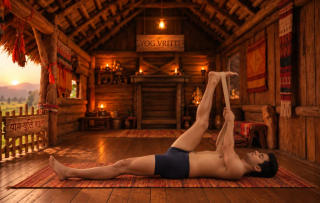
Supta Padangusthasana A, or Supine Leg Raise A, refines the foundational Reclined Big Toe Pose by specifically anchoring the non-lifted leg straight and fully grounded to the floor. This deliberate action transforms the experience, deepening the stretch in the lifted leg's hamstrings while simultaneously creating a profound opening in the hip flexors of the extended, grounded leg.
What this version changes: The strap in Supta Padangusthasana A acts as an intelligent extension of the arms, ensuring that practitioners can comfortably grasp the foot without compromising the integrity of the spine or lifting the shoulders. This support allows the upper body to remain deeply relaxed and grounded, preventing tension in the neck and shoulders. It enables a deeper, more sustained stretch in the hamstrings by facilitating proper alignment and encouraging a steady, unforced opening.
Muscles
- Hamstringsstretches
- Hip Flexorsstretches
- Quadricepsstrengthens
Joints
- Hip Jointmobilises
- Knee Jointmobilises
- Sacroiliac Jointstabilises
Inside the body
- Abdominal Organs
- Circulatory System
- Breathing
Mind
Supta Padangusthasana cultivates patience and acceptance, as the stretch in the hamstrings requires time and gentle persuasion rather than force or aggression.
Take care
This specific variation calls for particular attention for individuals with hamstring injuries or sciatica, as the sustained, deep stretch with the grounded leg fully extended can intensify symptoms if not approached with utmost care.
It is crucial to listen to the body's subtle signals, avoid pushing into pain, and modify the depth of the stretch or consult a qualified teacher to ensure safety and therapeutic benefit.
Muscles
Hamstrings
StretchesIn Supta Padangusthasana A, the hamstrings of the lifted leg are invited into a more progressive and sustained lengthening.
Read moreShow less
With the opposite leg firmly rooted and straight, the pelvis is stabilized, allowing for a deeper, more isolated stretch through the belly of the hamstring muscles.
This focused engagement encourages the fibers to release intelligently, cultivating greater flexibility and a sense of surrender without force, truly honoring the principle of ahimsa in stretching.
Hip Flexors (grounded leg)
StretchesA hallmark of variation 'A' is the active lengthening of the hip flexors, particularly the psoas and rectus femoris, of the grounded leg.
Read moreShow less
By maintaining this leg fully extended and pressing the inner thigh down, the anterior aspect of the hip joint is encouraged to open.
This counter-stretch balances the posterior lengthening, releasing deep-seated tension in the front of the hip that often contributes to lower back stiffness and fostering a more symmetrical pelvic alignment.
Quadriceps (lifted leg)
StrengthensThe quadriceps of the lifted leg are engaged with heightened intention in Supta Padangusthasana A, actively straightening the knee and drawing the kneecap upwards towards the hip.
Read moreShow less
This strong, isometric contraction creates a powerful reciprocal inhibition, signaling the hamstrings to relax and release more effectively.
It cultivates both strength and stability in the extended limb, ensuring the stretch is safe and integrated rather than merely passive.
Joints
Hip Joint (lifted leg)
MobilisesThe head of the thigh bone (femur) sits within the socket of the pelvis (acetabulum) in the lifted leg.
Read moreShow less
This pose gently mobilizes the hip joint through flexion, increasing its range of motion, particularly in the sagittal plane.
This improved mobility helps to release tightness around the joint capsule, allowing for a freer flow of energy and reducing stiffness that can impede walking and sitting, bringing greater ease to daily movements.
Knee Joint (lifted leg)
MobilisesThe knee joint, a hinge joint, is encouraged towards full extension in the lifted leg, promoting healthy articulation while activating the quadriceps for stability around the joint.
Read moreShow less
The gentle pressure of the strap encourages full extension without hyperextension, improving the joint's capacity to bear weight and move fluidly.
This mindful extension brings awareness to the subtle alignment of the leg, fostering a sense of integrity and strength from the hip to the ankle.
Sacroiliac Joint (SI Joint)
StabilisesThis joint connects the sacrum (the triangular bone at the base of the spine) to the ilium (the large bones of the pelvis).
Read moreShow less
In Supta Padangusthasana, keeping the grounded leg active and the pelvis level helps to stabilize the SI joints, preventing unwanted torsion or strain.
This stability creates a firm foundation for the stretch in the lifted leg, preventing compensatory movements and allowing for a calm, centered awareness in the pelvic region, promoting structural integrity.
Inside the body
Abdominal Organs
While not directly compressed or stretched, the supine position with gentle core engagement and the absence of gravitational pressure on the abdomen provides a subtle internal massage and improved circulation to the abdominal organs.
Read moreShow less
This can aid in digestion and detoxification processes by encouraging healthy blood flow and lymphatic drainage.
Energetically, this gentle support helps to balance samana vayu, the energy responsible for assimilation and digestion, promoting overall well-being and vitality.
Circulatory System
By elevating one leg above the level of the heart, this pose gently assists venous return, helping deoxygenated blood flow back to the heart from the lower extremities.
Read moreShow less
This can reduce swelling and fatigue in the legs and improve overall circulation without placing strain on the heart.
The fresh blood flow brings renewed prana to the tissues, invigorating the lower body and promoting a sense of lightness and vitality, especially beneficial after prolonged standing.
Breathing
The supine position naturally encourages a deeper, more expansive diaphragmatic breath, as the abdomen is unconstrained by gravity or upright posture.
Read moreShow less
The stillness of the pose allows the practitioner to consciously lengthen the exhalation, which further stimulates the parasympathetic nervous system and deepens relaxation.
This deliberate control of the breath (pranayama) in a relaxed state not only oxygenates the body more efficiently but also calms the mind (chitta vritti nirodhah), making the pose a powerful tool for stress reduction and cultivating inner quiet.
Fascia (connective tissue)
The body's intricate web of connective tissue, known as fascia, plays a crucial role in the deep release experienced in this pose.
Read moreShow less
Supta Padangusthasana primarily lengthens the Superficial Back Line and parts of the Deep Front Line in the lifted leg, as well as the Lateral Line through the hip.
As you hold the pose, this sustained, gentle traction encourages the viscous ground substance within the fascia to become more fluid, releasing restrictions and allowing for greater elasticity.
This fascial unwinding is perceived as a profound release of stiffness, opening energetic channels (nadis) and allowing prana to flow more freely, dissolving long-held physical and energetic blockages.
Mind and nervous system
- Nervous system
The reclined position and the steady, sustained nature of the stretch immediately invite a sense of calm and introspection, signaling safety to the nervous system.
Read moreShow less
As the body settles, the breath naturally deepens and lengthens, stimulating the vagus nerve and activating the parasympathetic nervous system.
This shift helps to quiet the 'fight or flight' response, reducing stress hormones and fostering a profound sense of relaxation and inner peace.
Focusing on the sensations in the hamstrings and the steady rhythm of the breath draws the mind away from external distractions and internal chatter (chitta vritti).
Read moreShow less
This intentional awareness cultivates a meditative quality, allowing the practitioner to observe sensations without judgment and to release held tension not just physically, but also mentally.
Over time, this practice enhances proprioception and interoception, deepening the connection between mind and body, leading to greater self-awareness.
- Mind & mood
Supta Padangusthasana cultivates patience and acceptance, as the stretch in the hamstrings requires time and gentle persuasion rather than force or aggression.
Read moreShow less
The mind learns to observe the body's limits without judgment, fostering a compassionate relationship with oneself and letting go of expectations.
This practice of non-striving (aparigraha) translates into a calmer, more resilient mental state, reducing frustration and promoting a sense of inner contentment.
The inward focus required to maintain the pose and deepen the stretch acts as a form of pratyahara, drawing the senses inward and away from external stimuli.
Read moreShow less
This mental quietude creates space for dharana, focused concentration, as the practitioner becomes absorbed in the present moment and the subtle shifts within the body.
Teachers can guide students to use this pose to cultivate unwavering attention, a foundational step for deeper meditative practices and clarity of mind.
Because it is a hip opener pose
This pose is fundamentally a hip opener, specifically targeting the posterior aspect of the hip and thigh through flexion of the hip joint in the lifted leg.
Read moreShow less
It works to release tightness in the deep rotators and surrounding connective tissues, improving overall hip mobility and reducing stiffness that can hinder movement.
Energetically, opening the hips can release stored emotions and allow for a freer flow of apana vayu, promoting grounding and stability in the lower chakras and fostering emotional release.