Benefits· लाभ
What Reclined Big Toe Pose with Strap does for you
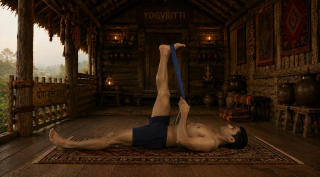
Supta Padangusthasana with Strap · सुप्त पादांगुष्ठासन स्ट्रैप
The addition of the strap in Supta Padangusthasana fundamentally shifts the experience from active grasping to supported release. This variation prioritizes accessibility and sustained, gentle lengthening, allowing practitioners to explore the stretch without the common compensatory actions of straining to reach the foot.
What this version changes: The strap acts as an intelligent extension of the arms, effectively bridging any gap in hamstring flexibility and making the pose accessible to all. By providing a secure and adjustable anchor for the lifted foot, it allows the practitioner to relax the upper body, shoulders, and neck, preventing compensatory tension. This redistribution of effort enables a more profound and sustained stretch in the hamstrings and calves, promoting correct, neutral alignment of the spine and pelvis.
Muscles
- Hamstringsstretches
- Calvesstretches
Joints
- Hip Jointmobilises
- Knee Jointmobilises
- Sacroiliac Jointstabilises
Inside the body
- Abdominal Organs
- Circulatory System
- Breathing
Mind
Supta Padangusthasana cultivates patience and acceptance, as the stretch in the hamstrings requires time and gentle persuasion rather than force or aggression.
Take care
Teachers should always emphasize listening to the body and never forcing the stretch, especially for students with hamstring injuries, sciatica, or lower back issues.
Instruct students to keep the grounded leg active and the pelvis level to protect the sacroiliac joint and lumbar spine from unnecessary strain. The strap is a tool for support and extension, not for pulling aggressively; the sensation should always be a stretch, not pain, guiding students towards intelligent effort (tapas) without harm (ahimsa).
Muscles
Hamstrings
StretchesWhile hamstrings are lengthening in both forms, the strap allows for a more passive and sustained release, removing the need for active engagement in the arms or rounding of the spine to reach the foot.
Read moreShow less
This ensures the stretch is localized purely to the posterior thigh, facilitating a deeper, more consistent lengthening.
It invites the muscle fibers to soften and extend without the resistance or compensatory tension that can arise from overreaching.
Calves
StretchesSimilar to the hamstrings, the strap provides a stable anchor for the lifted foot, enabling a more uniform and effective stretch through the gastrocnemius and soleus muscles.
Read moreShow less
Without the strain of physically grasping the foot, the calves can surrender more completely, allowing gravity and the strap's gentle pull to deepen their elongation.
This promotes a steady, even opening along the entire back of the lower leg, enhancing flexibility with less effort.
Joints
Hip Joint (lifted leg)
MobilisesThe head of the thigh bone (femur) sits within the socket of the pelvis (acetabulum) in the lifted leg.
Read moreShow less
This pose gently mobilizes the hip joint through flexion, increasing its range of motion, particularly in the sagittal plane.
This improved mobility helps to release tightness around the joint capsule, allowing for a freer flow of energy and reducing stiffness that can impede walking and sitting, bringing greater ease to daily movements.
Knee Joint (lifted leg)
MobilisesThe knee joint, a hinge joint, is encouraged towards full extension in the lifted leg, promoting healthy articulation while activating the quadriceps for stability around the joint.
Read moreShow less
The gentle pressure of the strap encourages full extension without hyperextension, improving the joint's capacity to bear weight and move fluidly.
This mindful extension brings awareness to the subtle alignment of the leg, fostering a sense of integrity and strength from the hip to the ankle.
Sacroiliac Joint (SI Joint)
StabilisesThis joint connects the sacrum (the triangular bone at the base of the spine) to the ilium (the large bones of the pelvis).
Read moreShow less
In Supta Padangusthasana, keeping the grounded leg active and the pelvis level helps to stabilize the SI joints, preventing unwanted torsion or strain.
This stability creates a firm foundation for the stretch in the lifted leg, preventing compensatory movements and allowing for a calm, centered awareness in the pelvic region, promoting structural integrity.
Inside the body
Abdominal Organs
While not directly compressed or stretched, the supine position with gentle core engagement and the absence of gravitational pressure on the abdomen provides a subtle internal massage and improved circulation to the abdominal organs.
Read moreShow less
This can aid in digestion and detoxification processes by encouraging healthy blood flow and lymphatic drainage.
Energetically, this gentle support helps to balance samana vayu, the energy responsible for assimilation and digestion, promoting overall well-being and vitality.
Circulatory System
By elevating one leg above the level of the heart, this pose gently assists venous return, helping deoxygenated blood flow back to the heart from the lower extremities.
Read moreShow less
This can reduce swelling and fatigue in the legs and improve overall circulation without placing strain on the heart.
The fresh blood flow brings renewed prana to the tissues, invigorating the lower body and promoting a sense of lightness and vitality, especially beneficial after prolonged standing.
Breathing
The supine position naturally encourages a deeper, more expansive diaphragmatic breath, as the abdomen is unconstrained by gravity or upright posture.
Read moreShow less
The stillness of the pose allows the practitioner to consciously lengthen the exhalation, which further stimulates the parasympathetic nervous system and deepens relaxation.
This deliberate control of the breath (pranayama) in a relaxed state not only oxygenates the body more efficiently but also calms the mind (chitta vritti nirodhah), making the pose a powerful tool for stress reduction and cultivating inner quiet.
Fascia (connective tissue)
The body's intricate web of connective tissue, known as fascia, plays a crucial role in the deep release experienced in this pose.
Read moreShow less
Supta Padangusthasana primarily lengthens the Superficial Back Line and parts of the Deep Front Line in the lifted leg, as well as the Lateral Line through the hip.
As you hold the pose, this sustained, gentle traction encourages the viscous ground substance within the fascia to become more fluid, releasing restrictions and allowing for greater elasticity.
This fascial unwinding is perceived as a profound release of stiffness, opening energetic channels (nadis) and allowing prana to flow more freely, dissolving long-held physical and energetic blockages.
Mind and nervous system
- Nervous system
The reclined position and the steady, sustained nature of the stretch immediately invite a sense of calm and introspection, signaling safety to the nervous system.
Read moreShow less
As the body settles, the breath naturally deepens and lengthens, stimulating the vagus nerve and activating the parasympathetic nervous system.
This shift helps to quiet the 'fight or flight' response, reducing stress hormones and fostering a profound sense of relaxation and inner peace.
Focusing on the sensations in the hamstrings and the steady rhythm of the breath draws the mind away from external distractions and internal chatter (chitta vritti).
Read moreShow less
This intentional awareness cultivates a meditative quality, allowing the practitioner to observe sensations without judgment and to release held tension not just physically, but also mentally.
Over time, this practice enhances proprioception and interoception, deepening the connection between mind and body, leading to greater self-awareness.
- Mind & mood
Supta Padangusthasana cultivates patience and acceptance, as the stretch in the hamstrings requires time and gentle persuasion rather than force or aggression.
Read moreShow less
The mind learns to observe the body's limits without judgment, fostering a compassionate relationship with oneself and letting go of expectations.
This practice of non-striving (aparigraha) translates into a calmer, more resilient mental state, reducing frustration and promoting a sense of inner contentment.
The inward focus required to maintain the pose and deepen the stretch acts as a form of pratyahara, drawing the senses inward and away from external stimuli.
Read moreShow less
This mental quietude creates space for dharana, focused concentration, as the practitioner becomes absorbed in the present moment and the subtle shifts within the body.
Teachers can guide students to use this pose to cultivate unwavering attention, a foundational step for deeper meditative practices and clarity of mind.
Because it is a hip opener pose
This pose is fundamentally a hip opener, specifically targeting the posterior aspect of the hip and thigh through flexion of the hip joint in the lifted leg.
Read moreShow less
It works to release tightness in the deep rotators and surrounding connective tissues, improving overall hip mobility and reducing stiffness that can hinder movement.
Energetically, opening the hips can release stored emotions and allow for a freer flow of apana vayu, promoting grounding and stability in the lower chakras and fostering emotional release.