Benefits· लाभ
What Standing Forward Bend I does for you
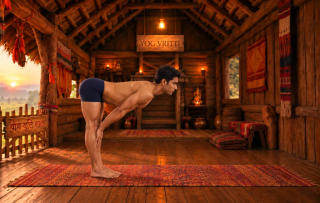
Uttanasana I · उत्तानासन १
Uttanasana I, or the 'Intense Stretch Pose,' distinguishes itself by emphasizing an active upward extension of the spine while firmly grounding through the feet, rather than a more general forward fold. This variant cultivates a dynamic lengthening along the posterior chain, promoting a more integrated stretch from the heels to the crown of the head.
What this version changes: The explicit mention of using a block to 'support correct alignment' in Uttanasana I highlights its role in facilitating spinal extension rather than merely making the pose accessible. By providing a stable platform for the hands, the block allows practitioners to maintain a long, neutral spine, ensuring that the stretch originates from the hips and hamstrings without compromising the integrity of the lower back. This targeted support enables a deeper and safer exploration of the 'intense stretch' inherent in the pose.
Muscles
- Hamstringsstretches
- Erector Spinaestrengthens
- Calvesstretches
Joints
- Hip Jointsmobilises
- Spinedecompressing
- Knee Jointsstabilises
- Ankle Jointsmobilises
Inside the body
- Abdominal Organs
- Brain
- Breathing
Mind
This forward bend naturally encourages an inward focus, serving as a powerful practice of pratyahara, the withdrawal of the senses.
Take care
This variation specifically advises caution for practitioners with glaucoma and hypertension.
The direct and sustained inversion, particularly with the emphasis on active spinal extension and intense stretch, can increase intraocular and cranial pressure, which warrants careful consideration. Such individuals should approach the posture with modifications or under the guidance of a qualified teacher to ensure safety.
Muscles
Hamstrings
StretchesIn Uttanasana I, the lengthening of the hamstrings becomes a more conscious and active process, driven by the upward extension of the spine from the pelvis.
Read moreShow less
Rather than just a passive release, the practitioner is encouraged to root the sit bones and actively lift the spine, creating a deeper, more uniform stretch along the entire belly of the muscle.
This integrated action influences the pelvic tilt with greater precision, helping to prevent hyperextension of the knees and encouraging a more complete stretch from the hip joint down to the knee.
Erector Spinae
StrengthensThe instruction to 'extend the spine upward' in Uttanasana I shifts the engagement of the Erector Spinae from a mere passive lengthening or relaxation to an active, isometric lengthening.
Read moreShow less
These muscles work continuously to create length along the vertebral column, resisting gravity's pull to round the back.
This sustained action helps to decompress the spinal discs and ensures that the forward fold originates primarily from the hip joints, maintaining the natural curves of the spine and protecting the lower back from undue strain.
Calves
StretchesThe emphasis on 'rooting firmly through the feet' in Uttanasana I brings a more pronounced and active stretch to the calves, specifically targeting the gastrocnemius and soleus muscles.
Read moreShow less
By consciously pressing down through the heels and lifting the arches, the stretch is intensified, not just in the muscle belly but also in the Achilles tendon and plantar fascia.
This active rooting helps to stabilize the stance, ensuring the lengthening effect extends through the entire posterior fascial line of the leg and promotes a grounded foundation for the pose.
Joints
Hip Joints
MobilisesThe ball-and-socket joints where your thigh bones meet your pelvis (hip joints) are deeply mobilized in Uttanasana through flexion.
Read moreShow less
As the torso folds forward, the femurs articulate within the acetabulum, encouraging greater range of motion and creating space in the inner groins.
This movement helps to release long-held stiffness, improving circulation to the pelvic region and facilitating the release of apana vayu.
With consistent practice, students will notice greater ease in walking, sitting, and other daily movements, as the hips become more fluid and less restricted.
Spine
DecompressingThe entire vertebral column (spine) benefits from a gentle, sustained traction as you fold forward with length, rather than collapsing.
Read moreShow less
This action helps to decompress the intervertebral discs, creating space between the vertebrae and relieving pressure that can impinge on spinal nerves.
This subtle lengthening promotes a healthier flow of cerebrospinal fluid and allows for a freer, more unobstructed path for prana to move along the central axis of the body.
The spine gradually becomes more supple and resilient, improving overall posture and reducing back discomfort.
Knee Joints
StabilisesWhile the knees are extended, a subtle engagement of the quadriceps and a micro-bend (if needed) protects these hinge joints (knee joints) from hyperextension.
Read moreShow less
This mindful awareness prevents strain and encourages a balanced lengthening of the hamstrings without compromising joint integrity.
It teaches students to listen to their bodies and find the optimal alignment where strength and flexibility coexist.
This intelligent stabilization ensures that the benefits of the pose are felt throughout the posterior chain without placing undue stress on the knees, cultivating long-term joint health.
Ankle Joints
MobilisesThe ankle joints (talocrural joints) receive a subtle but important mobilization, particularly as the weight shifts slightly forward into the balls of the feet while keeping the heels grounded.
Read moreShow less
This action encourages greater dorsiflexion and can release tension in the surrounding ligaments and tendons, improving overall ankle mobility.
From a grounding perspective, the firm connection of the feet to the earth through the ankles helps to channel energy downwards, fostering a sense of stability and connection.
This improved mobility in the ankles contributes to a more stable foundation for all standing poses.
Inside the body
Abdominal Organs
In Uttanasana, the abdominal organs — including the stomach, intestines, liver, and spleen — experience a gentle, internal compression as the torso folds towards the thighs.
Read moreShow less
This mild internal massage stimulates peristalsis, the natural wave-like motion of the intestines, which can significantly aid digestion and relieve issues like constipation.
Upon release from the pose, there's a fresh rush of blood to these organs, revitalizing their function and helping to balance samana vayu, the energy responsible for assimilation and digestion.
This internal cleansing contributes to overall systemic health and vitality.
Brain
As a mild inversion, Uttanasana brings the head below the heart, encouraging a gentle increase in blood flow to the brain.
Read moreShow less
This fresh, oxygenated blood nourishes brain cells, which can help to reduce mental fatigue, improve concentration, and clear away mental fog.
This subtle shift in gravitational pull has a profoundly calming effect on the nervous system, settling agitated thoughts (chitta vritti) and promoting mental clarity.
Many students report feeling a sense of quietude and renewed focus after practicing this pose.
Breathing
The forward-bending shape of Uttanasana naturally encourages a longer, more complete exhalation.
Read moreShow less
As the torso folds and the diaphragm has less space for expansion on the inhale, the body intuitively emphasizes the release of breath, which activates the parasympathetic nervous system.
This extended exhalation is inherently calming and purifying, helping to release stale air and subtle energetic impurities (malas) from the system.
Practicing Ujjayi breath in this pose can deepen the internal experience, further enhancing the sense of introspection and quietude.
Fascia (connective tissue)
In Uttanasana, the entire Superficial Back Line of fascia, a continuous web of connective tissue running from the soles of the feet up the back of the legs, across the sacrum, and along the spine to the scalp, gets a profound release.
Read moreShow less
This holistic lengthening helps to unwind chronic tension patterns that often restrict movement and contribute to poor posture.
By opening these fascial lines, we not only improve physical flexibility but also facilitate the unhindered flow of prana, releasing energetic blockages and cultivating a sense of spaciousness and freedom within the body.
Mind and nervous system
- Nervous system
The sustained stretch and the inverted nature of Uttanasana have a profoundly calming effect on the nervous system, shifting it from a sympathetic (fight-or-flight) to a parasympathetic (rest-and-digest) state.
Read moreShow less
This is achieved through a combination of the gentle pressure on the abdominal organs, the lengthening of the posterior chain which releases stored tension, and the downward-directed focus.
The deep, steady breathing cultivated in the pose further reinforces this calming response, helping to alleviate anxiety and promote deep relaxation.
Uttanasana is a master pose for grounding, bringing the practitioner's awareness firmly into the earth and the present moment.
Read moreShow less
By connecting deeply through the feet and allowing the head to release downwards, we encourage the flow of apana vayu, the downward-moving energy, which helps to stabilize the mind and body.
This sense of stability reduces mental agitation and can be incredibly beneficial for those experiencing anxiety or feeling overwhelmed, fostering a sense of inner peace and steadiness.
- Mind & mood
This forward bend naturally encourages an inward focus, serving as a powerful practice of pratyahara, the withdrawal of the senses.
Read moreShow less
As the gaze softens and the head releases, the external world recedes, allowing the mind to turn inward and observe internal sensations and thoughts without judgment.
This deep introspection helps to quiet mental chatter, offering a much-needed respite from overthinking and promoting a profound sense of mental clarity and calm.
Uttanasana is an excellent pose for stress relief and cultivating a sense of surrender.
Read moreShow less
By releasing physical tension in the back body and calming the nervous system, it creates a cascade effect that helps to alleviate mental and emotional stress.
The act of folding forward, letting go of the need to hold oneself up, can be deeply liberating, allowing practitioners to release pent-up emotions and find a renewed sense of peace and emotional balance.
It teaches the wisdom of letting go.
Through the sustained holding and the mindful breathing in Uttanasana, practitioners cultivate heightened self-awareness – dharana, or concentration.
Read moreShow less
They learn to feel subtle shifts in the body, the rhythm of their breath, and the patterns of their mind.
This intimate connection to the inner landscape builds a stronger sense of presence and mindfulness, helping students to better understand their own physical and energetic limits and to approach their practice with greater intelligence and compassion.
Because it is a forward bend pose
Forward bends are inherently introspective, guiding the practitioner's awareness inward and downward.
Read moreShow less
Physically, this shape encourages a deep lengthening of the entire posterior chain of the body, from the heels through the hamstrings, glutes, and up the spine to the crown of the head.
Energetically, it channels apana vayu, the grounding force, fostering stability and a quiet mind, making it an ideal shape for calming the nervous system and preparing for meditation.
As a forward bend, Uttanasana provides a gentle form of inversion, bringing the head below the heart.
Read moreShow less
This action reverses the typical pull of gravity on the body, encouraging fresh, oxygenated blood to flow to the brain and sense organs.
This increased circulation can rejuvenate the mind, alleviate mental fatigue, and shift perspective, offering a sense of clarity and renewed focus.
It's a subtle way to experience the benefits of inversions without the intensity of more challenging poses.
The compressive action of a forward bend on the abdominal region stimulates the digestive organs, promoting healthy peristalsis and detoxification.
Read moreShow less
This internal massage, combined with the subsequent release, encourages fresh blood flow and supports the body's natural cleansing processes.
From a yogic perspective, this helps to balance samana vayu, the energy associated with digestion and assimilation, contributing to overall physical well-being and a feeling of lightness in the gut.