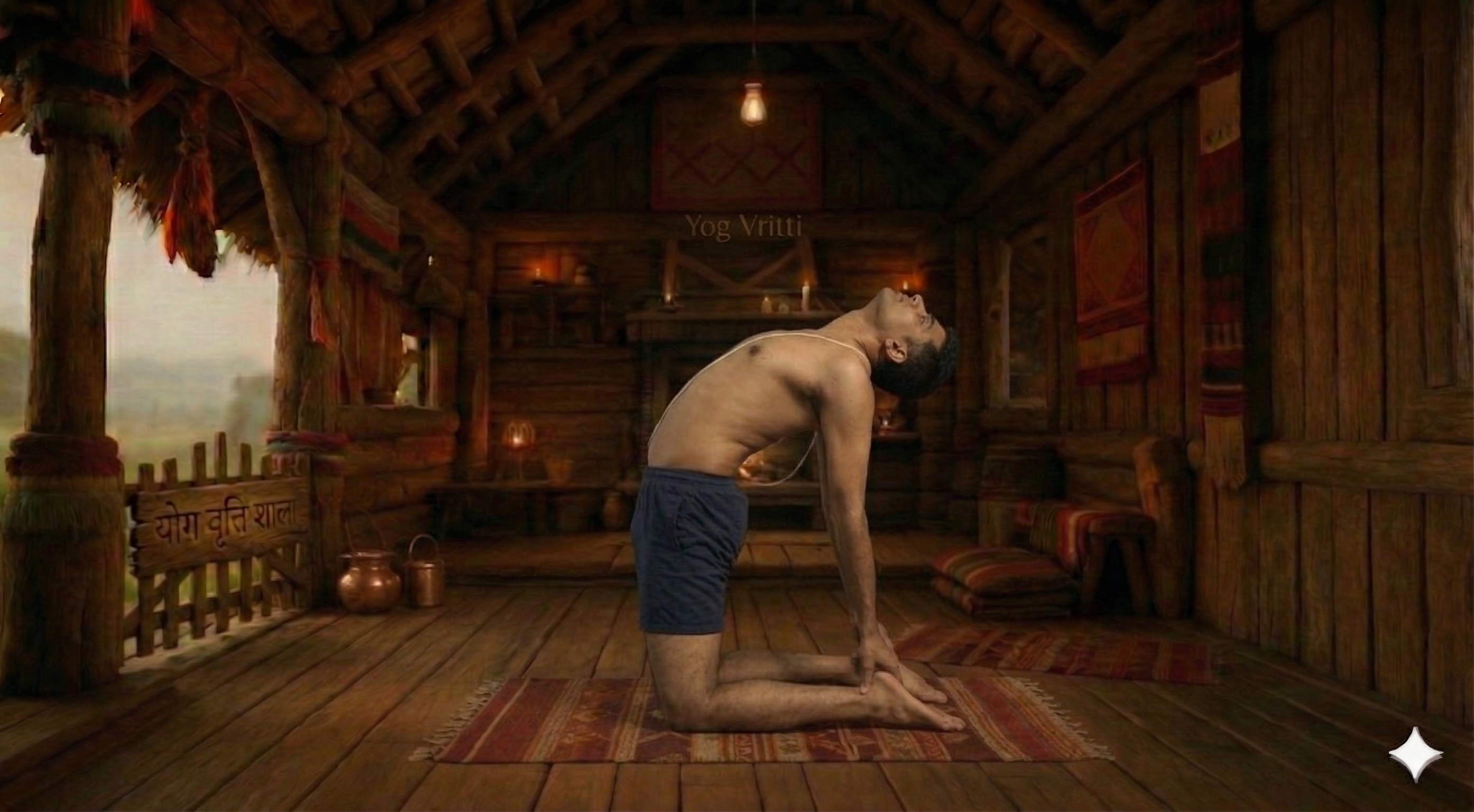
उष्ट्रासन ऊर्ध्व हस्तासन
Camel Pose with Arms Raised
उष्ट्रासन ऊर्ध्व हस्तासन पीठ की मांसपेशियों को मजबूत करता है और रीढ़ की हड्डी के लचीलेपन में सुधार करता है। भुजाओं को ऊपर उठाने के साथ ऊंट मुद्रा का यह भिन्नता छाती और कंधों में खिंचाव को बढ़ाता है, जिससे गहरी साँस लेने को बढ़ावा मिलता है।
फायदे
5Quadriceps(lengthening)
The muscles along the front of your thighs (quadriceps), particularly the rectus femoris which crosses the hip, experience a significant lengthening as the hips extend and the knees remain bent. This deep stretch helps to release chronic tightness often stored from prolonged sitting, enhancing the range of motion in the hip joint. Anatomically, this action allows for greater pelvic stability and freedom in hip extension. Energetically, releasing these powerful muscles can free up stagnant energy in the lower body, cultivating a feeling of lightness and openness.
Hip Flexors(lengthening)
The deep muscles connecting your spine and pelvis to your thigh bone (hip flexors, primarily the iliopsoas) are profoundly lengthened as you push your pelvis forward in Ustrasana. This sustained extension directly counteracts the shortening effect of modern lifestyles, which often contributes to lower back pain and restricted movement. From an anatomical perspective, this restores optimal length to these key postural muscles, allowing for more balanced pelvic alignment. Yogically, the psoas is often considered a 'muscle of the soul,' and its release can be deeply cathartic, freeing stored emotional tension and promoting a sense of inner spaciousness.
Abdominal Muscles(stabilizing | lengthening under greater demand)
In the root pose, the abdominal muscles lengthen and engage to protect the lumbar spine. With the arms raised overhead, the base of support for the backbend is reduced, and the lever arm of the torso is extended. This significantly increases the demand on the abdominal muscles for active lengthening while simultaneously stabilizing the lumbar spine against increased gravitational pull, preventing excessive lordosis and drawing the front body upwards with greater intensity.
- पूर्ण शारीरिक विश्लेषण →
सावधानियाँ
4Back Injury / Back Pain
Spinal flexion, extension, or rotation under load can compress vertebral discs or strain the paraspinal muscles.
Limit the depth of the backbend, engage the core actively before moving, and avoid any movement that creates pinching in the lumbar spine.
High Blood Pressure
Vigorous effort and inverted positions temporarily raise blood pressure in the head, increasing strain on blood vessels.
Limit the depth of the backbend, breathe smoothly, and avoid holding the pose for extended periods.
Headache / Migraine
Physical exertion, inversions, and strong breath work can intensify an existing headache or trigger a migraine.
Avoid inversions and strong pranayama; rest in a supported, restorative posture with a cool cloth on the forehead.
Insomnia
Stimulating pranayama and energising poses can activate the sympathetic nervous system, making sleep harder if practised late in the day.
Practise calming, exhalation-focused breath work; avoid stimulating postures or pranayama close to bedtime.
विधि
चरण-दर-चरण निर्देश
वज्रासन में बैठें। पीठ सीधी रखें।
घुटनों पर खड़े हो जाएं, घुटने कूल्हों की चौड़ाई पर रखें।
हाथों को कूल्हों पर रखें, उंगलियां नीचे की ओर हों।
श्वास अंदर लें, छाती को ऊपर उठाएं।
श्वास छोड़ते हुए, धीरे-धीरे पीछे की ओर झुकें।
भुजाओं को ऊपर की ओर उठाएं, कंधों को पीछे की ओर घुमाएं।
नज़र सामने रखें।
इस स्थिति में 20-30 सेकंड तक रहें।
श्वास अंदर लेते हुए, धीरे-धीरे वापस सीधे हो जाएं।
भुजाओं को नीचे लाएं और वज्रासन में बैठ जाएं।
सामान्य गलतियाँ
शिक्षण संकेत
अभ्यास क्रम
अक्सर पूछे जाने वाले प्रश्न
उष्ट्रासन ऊर्ध्व हस्तासन के बारे में सामान्य प्रश्न
उष्ट्रासन ऊर्ध्व हस्तासन क्या है?
उष्ट्रासन ऊर्ध्व हस्तासन पीठ की मांसपेशियों को मजबूत करता है और रीढ़ की हड्डी के लचीलेपन में सुधार करता है। भुजाओं को ऊपर उठाने के साथ ऊंट मुद्रा का यह भिन्नता छाती और कंधों में खिंचाव को बढ़ाता है, जिससे गहरी साँस लेने को बढ़ावा मिलता है।
उष्ट्रासन ऊर्ध्व हस्तासन के क्या फायदे हैं?
Strengthens back muscles। Improves spinal flexibility। Opens the chest and shoulders।
उष्ट्रासन ऊर्ध्व हस्तासन किस स्तर के लिए है?
उष्ट्रासन ऊर्ध्व हस्तासन एक मध्यम स्तर का आसन है। शुरुआती लोग किसी योग गुरु के मार्गदर्शन में अभ्यास करें।
उष्ट्रासन ऊर्ध्व हस्तासन कौन न करे?
Severe back pain, High blood pressure, Migraine की स्थिति में यह आसन न करें।