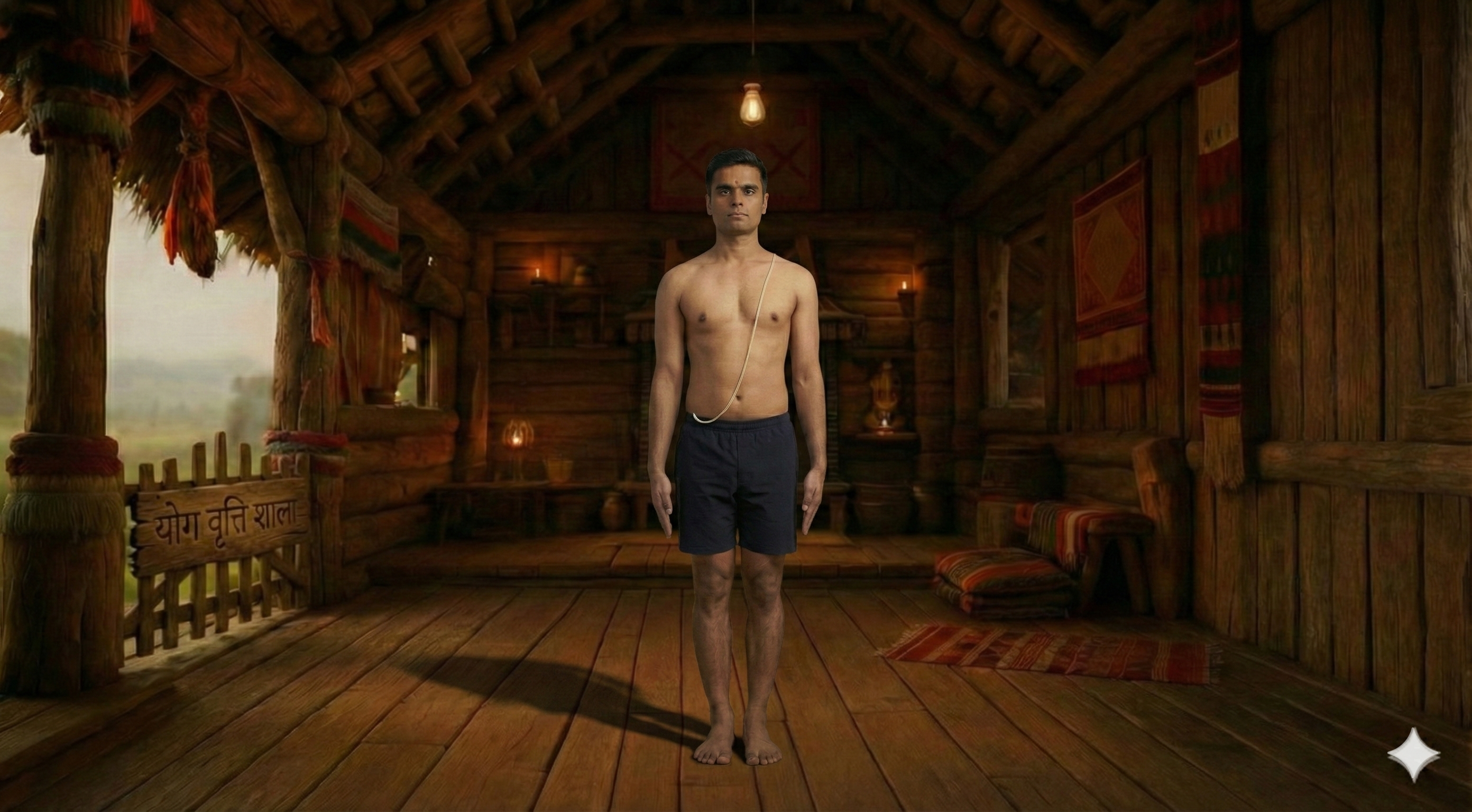
पार्श्व ताड़ासन
Mountain Pose Side Variation
खड़े होकर बगल का खिंचाव — ताड़ासन से सरलतम पार्श्व मोड़।
फायदे
4Intrinsic Foot Muscles(stabilizing | grounding)
As the body shifts laterally, even subtly, in Parsva Tadasana, the intrinsic foot muscles must adjust their intricate balance to counteract this new vector of force. They work more actively to grip the earth, preventing any tendency to lean excessively onto the inner or outer edges of the feet, thereby maintaining the stable foundation crucial for an integrated side stretch. This refined engagement ensures a balanced distribution of weight, even as the upper body moves.
Quadriceps(strengthening)
The large muscles on the front of your thighs (quadriceps) are subtly yet powerfully engaged in Tadasana, lifting the kneecaps and firming the thighs towards the bone. This action prevents hyperextension of the knees, creating a stable platform for the pelvis and spine. Through this mindful engagement, we cultivate a sense of unwavering strength in the legs, which in yogic terms, helps to solidify the earth element within the body, fostering stability and self-reliance. It teaches the legs to be both strong and intelligently responsive, rather than passively locked.
Erector Spinae(lengthening | stabilizing)
In Parsva Tadasana, the erector spinae muscles on the side of the body being lengthened undergo an eccentric stretch, allowing the lateral flexion while still maintaining spinal integrity and preventing collapse. Conversely, on the compressing side, they subtly contract to support the vertebral column, ensuring the bend is even and avoids undue pressure on the intervertebral discs. This dynamic engagement differs from their more uniform, isometric stabilization in Tadasana.
- पूर्ण शारीरिक विश्लेषण →
सावधानियाँ
1Back Injury / Back Pain
Spinal flexion, extension, or rotation under load can compress vertebral discs or strain the paraspinal muscles.
Engage the core before any movement, keep a slight bend in the knees, and avoid locking the lower back.
विधि
चरण-दर-चरण निर्देश
ताड़ासन।
बाहें ऊपर, हथेलियां जुड़ी।
श्वास छोड़ें, दाईं ओर झुकें।
बायीं बगल में खिंचाव।
कूल्हे केंद्र में — शिफ्ट न हों।
3-5 सांसें।
केंद्र।
बाईं ओर। 3-5 सांसें।
केंद्र।
बाहें नीचे।
सामान्य गलतियाँ
शिक्षण संकेत
अभ्यास क्रम


अक्सर पूछे जाने वाले प्रश्न
पार्श्व ताड़ासन के बारे में सामान्य प्रश्न
पार्श्व ताड़ासन क्या है?
खड़े होकर बगल का खिंचाव — ताड़ासन से सरलतम पार्श्व मोड़।
पार्श्व ताड़ासन के क्या फायदे हैं?
Opens side body। Quick warm-up। Can do anywhere।
पार्श्व ताड़ासन किस स्तर के लिए है?
पार्श्व ताड़ासन एक शुरुआती स्तर का आसन है। यह सभी के लिए उपयुक्त है।
पार्श्व ताड़ासन कौन न करे?
Spinal injuries की स्थिति में यह आसन न करें।